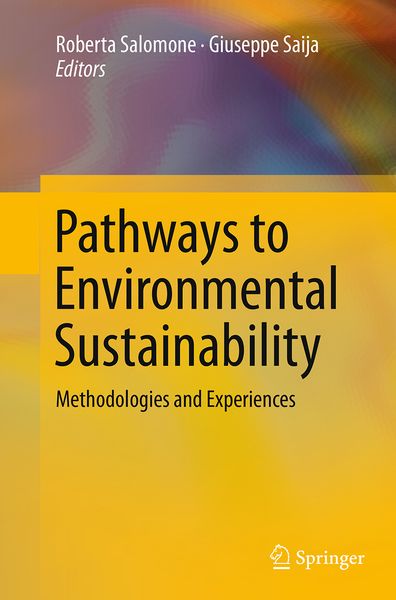
Pathways to Environmental Sustainability Methodologies and Experiences
-
- Hardcover
- Taschenbuch ausgewählt
- eBook
-
Sprache:Englisch
Fr. 150.00
inkl. gesetzl. MwSt.,
Beschreibung
Produktdetails
Einband
Taschenbuch
Erscheinungsdatum
23.08.2016
Abbildungen
XXIII, 54 illus., 4 illus. in color., farbige Illustrationen, schwarz-weiss Illustrationen
Herausgeber
Roberta Salomone + weitereVerlag
SpringerSeitenzahl
276
Maße (L/B/H)
23.5/15.5/1.7 cm
Gewicht
458 g
Auflage
Softcover reprint of the original 1st edition 2014
Sprache
Englisch
ISBN
978-3-319-34800-1
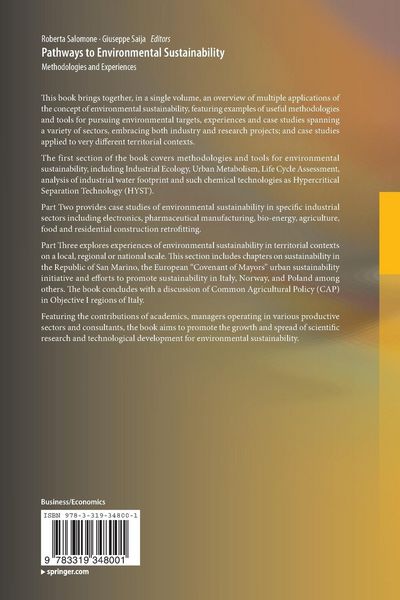
This book brings together, in a single volume, an overview of multiple applications of the concept of environmental sustainability, featuring examples of useful methodologies and tools for pursuing environmental targets, experiences and case studies spanning a variety of sectors, embracing both industry and research projects; and case studies applied to very different territorial contexts.
The first section of the book covers methodologies and tools for environmental sustainability, including Industrial Ecology, Urban Metabolism, Life Cycle Assessment, analysis of industrial water footprint and such chemical technologies as Hypercritical Separation Technology (HYST).
Part Two provides case studies of environmental sustainability in specific industrial sectors including electronics, pharmaceutical manufacturing, bio-energy, agriculture, food and residential construction retrofitting.
Part Three explores experiences of environmental sustainability in territorial contexts on a local, regional or national scale. This section includes chapters on sustainability in the Republic of San Marino, the European “Covenant of Mayors” urban sustainability initiative and efforts to promote sustainability in Italy, Norway and Poland among others. The book concludes with a discussion of Common Agricultural Policy (CAP) in Objective I regions of Italy.
Featuring the contributions of academics, managers operating in various productive sectors and consultants, the book aims to promote the growth and spread of scientific research and technological development for environmental sustainability.
Kundinnen und Kunden meinen
Verfassen Sie die erste Bewertung zu diesem Artikel
Helfen Sie anderen Kund*innen durch Ihre Meinung