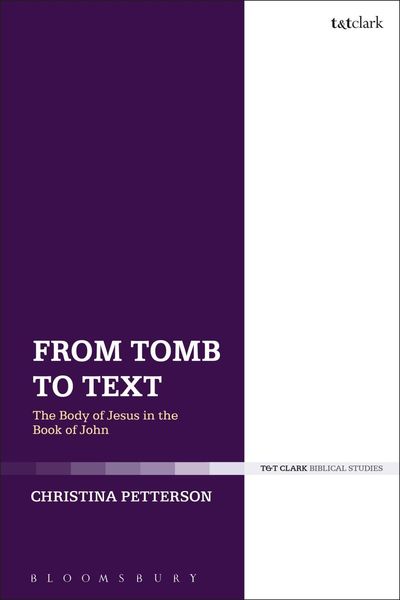
From Tomb to Text The Body of Jesus in the Book of John
-
Form:Einzelkauf Download
-
Sprache:Englisch
-
eBook Format:PDF
- PDF Fr. 44.90 ausgewählt
- ePUB Fr. 43.90
Fr. 44.90
inkl. gesetzl. MwSt.Beschreibung
Produktdetails
Format
Kopierschutz
Ja
Family Sharing
Nein
Text-to-Speech
Nein
Erscheinungsdatum
01.12.2016
Verlag
Bloomsbury eBooks UKSeitenzahl
160 (Printausgabe)
Dateigröße
1324 KB
Auflage
1. Auflage
Sprache
Englisch
EAN
9780567670564
The idea of writing plays a central role in John. Apart from the many references to scriptural texts, John emphasizes the role of writing in the inscription on the cross and in its own production. Petterson's From Tomb to Text examines what this means for the understanding of the Johannine Jesus in two interrelated ways. First Petterson takes these claims to revelation through writing seriously, noting the immense effort expended by biblical scholars in order to dismiss them and to produce a canonically palatable John. With few exceptions, Johannine studies have consistently attempted to domesticate or tame John's book through reference to, and in harmony with, an externalized historical reality or with a synoptic pattern. Second, the study suggests alternative ways of understanding John once this synoptic compulsion has been dissolved.
Petterson argues that John's Jesus is unacceptable to the project for the recovery of 'Early Christianity' as imagined in Johannine research over the last 70 years or so. Instead, she shows how John produces itself as the vehicle of Jesus' revelation in place of a body. This takes place through its use of writing, its characteristic use of verbs and syntax, and its mode of revelation. The book thus situates John in a context that does not begin with, and thus attempts to be, unconstrained by fixed categories of Christ, gnosticism, Eucharist, body and flesh, and shows how such readings curtail the fullness of the text in favour of a more familiar earthly Jesus. Petterson concludes by outlining ways in which John can be read if these containment strategies are disregarded.
Petterson argues that John's Jesus is unacceptable to the project for the recovery of 'Early Christianity' as imagined in Johannine research over the last 70 years or so. Instead, she shows how John produces itself as the vehicle of Jesus' revelation in place of a body. This takes place through its use of writing, its characteristic use of verbs and syntax, and its mode of revelation. The book thus situates John in a context that does not begin with, and thus attempts to be, unconstrained by fixed categories of Christ, gnosticism, Eucharist, body and flesh, and shows how such readings curtail the fullness of the text in favour of a more familiar earthly Jesus. Petterson concludes by outlining ways in which John can be read if these containment strategies are disregarded.
Kundinnen und Kunden meinen
Verfassen Sie die erste Bewertung zu diesem Artikel
Helfen Sie anderen Kund*innen durch Ihre Meinung