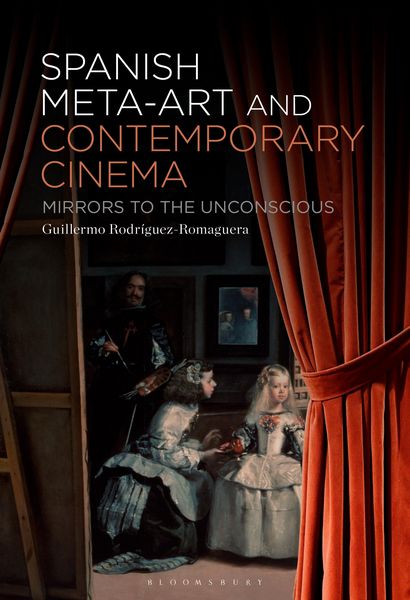
Spanish Meta-Art and Contemporary Cinema Mirrors to the Unconscious
-
- Taschenbuch
- eBook ausgewählt
-
Form:Einzelkauf Download
-
Sprache:Englisch
-
eBook Format:ePUB
- PDF Fr. 36.90
- ePUB Fr. 36.90 ausgewählt
Fr. 36.90
inkl. gesetzl. MwSt.Beschreibung
Produktdetails
Format
ePUB
Kopierschutz
Ja
Family Sharing
Nein
Text-to-Speech
Ja
Erscheinungsdatum
10.08.2023
Verlag
Bloomsbury eBooks USSeitenzahl
208 (Printausgabe)
Dateigröße
3221 KB
Auflage
1. Auflage
Sprache
Englisch
EAN
9798765101360
Can cinema reveal its audience's most subversive thinking? Do films have the potential to project their viewers' innermost thoughts making them apparent on the screen? This book argues that cinema has precisely this power, to unveil to the spectator their own hidden thoughts. It examines case studies from various cultures in conversation with Spain, a country whose enduring masterpieces in self-reflexive or meta-art provide insight into the special dynamic between viewer and screen.
Framed around critical readings of Miguel de Cervantes' Don Quixote, Diego Velázquez' Las meninas and Luis Buñuel's Un chien andalou, this book examines contemporary films by Víctor Erice, Carlos Saura, Bigas Luna, Alejandro Amenábar, Lucrecia Martel, Krzysztof Kieslowski, David Lynch, Pedro Almodóvar, Spike Jonze, Andrzej Zulawski, Fernando Pérez, Alfred Hitchcock, Wes Craven and David Cronenberg to illustrate how self-reflexivity in film unbridles the mental repression of film spectators. It proposes cinema as an uncanny duplication of the workings of the brain - a doppelgänger to human thought.
Framed around critical readings of Miguel de Cervantes' Don Quixote, Diego Velázquez' Las meninas and Luis Buñuel's Un chien andalou, this book examines contemporary films by Víctor Erice, Carlos Saura, Bigas Luna, Alejandro Amenábar, Lucrecia Martel, Krzysztof Kieslowski, David Lynch, Pedro Almodóvar, Spike Jonze, Andrzej Zulawski, Fernando Pérez, Alfred Hitchcock, Wes Craven and David Cronenberg to illustrate how self-reflexivity in film unbridles the mental repression of film spectators. It proposes cinema as an uncanny duplication of the workings of the brain - a doppelgänger to human thought.
Kundinnen und Kunden meinen
Verfassen Sie die erste Bewertung zu diesem Artikel
Helfen Sie anderen Kund*innen durch Ihre Meinung