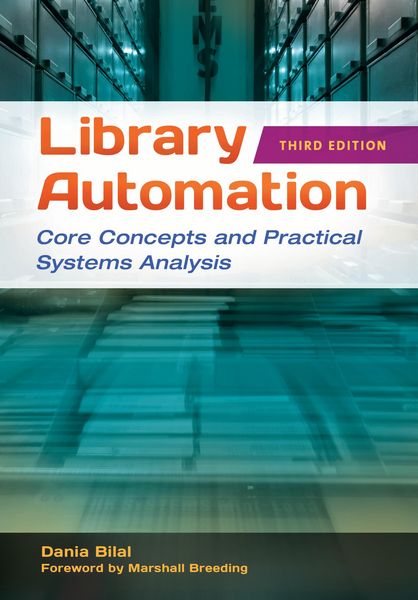
Library Automation Core Concepts and Practical Systems Analysis
-
- Taschenbuch
- eBook ausgewählt
-
Form:Einzelkauf Download
-
Sprache:Englisch
-
eBook Format:ePUB
- PDF Fr. 54.90
- ePUB Fr. 54.90 ausgewählt
Fr. 54.90
inkl. gesetzl. MwSt.Beschreibung
Produktdetails
Format
ePUB
Kopierschutz
Ja
Family Sharing
Nein
Text-to-Speech
Ja
Altersempfehlung
ab 7 Jahr(e)
Erscheinungsdatum
26.03.2014
Verlag
Bloomsbury eBooks USSeitenzahl
312 (Printausgabe)
Auflage
3. Auflage
Sprache
Englisch
EAN
9798216111191
Recent advances in technology such as cloud computing, recent industry standards such as RFID, bibliographic standards like RDA and BIBFRAME, the increased adoption of open source integrated library systems (ILS), and continued shift in users' expectations have increased the complexity of the decision regarding ILS for all types of libraries.
Recent advances in technology such as cloud computing, recent industry standards such as RFID, bibliographic standards like RDA and BIBFRAME, the increased adoption of open source integrated library systems (ILS), and continued shift in users' expectations have increased the complexity of the decision regarding ILS for all types of libraries.
In a complete re-envisioning of the previous edition, Automating Media Centers and Small Libraries: A Microcomputer-Based Approach, Dania Bilal conceptualizes library automation in the Library Automation Life Cycle (LALC) that is informed by the systems development lifecycle (SDLC). She explains how the next-generation discovery services supported in the library services platforms (LSPs) provide a single point of access to library content in all types and formats, thereby offering a unified solution to managing library operations. The book covers methods of analyzing user requirements, describes how to structure these requirements in RFPs, and details proprietary and open-source integrated library systems (ILSs) and LSPs for school, public, special, and academic libraries. Up-to-date information is provided about ILS software installation and testing, software and hardware architecture such as single- and multi-tenant SaaS and Paas and IaaS, and usability assessment strategies for evaluating the ILS or LSP. The author concludes by describing what is likely coming next in the library automation arena.
Recent advances in technology such as cloud computing, recent industry standards such as RFID, bibliographic standards like RDA and BIBFRAME, the increased adoption of open source integrated library systems (ILS), and continued shift in users' expectations have increased the complexity of the decision regarding ILS for all types of libraries.
In a complete re-envisioning of the previous edition, Automating Media Centers and Small Libraries: A Microcomputer-Based Approach, Dania Bilal conceptualizes library automation in the Library Automation Life Cycle (LALC) that is informed by the systems development lifecycle (SDLC). She explains how the next-generation discovery services supported in the library services platforms (LSPs) provide a single point of access to library content in all types and formats, thereby offering a unified solution to managing library operations. The book covers methods of analyzing user requirements, describes how to structure these requirements in RFPs, and details proprietary and open-source integrated library systems (ILSs) and LSPs for school, public, special, and academic libraries. Up-to-date information is provided about ILS software installation and testing, software and hardware architecture such as single- and multi-tenant SaaS and Paas and IaaS, and usability assessment strategies for evaluating the ILS or LSP. The author concludes by describing what is likely coming next in the library automation arena.
Kundinnen und Kunden meinen
Verfassen Sie die erste Bewertung zu diesem Artikel
Helfen Sie anderen Kund*innen durch Ihre Meinung