• Produktbild: Conservation, Management and Monitoring of Forest Resources in India
  • Produktbild: Conservation, Management and Monitoring of Forest Resources in India

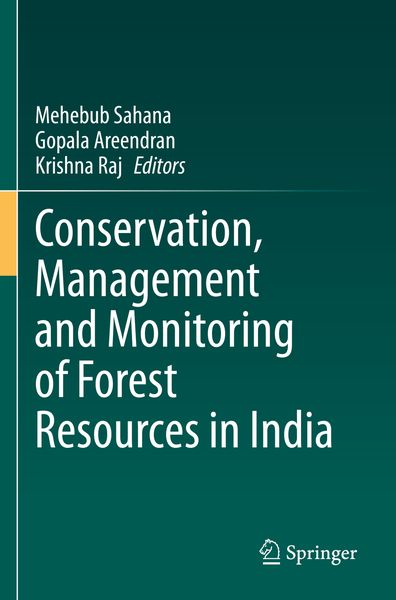
Conservation, Management and Monitoring of Forest Resources in India

Fr. 191.00

inkl. gesetzl. MwSt., Versandkostenfrei


Beschreibung

Produktdetails

Einband

Taschenbuch

Erscheinungsdatum

05.08.2023

Herausgeber

Mehebub Sahana + weitere

Verlag

Springer

Seitenzahl

571

Maße (L/B/H)

23.5/15.5/3.2 cm

Gewicht

879 g

Auflage

1st ed. 2022

Sprache

Englisch

ISBN

978-3-030-98235-5

Beschreibung

Portrait

Dr Mehebub Sahana is a cultural and environmental geographer with an interest in analysing land-use changes with special respect to spaces, politics, and the governance of the living and materialistic world. His present research interests include social-environmental interface, socio-ecological resilience and systems thinking; geohazards; landscape ecology; multi hazard risk assessment; land-use change; rural-urban conversion and the socio-political implications of land-use dynamics. He is currently working as a Research Associate at the School of Environment, Education & Development, The University of Manchester, UK. Previously, he was employed as a Lecturer/research consultant (2018-2019) at Indira Gandhi Conservation Monitoring Centre (IGCMC), WWF-India, New Delhi. He received his Ph.D. in Environmental Geography (2018) from the Department of Geography, Faculty of Natural Sciences, Jamia Millia Islamia, New Delhi, India. He has contributed more than 50 scientific researchpapers in international journals on issues pertaining to land-use changes and environmental degradation and their links with climate change induced vulnerabilities.


Dr Gopala Areendran is the Director of Indira Gandhi Conservation Monitoring Centre (IGCMC) at WWF – India. He has more than 25 years of experience as a professional and leader in geospatial technology and has been the driving force of location-based data monitoring and analytics since 2001 at WWF-India. His work at WWF ranges from addressing conservation issues occurring in various landscapes, with a high focus on the tiger, elephant, and rhinoceros to overseeing several institutional GIS based projects. Dr Areendran has an MS degree in Ecology from Pondicherry University and PhD from Wildlife Institute of India.  He has also worked with leading research centres like Salim Ali Centre for Ornithology and Natural History (SACON), Wildlife Institute of India (WII) and Madras Environmental Society (MES), Chennai and Institute of Remote Sensing, Anna University, Chennai. He has published several research papers and reports in peer reviewed journals, and were involved in publication of 4 books in the capacity of editor, and co- author.  As a pioneer of geospatial education, has also supervised over a hundred masters and research students.


Dr. Krishna Raj is a Specialist in Geo-spatial Application has done Masters in Geography from Banaras Hindu University, Varanasi, India. P.G. Diploma in Advanced Remote Sensing and Cartography. Presently working with WWF – India as Sr. Programme Coordinator (GIS/RS), IGCMC, WWF-India and responsible for all kind of GIS and Remote sensing projects within IGCMC, WWF-India. He has handled Geospatial Modeling and Analytical work in various major research projects of WWF – India during last 20 years. Prior Joining to WWF-India has worked with multinational company RMSI as a GIS Engineer & Lepton Software India Ltd as GIS Professional, got expertise on different Remote Sensing & GIS projects.

Produktdetails

Einband

Taschenbuch

Erscheinungsdatum

05.08.2023

Herausgeber

Verlag

Springer

Seitenzahl

571

Maße (L/B/H)

23.5/15.5/3.2 cm

Gewicht

879 g

Auflage

1st ed. 2022

Sprache

Englisch

ISBN

978-3-030-98235-5

Herstelleradresse

Springer-Verlag KG
Sachsenplatz 4-6
1201 Wien
AT

Email: ProductSafety@springernature.com

Kundinnen und Kunden meinen

0 Bewertungen

Informationen zu Bewertungen

Zur Abgabe einer Bewertung ist eine Anmeldung im Konto notwendig. Die Authentizität der Bewertungen wird von uns nicht überprüft. Wir behalten uns vor, Bewertungstexte, die unseren Richtlinien widersprechen, entsprechend zu kürzen oder zu löschen.

Die Bewertungen sind nach Format, Anzahl Sterne und Datum sortiert.

Verfassen Sie die erste Bewertung zu diesem Artikel

Helfen Sie anderen Kund*innen durch Ihre Meinung

Kundinnen und Kunden meinen

0 Bewertungen filtern

  • Produktbild: Conservation, Management and Monitoring of Forest Resources in India
  • Produktbild: Conservation, Management and Monitoring of Forest Resources in India
  • 1-Introduction to the Forest Resources in India.- 2-Assessment of Carbon sequestration in Delhi, India.- 3-Assessments of Bio-physical characteristics of Vegetation cover in Western Part of Rarh Plateau in West Bengal.- 4-Forest Cover Change Detection Using Remote Sensing and GIS in The Uttara Kannada District of Karnataka.- 5-Delineating the mangrove patches along coastal Kerala using GIS, satellite data and field validation.- 6-Assessing potential Habitat suitability for Panthera Tigris using multiple grain size and different ensemble methods in maximum entropy modeling.- 7-Bhutan heading from carbon negative to carbon neutral country.- 8-Analyzing the Dynamics of Forest Fire in Almora District using GIS and Remote Sensing.- 9-Green placemaking in Kolkata: Role of Urban Greens and Urban Forestry.- 10-Forest Resource Scenario of Industrial town: A Study of Asansol Durgapur Region.- 11-Application of participatory rural appraisal and geospatial techniques for analyzing the dynamics ofmangrove forest and dependent livelihood in Indian Sundarban.- 12-Forest Cover Change Detection and Local Community Participation in Forest Management: Evidence from Rural North Sikkim, India.- 13-Seasonal relation of NTFPs and socio-economic indicators to the household income of the forest-fringe communities of Jaldapara National Park.- 14-A People’s Biodiversity Register of Henry’s Island, Indian Sundarban.- 15-Forest Management in the age of Geospatial technology.- 16-Landscape characterisation and forest fragmentation analysis using geospatial techniques: Case study from Central Indian Highlands.- 17-Monitoring forest status in Barail wildlife sanctuary using forest fragmentation approach.- 18-Geo-spatial analysis to assess the changing pattern of land use and its impact on forest fragmentation in Sri Lanka from 2000 to 2020.- 19-Assessment of mangroves suitability in Andaman Islands, using geospatial technique.- 20-Remote Sensing Based Forest Cover Change Detection and Ecosystem Assessment in Madhupur Sal Forest of Bangladesh.- 21-Changing landscape and increasing human wildlife conflict: Introspection from a transboundary landscape.- 22-Corridor Mapping of Asian Elephant (Elephas maximus) in Central Indian Corridors (Jharkhand and West Bengal), using Geospatial Techniques.- 23-Issues of Biodiversity Conservation and Conflict in Gorumara National Park, West Bengal, India.- 24-A Combined Machine Learning and Data Fusion Based Approach for Flood Susceptibility Analysis to Study Impact on Vulnerable Wildlife in Kaziranga National Park.- 25-The future of Indian forests: Conservation and Monitoring and management perspectives.