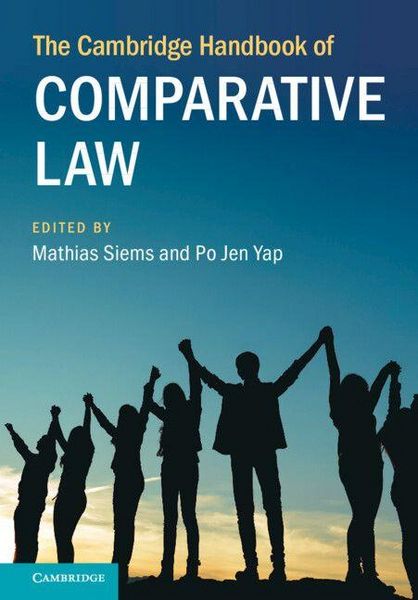
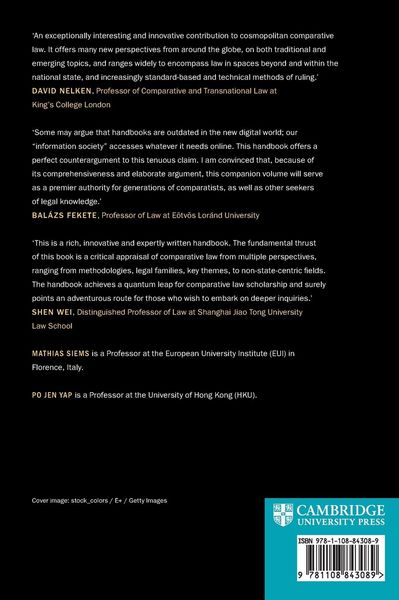
• Produktbild: The Cambridge Handbook of Comparative Law
  • Produktbild: The Cambridge Handbook of Comparative Law

The Cambridge Handbook of Comparative Law

Fr. 259.00

inkl. gesetzl. MwSt., Versandkostenfrei


Beschreibung

Produktdetails

Einband

Gebundene Ausgabe

Erscheinungsdatum

01.02.2024

Herausgeber

Mathias Siems + weitere

Verlag

Cambridge Academic

Seitenzahl

780

Maße (L/B/H)

26.1/18.3/4.7 cm

Gewicht

1636 g

Sprache

Englisch

ISBN

978-1-108-84308-9

Beschreibung

Produktdetails

Einband

Gebundene Ausgabe

Erscheinungsdatum

01.02.2024

Herausgeber

Verlag

Cambridge Academic

Seitenzahl

780

Maße (L/B/H)

26.1/18.3/4.7 cm

Gewicht

1636 g

Sprache

Englisch

ISBN

978-1-108-84308-9

Herstelleradresse

Libri GmbH
Europaallee 1
36244 Bad Hersfeld
DE

Email: gpsr@libri.de

Kundinnen und Kunden meinen

0 Bewertungen

Informationen zu Bewertungen

Zur Abgabe einer Bewertung ist eine Anmeldung im Konto notwendig. Die Authentizität der Bewertungen wird von uns nicht überprüft. Wir behalten uns vor, Bewertungstexte, die unseren Richtlinien widersprechen, entsprechend zu kürzen oder zu löschen.

Die Bewertungen sind nach Format, Anzahl Sterne und Datum sortiert.

Verfassen Sie die erste Bewertung zu diesem Artikel

Helfen Sie anderen Kund*innen durch Ihre Meinung

Kundinnen und Kunden meinen

0 Bewertungen filtern

Die Leseprobe wird geladen.
  • Produktbild: The Cambridge Handbook of Comparative Law
  • Produktbild: The Cambridge Handbook of Comparative Law
  • 1. Introduction: a new handbook for comparative law in a global context Mathias Siems and Po Jen Yap; Part I. Methods of Comparative Law: 2. Traditional methods Jaakko Husa; 3. Historical-jurisprudential methods Jean-Louis Halpérin; 4. Critical methods Thomas Coendet; 5. Culture and comparative law methodology Qian Xiangyang; 6. Linguistic approaches Łucja Biel; 7. Qualitative fieldwork Petra Mahy, Richard Mitchell, John Howe, Ingrid Landau and Carolyn Sutherland; 8. New institutional economics Olive Sabiiti; 9. Empirical methods Mathias Siems; 10. Machine-learning methods Han-wei Ho, Patrick Chung-Chia Huang and Yun-chien Chang; Part II. Legal Families and Geographical Comparisons: 11. Civil law Andrea Ortolani; 12. Common law Shivprasad Swaminathan; 13. Confucian legal tradition Ngoc Son Bui; 14.Former Soviet States of Eastern Europe, Caucasus and Central Asia Andrey Shirvindt; 15. Latin America Isabel Zuloaga and José Manuel Díaz de Valdés; 16. Middle East and North Africa Radwa Elsaman; 17. South Asia Rehan Abeyratne; 18. Sub-Saharan Africa Charles Manga Fombad; Part III. Central Themes in Comparative Law: 19. The tradition of comparative law: comparison and its colonial legacies Helge Dedek; 20. Decolonial theory and comparative law Roger Merino; 21. Legal transplants: a theoretical framework and a case study from public law Margit Cohn; 22. Legal transplants: a case study of private law in its historical context Gerardo Caffera, Rodrigo Momberg and María Elisa Morales; 23. Convergence and divergence in public law Po Jen Yap; 24. Convergence and divergence in company law Hatice Kübra Kandemir; 25. Law and development Yong-Shik Lee and Andrew Harding; 26. Divided legal systems: understanding legal systems in conflict-prone societies M. Bashir Mobasher and Haroun Rahimi; 27. Legal pluralism and commerce Ada Ordor, Nojeem Amodu and Victor Amadi; Part IV. Comparative Law Beyond the State: 28. Comparative international law Danielle Hanna Rached and Conrado Hubner Mendes; 29. Transnational regulation Victor V. Ramraj; 30. Quantitative forms of legal governance Rene Urueña; 31. Comparative international arbitration law Shahla Ali; 32. Cross-border judicial dialogue Tom Gerald Daly; 33. Comparing regional law Armin Cuyvers; 34. Comparative conflict of laws Yuko Nishitani; 35. Comparative indigenous law Anthony C. Diala; 36. Comparative legal education Tan Cheng-Han, Alan Koh, Topo Santoso, Umakanth Varottil and Jiangyu Wang.