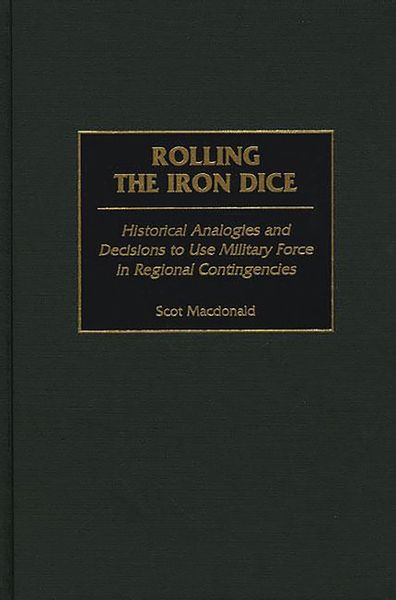
Rolling the Iron Dice Historical Analogies and Decisions to Use Military Force in Regional Contingencies
Fr. 90.90
inkl. gesetzl. MwSt.Beschreibung
Produktdetails
Format
Kopierschutz
Ja
Family Sharing
Nein
Text-to-Speech
Nein
Altersempfehlung
ab 7 Jahr(e)
Erscheinungsdatum
30.07.2000
Verlag
Bloomsbury eBooks USSeitenzahl
264 (Printausgabe)
Auflage
1. Auflage
Sprache
Englisch
EAN
9780313001727
Does history provide lessons for foreign policy makers today? Macdonald combines cognitive psychology theories about analogical reasoning, international relations theories about military intervention, and original archival research to analyze the role of historical information in foreign policy decision making. He looks at the role of historical analogies in Anglo-American decision making during foreign policy crises involving the possible use of force in regional contingencies during a crucial period in the 1950s when the West faced an emerging Soviet threat. This study analyzes the influence of situational and individual variables in a comparison of more than ten leaders from two nations facing four different crises.
Rolling the Iron Dice describes the often significant effect of historical analogies on perceptions of the adversary and of allies, time constraints, policy options and risks, as well as the justification of policy in four crises: the 1950 Korean invasion; the 1951-53 Iranian oil nationalization incident; the 1956 Suez crisis; and the 1958 crisis in Lebanon and Jordan. Contrary to both the slippery slope and the escalation models of military intervention, Macdonald argues that leaders decide extremely early in a crisis, often on the basis of an historical analogy, but also based on perceptions of the rationality of an adversary, whether to use military force. Their decision does not change unless the adversary capitulates to every demand.
Rolling the Iron Dice describes the often significant effect of historical analogies on perceptions of the adversary and of allies, time constraints, policy options and risks, as well as the justification of policy in four crises: the 1950 Korean invasion; the 1951-53 Iranian oil nationalization incident; the 1956 Suez crisis; and the 1958 crisis in Lebanon and Jordan. Contrary to both the slippery slope and the escalation models of military intervention, Macdonald argues that leaders decide extremely early in a crisis, often on the basis of an historical analogy, but also based on perceptions of the rationality of an adversary, whether to use military force. Their decision does not change unless the adversary capitulates to every demand.
Kundinnen und Kunden meinen
Verfassen Sie die erste Bewertung zu diesem Artikel
Helfen Sie anderen Kund*innen durch Ihre Meinung