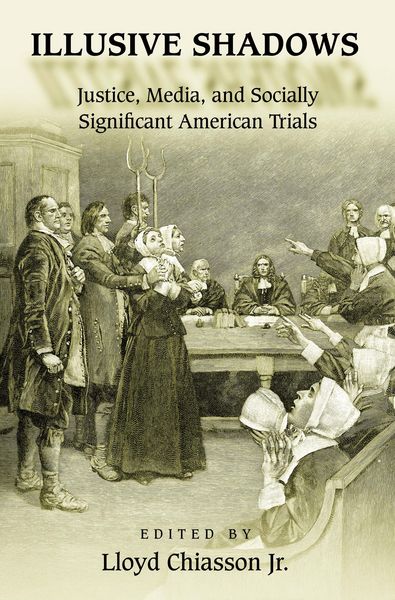
Illusive Shadows Justice, Media, and Socially Significant American Trials
-
- Hardcover
- Taschenbuch
- eBook ausgewählt
-
Form:Einzelkauf Download
-
Sprache:Englisch
Fr. 42.90
inkl. gesetzl. MwSt.Beschreibung
Produktdetails
Format
Kopierschutz
Ja
Family Sharing
Nein
Text-to-Speech
Nein
Altersempfehlung
ab 7 Jahr(e)
Erscheinungsdatum
30.11.2003
Verlag
Bloomsbury eBooks USSeitenzahl
248 (Printausgabe)
Auflage
1. Auflage
Sprache
Englisch
EAN
9780313057052
As Chiasson and his contributors illustrate, trials are media events that can have long-reaching significance. They can, and have, changed the way people think, how institutions function, and have shaped public opinions. While this collection on ten trials is about withcraft, slavery, religion, and radicalism, it is, in many ways, the story of America.
Trials are the stuff of news. Those rare moments when justice, or a reasonable facsimile, is meted out. And what offers up more high drama, or melodrama, than a highly publicized trial? Most news events enjoy short life spans. They happen; they are reported; they are quickly forgotten. As Chiasson and his contributors make clear, a trial often is a lingering, living thing that builds in tension. It is, every once in a long while, a modern Shakespearean drama with a twist: The audience becomes members of the cast because, every once in a long while, society finds itself the defendant.
Trials can have lasting importance beyond how the public perceives them. A trial can have long-reaching significance if it changes the way people think, or how institutions function, or shapes public opinion. Ten such American trials covering a span of 307 years are covered here. In each, the sociological underpinnings of events often has greater significance than either the crime or the trial. The ten trials included are the Salem witch trials, the Amistad trial, the Sioux Indian Uprising trials, the Ed Johnson/Sheriff Shipp trial, the Big Bill Haywood trial, the Ossian Sweet trial, the Clay Shaw trial, the Manuel Noriega trial, and the Matthew Shepard trial. While the book is about ten crimes, the subsequent trials, and the media coverage of each, it is also a book about witchcraft, about religion, slavery, and radicalism. It paints portraits of a racist America, a capitalistic America, an anarchist America. It relates compelling tales of compassion, greed, stupidity, and hate beginning in 17th-century colonial times and ending in present-day America. In many ways, it is the story of America.
Trials are the stuff of news. Those rare moments when justice, or a reasonable facsimile, is meted out. And what offers up more high drama, or melodrama, than a highly publicized trial? Most news events enjoy short life spans. They happen; they are reported; they are quickly forgotten. As Chiasson and his contributors make clear, a trial often is a lingering, living thing that builds in tension. It is, every once in a long while, a modern Shakespearean drama with a twist: The audience becomes members of the cast because, every once in a long while, society finds itself the defendant.
Trials can have lasting importance beyond how the public perceives them. A trial can have long-reaching significance if it changes the way people think, or how institutions function, or shapes public opinion. Ten such American trials covering a span of 307 years are covered here. In each, the sociological underpinnings of events often has greater significance than either the crime or the trial. The ten trials included are the Salem witch trials, the Amistad trial, the Sioux Indian Uprising trials, the Ed Johnson/Sheriff Shipp trial, the Big Bill Haywood trial, the Ossian Sweet trial, the Clay Shaw trial, the Manuel Noriega trial, and the Matthew Shepard trial. While the book is about ten crimes, the subsequent trials, and the media coverage of each, it is also a book about witchcraft, about religion, slavery, and radicalism. It paints portraits of a racist America, a capitalistic America, an anarchist America. It relates compelling tales of compassion, greed, stupidity, and hate beginning in 17th-century colonial times and ending in present-day America. In many ways, it is the story of America.
Kundinnen und Kunden meinen
Verfassen Sie die erste Bewertung zu diesem Artikel
Helfen Sie anderen Kund*innen durch Ihre Meinung