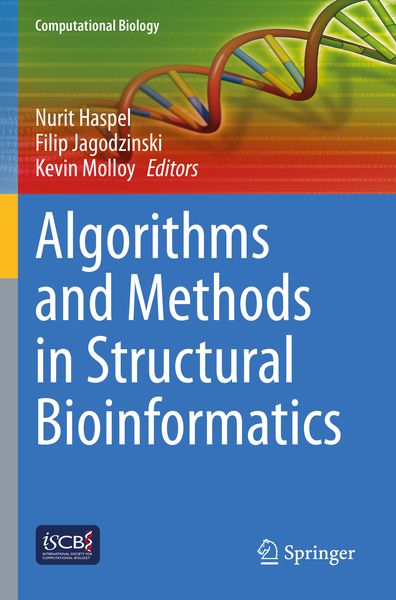
Algorithms and Methods in Structural Bioinformatics
Aus der Reihe
Computational Biology
-
- Hardcover
- Taschenbuch ausgewählt
- eBook
-
Sprache:Englisch
Fr. 137.00
inkl. gesetzl. MwSt.,
Beschreibung
Produktdetails
Einband
Taschenbuch
Erscheinungsdatum
03.09.2023
Herausgeber
Nurit Haspel + weitereVerlag
SpringerSeitenzahl
114
Maße (L/B/H)
23.5/15.5/0.8 cm
Gewicht
201 g
Auflage
1st ed. 2022
Sprache
Englisch
ISBN
978-3-031-05916-2
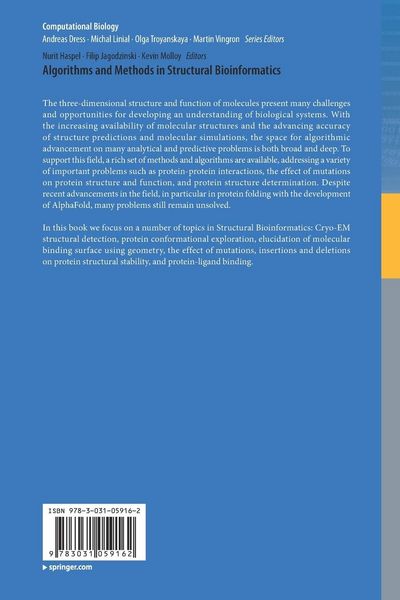
The three-dimensional structure and function of molecules present many challenges and opportunities for developing an understanding of biological systems. With the increasing availability of molecular structures and the advancing accuracy of structure predictions and molecular simulations, the space for algorithmic advancement on many analytical and predictive problems is both broad and deep. To support this field, a rich set of methods and algorithms are available, addressing a variety of important problems such as protein-protein interactions, the effect of mutations on protein structure and function, and protein structure determination. Despite recent advancements in the field, in particular in protein folding with the development of AlphaFold, many problems still remain unsolved.
In this book we focus on a number of topics in Structural Bioinformatics: Cryo-EM structural detection, protein conformational exploration, elucidation of molecular binding surface using geometry, the effect of mutations, insertions and deletions on protein structural stability, and protein-ligand binding.
In this book we focus on a number of topics in Structural Bioinformatics: Cryo-EM structural detection, protein conformational exploration, elucidation of molecular binding surface using geometry, the effect of mutations, insertions and deletions on protein structural stability, and protein-ligand binding.
Kundinnen und Kunden meinen
Verfassen Sie die erste Bewertung zu diesem Artikel
Helfen Sie anderen Kund*innen durch Ihre Meinung