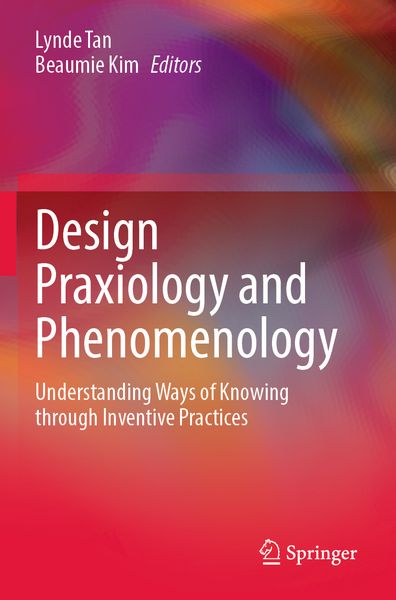
Produktbild: Design Praxiology and Phenomenology

Design Praxiology and Phenomenology Understanding Ways of Knowing through Inventive Practices

Fr. 137.00

inkl. gesetzl. MwSt., Versandkostenfrei


Beschreibung

Produktdetails

Einband

Taschenbuch

Erscheinungsdatum

05.09.2023

Herausgeber

Lynde Tan + weitere

Verlag

Springer Singapore

Seitenzahl

232

Maße (L/B/H)

23.5/15.5/1.4 cm

Gewicht

382 g

Auflage

1st ed. 2022

Sprache

Englisch

ISBN

978-981-19-2808-6

Beschreibung

Portrait

Lynde Tan holds a PhD in Applied Linguistics from the University of Lancaster, United Kingdom. She is interested in pedagogical issues pertinent to the use of digital media for literacies and new culture of learning.  Prior to Western Sydney University, Lynde researched and taught at the Learning Sciences Lab and Learning Sciences and Technologies Academic Group in National Institute of Education, Nanyang Technological University in Singapore. Passionate about designing social futures for young people, Lynde has co-chaired committees headed by Microsoft (Singapore) and Infocomm Development Authority of Singapore to design and scale innovative digital practices using emerging technologies among Singapore teachers.  She has recently completed a research on using augmented reality for primary literacy education in Australia. Her recent book “Between worlds: Extending Students’ Multimodal Literacy Practices with Augmented Reality” is now used as a national resource for primaryschool teachers’ professional development in Australia.  As a researcher with keen interests in digital literacy practices, she has published extensively in Q1 journals on teachers’ design capacities for 21st Century new culture of learning, and learner-generated designs in participatory culture in the formal and informal spaces.

Beaumie Kim completed her PhD in Instructional Technology at the University of Georgia, USA. She joined University of Calgary in January 2013. Prior to University of Calgary, she researched and taught at the Learning Sciences Lab and Learning Sciences and Technologies Academic Group in National Institute of Education, Nanyang Technological University in Singapore. She previously worked for NASA-sponsored Classroom of the Future program at the Center for Educational Technologies in Wheeling Jesuit University in the United States. Her earlier work was focused on using experts’ resources and tools for the research and development of learning resourcesand tools using technology, including co-designing educational games with stakeholders, such as scientists, designers, educators, and students. Her current research engages learners in creating games for their own and others' learning in a playful manner in diverse educational contexts. Her work is carried out in collaboration with teachers and students as design partners, and by observing their interactions, discourse and artifacts.

Produktdetails

Einband

Taschenbuch

Erscheinungsdatum

05.09.2023

Herausgeber

Verlag

Springer Singapore

Seitenzahl

232

Maße (L/B/H)

23.5/15.5/1.4 cm

Gewicht

382 g

Auflage

1st ed. 2022

Sprache

Englisch

ISBN

978-981-19-2808-6

Herstelleradresse

Springer-Verlag KG
Sachsenplatz 4-6
1201 Wien
AT

Email: ProductSafety@springernature.com

Kundinnen und Kunden meinen

0 Bewertungen

Informationen zu Bewertungen

Zur Abgabe einer Bewertung ist eine Anmeldung im Konto notwendig. Die Authentizität der Bewertungen wird von uns nicht überprüft. Wir behalten uns vor, Bewertungstexte, die unseren Richtlinien widersprechen, entsprechend zu kürzen oder zu löschen.

Die Bewertungen sind nach Format, Anzahl Sterne und Datum sortiert.

Verfassen Sie die erste Bewertung zu diesem Artikel

Helfen Sie anderen Kund*innen durch Ihre Meinung

Kundinnen und Kunden meinen

0 Bewertungen filtern

  • Produktbild: Design Praxiology and Phenomenology
  • Chapter 1. Design thinking the future?.- Chapter 2. Looking inside the box to think outside it: Contextualizing design thinking.- Chapter 3. The development of social design education: toward social field and new media application.- Chapter 4. Learning as subversive design practice: Graffiti artists’ learning of social structure and invention of creative expressions.- Chapter 5. Designing a future through imaginative responses to artists.- Chapter 6. Solving your game's Rubik's Cube: Systematizing the design process for digital and tabletop games.- Chapter 7. Transforming the Bard through Digital Media: Modern design approaches for Shakespeare education.- Chapter 8. Making museum collections more accessible for the public: Multiplicity of designing natural history exhibits.- Chapter 9. Nature can inspire the things we make and why it matters.- Chapter 10. Reimagining the book: ‘Writerly’ ways of knowing.- Chapter 11. Designing for designerly knowing: Strategies for creating instructional design futures.- Chapter 12. How people learn in design practices.- Chapter 13. Commentary I on four chapters.- Chapter 14. Commentary II on four chapters.