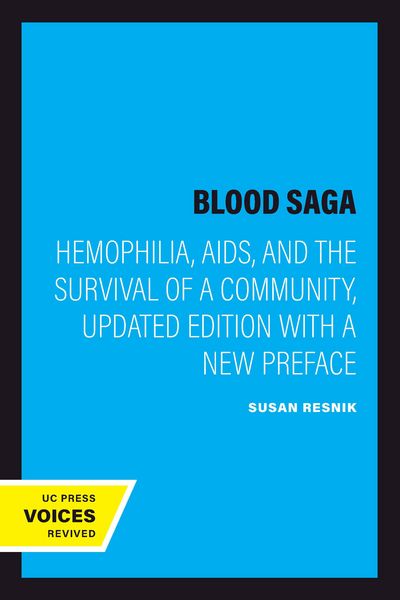
Blood Saga Hemophilia, AIDS, and the Survival of a Community, Updated Edition With a New Preface
Fr. 67.90
inkl. gesetzl. MwSt.Beschreibung
Produktdetails
Format
ePUB
Kopierschutz
Nein
Family Sharing
Nein
Text-to-Speech
Ja
Erscheinungsdatum
01.09.2023
Verlag
Kensington BooksSeitenzahl
308 (Printausgabe)
Auflage
1. Auflage
Sprache
Englisch
EAN
9780520920293
For thousands of years boys known as "bleeders" faced an early, painful death from hemophilia. Dubbed "the Royal Disease" because of its identification with Queen Victoria, the world's most renowned carrier, hemophilia is a genetic disease whose sufferers had little recourse until the mid-twentieth century. In the first book to chronicle the emergence and transformation of the hemophilia community, Susan Resnik sets her story within our national political landscape-where the disease is also a social, psychological, and economic experience.
Blood Saga includes many players and domains: men with hemophilia and their families, medical personnel, science researchers, and the author herself, who was Director of Education of the National Hemophilia Foundation in the early 1980s. At that time the "miracle treatment" of freeze-dried pooled plasma blood products enabled men with hemophilia to lead full, normal lives. Then the AIDS virus infiltrated the treatment system and over fifty percent of the hemophilia community became HIV-positive. But rather than collapsing, this community refocused its priorities, extended its reach, and helped shape blood safety policies to prevent further tragedy.
The hemophilia community includes people from every socioeconomic and ethnic group, and Resnik's narrative and use of oral histories never lose touch with those affected by the disease. Her extensive informant interviewing allows much of this social history to be told by participants on all levels: parents, wives, nurses, doctors, government agency directors, health care providers, and many others.
Gene insertion therapy now holds the promise of a cure for hemophilia in the near future. Scientific breakthroughs inevitably become intertwined with the industry and academic medical centers that govern the national health care system. And in that system, says Resnik, costs and safety are sometimes contending issues. She makes clear that the lessons learned in Blood Saga apply to all of us.
For thousands of years boys known as "bleeders" faced an early, painful death from hemophilia. Dubbed "the Royal Disease" because of its identification with Queen Victoria, the world's most renowned carrier, hemophilia is a genetic disease whose sufferers
Blood Saga includes many players and domains: men with hemophilia and their families, medical personnel, science researchers, and the author herself, who was Director of Education of the National Hemophilia Foundation in the early 1980s. At that time the "miracle treatment" of freeze-dried pooled plasma blood products enabled men with hemophilia to lead full, normal lives. Then the AIDS virus infiltrated the treatment system and over fifty percent of the hemophilia community became HIV-positive. But rather than collapsing, this community refocused its priorities, extended its reach, and helped shape blood safety policies to prevent further tragedy.
The hemophilia community includes people from every socioeconomic and ethnic group, and Resnik's narrative and use of oral histories never lose touch with those affected by the disease. Her extensive informant interviewing allows much of this social history to be told by participants on all levels: parents, wives, nurses, doctors, government agency directors, health care providers, and many others.
Gene insertion therapy now holds the promise of a cure for hemophilia in the near future. Scientific breakthroughs inevitably become intertwined with the industry and academic medical centers that govern the national health care system. And in that system, says Resnik, costs and safety are sometimes contending issues. She makes clear that the lessons learned in Blood Saga apply to all of us.
For thousands of years boys known as "bleeders" faced an early, painful death from hemophilia. Dubbed "the Royal Disease" because of its identification with Queen Victoria, the world's most renowned carrier, hemophilia is a genetic disease whose sufferers
Kundinnen und Kunden meinen
Verfassen Sie die erste Bewertung zu diesem Artikel
Helfen Sie anderen Kund*innen durch Ihre Meinung
Weitere Artikel finden Sie in
- eBooks >
- Fachbücher >
- Medizin