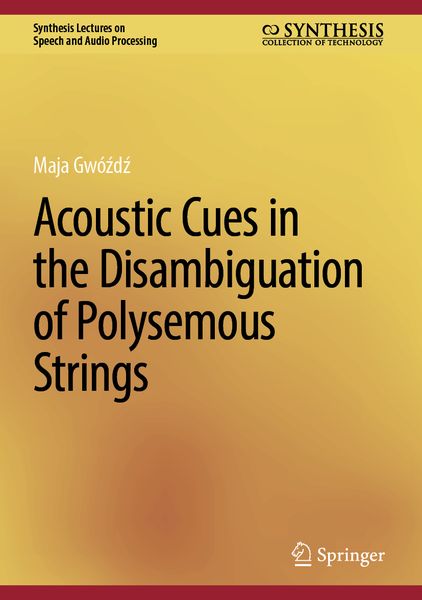
Acoustic Cues in the Disambiguation of Polysemous Strings
-
- Hardcover ausgewählt
- Taschenbuch
- eBook
-
Sprache:Englisch
Fr. 72.90
inkl. gesetzl. MwSt.,
Beschreibung
Produktdetails
Einband
Gebundene Ausgabe
Erscheinungsdatum
05.01.2024
Verlag
SpringerSeitenzahl
99
Maße (L/B/H)
24.6/17.3/1.3 cm
Gewicht
385 g
Sprache
Englisch
ISBN
978-3-031-46679-3
This book provides an analysis of acoustic features of polysemous strings and an implementation of a speech disambiguation program based on the phonetic information. Throughout the book, the term ‘polysemous string’ refers to idioms with plausible literal interpretations, restrictive and non–restrictive relative clauses, and the same expressions used as quotations and appearing in a non–quotational context. The author explains how, typically, context is sufficient to determine the intended meaning. But there is enough evidence in psycholinguistic and phonetic literature to suspect that these superficially identical strings exhibit different acoustic features. In the experiment presented in the book, the participants were asked to read short excerpts containing corresponding elements of polysemous strings placed in the same intonational position. The acoustic analyses of ditropic pairs and subsequent statistical tests revealed that there is almost no difference in the duration, pitch, or intensity in literal and figurative interpretations. However, the analysis of relative clauses and quotations demonstrated that speakers are more likely to use acoustic cues to differentiate between the two possible readings. The book argues that the acoustic analysis of polysemous phrases could be successfully implemented in designing automatic speech recognition systems in order to improve their performance in disambiguating polysemous phrases.
- Analyzes acoustic features of polysemous strings and an implementation of a speech disambiguation program
- Includes evidence that superficially identical strings exhibit different acoustic features
- Argues that acoustic analysis of polysemous phrases can be successfully implemented in automatic speech recognition
Kundinnen und Kunden meinen
Verfassen Sie die erste Bewertung zu diesem Artikel
Helfen Sie anderen Kund*innen durch Ihre Meinung