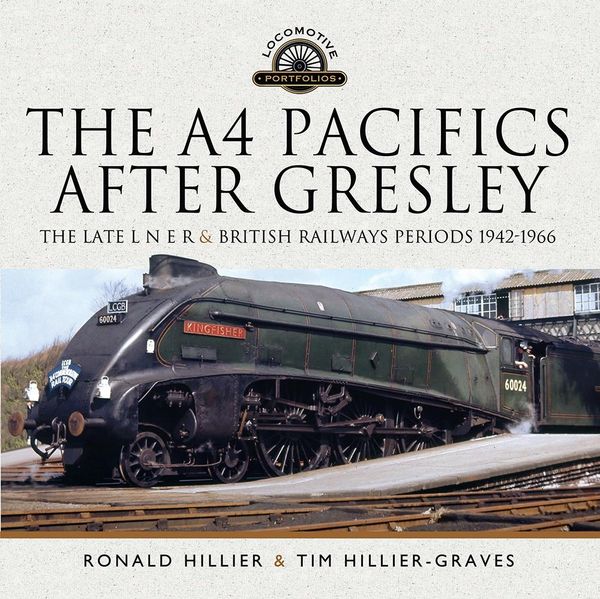
A4 Pacifics After Gresley
Aus der Reihe
Locomotive Portfolio
-
Form:Einzelkauf Download
-
Sprache:Englisch
-
eBook Format:ePUB
- PDF Fr. 24.90
- ePUB Fr. 24.90 ausgewählt
Fr. 24.90
inkl. gesetzl. MwSt.Beschreibung
Produktdetails
Format
ePUB
Kopierschutz
Ja
Family Sharing
Ja
Text-to-Speech
Ja
Erscheinungsdatum
30.09.2023
Verlag
Pen And SwordSeitenzahl
224 (Printausgabe)
Dateigröße
94624 KB
Sprache
Englisch
EAN
9781399073448
In their book 'Gresley's Silver Link' the authors analyzed the evolution of the A4s Gresley's and their service up to Gresley's death in 1941. This book takes this compelling story from the early years of the war up to their demise in the 1960s
After four years of service pulling the LNER's most prestigious trains the A4s took on a more utilitarian role and for six years worked hard to support Britain's war effort. From this they emerged bowed, but unbeaten, although in an extremely jaded condition. Once restored they took up where they had left off in 1939 and did exceptional service for the rest of their days.
With the help of previously unpublished material the authors analyze the second phase of the A4s careers, first as LNER engines, then, from 1948, under British Railways management. Without a diesel or electric fleet of engines to replace them they entered a second golden age of fast running in the '50s. Then in the 'Swinging Sixties' they faced, as some thought, a premature end as part of a much delayed modernization program. Until withdrawn from service they continued to astound their footplate crew and performed exceptionally well, even when maintenance standards had slipped and their condition had deteriorated. They were thoroughbreds and have become a fitting memorial to the master engineers who produced and sustained them for 30 years or more.
After four years of service pulling the LNER's most prestigious trains the A4s took on a more utilitarian role and for six years worked hard to support Britain's war effort. From this they emerged bowed, but unbeaten, although in an extremely jaded condition. Once restored they took up where they had left off in 1939 and did exceptional service for the rest of their days.
With the help of previously unpublished material the authors analyze the second phase of the A4s careers, first as LNER engines, then, from 1948, under British Railways management. Without a diesel or electric fleet of engines to replace them they entered a second golden age of fast running in the '50s. Then in the 'Swinging Sixties' they faced, as some thought, a premature end as part of a much delayed modernization program. Until withdrawn from service they continued to astound their footplate crew and performed exceptionally well, even when maintenance standards had slipped and their condition had deteriorated. They were thoroughbreds and have become a fitting memorial to the master engineers who produced and sustained them for 30 years or more.
Kundinnen und Kunden meinen
Verfassen Sie die erste Bewertung zu diesem Artikel
Helfen Sie anderen Kund*innen durch Ihre Meinung