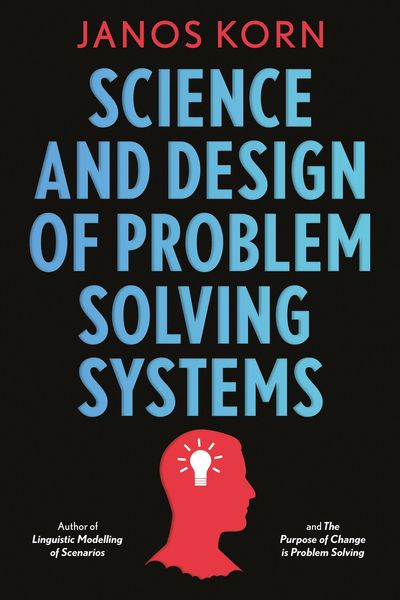
Science and Design of Problem Solving Systems
-
- Einzelkauf Download ausgewählt
-
Sprache:Englisch
Fr. 12.90
inkl. gesetzl. MwSt.Beschreibung
Produktdetails
Format
ePUB
Kopierschutz
Ja
Family Sharing
Ja
Text-to-Speech
Ja
Erscheinungsdatum
18.11.2022
Verlag
Troubador Publishing LtdSeitenzahl
368 (Printausgabe)
Dateigröße
9719 KB
Sprache
Englisch
EAN
9781803134253
The book is about an empirical, systems theory of a general, systemic/structural view of parts of the world integrated with creative problem solving procedure with the latter generating a 'product and systems' design method. As an alternative to the speculative and fragmented nature of current 'systems thinking' and practice, the book proposes three principles of systems: 'Generality/nested hierarchy, changes of equilibrium states and problem solving/purpose' together with 'linguistic modelling' using processed, natural language or transformation of narratives of scenarios into sequences of logical conditionals, the executor of the principles. Implementation of the creative, innovative, inspirational stage leads to 'design parameters' which guide the detailed design of systems and products defined as any entity capable of generating interaction. Uncertainties and mathematical models are introduced at the object/agent level as required. The theory is 'property driven' i.e., uses qualitative, quantitative properties including social, emotive and other mental states. Elementary, systemic or structural properties are '1 - and 2 - place simple sentences' which can lead to operational representations when appropriate. Meaning preserving, linguistic transformations convert a narrative or story into such sentences. A user driven approach to the analysis of 'information' is introduced. Recent paradigm changes and problematic issues in current 'systems thinking' are reviewed. The theory is based on accepted branches of knowledge such as linguistics, network theory, biology, physics, chemistry, social science as needed, it is highly teachable, introduces linguistics in addition to mathematics as a symbolic model and can inspire further research. It introduces four criteria for judging the 'soundness' of symbolic models. However, it needs peer review, software development to work out the dynamics of scenarios and further developments for applications to more practical problem situations in organisations, technical and natural circumstances.
Kundinnen und Kunden meinen
Verfassen Sie die erste Bewertung zu diesem Artikel
Helfen Sie anderen Kund*innen durch Ihre Meinung