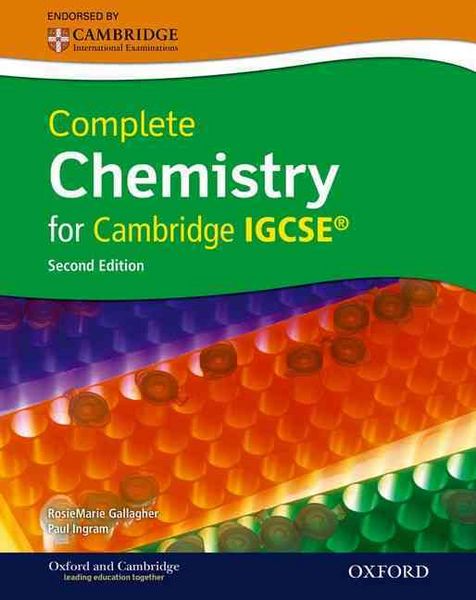
Produktbild: Complete Chemistry for Cambridge IGCSE with CD-ROM

Complete Chemistry for Cambridge IGCSE with CD-ROM

Fr. 46.90

inkl. gesetzl. MwSt., Versandkostenfrei


Beschreibung

Produktdetails

ISBN

978-0-19-913878-4

Auflage

2nd Revised edition.

Erscheinungsdatum

31.03.2011

Bundesländer

Baden-Württemberg + weitere

Einband

Taschenbuch

Verlag

Oxford University Press

Seitenzahl

320

Maße (L/B/H)

27.7/21.7/1.7 cm

Gewicht

922 g

Sprache

Englisch

Beschreibung

Produktdetails

ISBN

978-0-19-913878-4

Auflage

2nd Revised edition.

Erscheinungsdatum

31.03.2011

Bundesländer

  • Baden-Württemberg
  • Bayern
  • Berlin
  • Brandenburg
  • Bremen
  • Hamburg
  • Hessen
  • Mecklenburg-Vorpommern
  • Niedersachsen
  • Nordrhein-Westfalen
  • Rheinland-Pfalz
  • Saarland
  • Sachsen
  • Sachsen-Anhalt
  • Schleswig-Holstein
  • Thüringen

Einband

Taschenbuch

Verlag

Oxford University Press

Seitenzahl

320

Maße (L/B/H)

27.7/21.7/1.7 cm

Gewicht

922 g

Sprache

Englisch

Noch keine Bewertungen vorhanden

Verfassen Sie die erste Bewertung zu diesem Artikel

Helfen Sie anderen Kundinnen und Kunden durch Ihre Meinung.

Kundinnen und Kunden meinen

Bewertungen (0)

Weitere Artikel finden Sie in

  • Produktbild: Complete Chemistry for Cambridge IGCSE with CD-ROM
  • 1. STATES OF MATTER ; 1.1 Everything is made of particles ; 1.2 Solids, liquids, and gases ; 1.3 The particles in solids, liquids, and gases ; 1.4 A closer look at gases ; Checkup on Chapter 1 ; 2. SEPARATING SUBSTANCES ; 2.1 Mixtures, solutions, and solvents ; 2.2 Pure substances and impurities ; 2.3 Separation methods (part I) ; 2.4 Separation methods (part II) ; 2.5 More about paper chromatography ; 2.6 The chromatography detectives ; Checkup on Chapter 2 ; 3. ATOMS AND ELEMENTS ; 3.1 Atoms, elements, and the Periodic Table ; 3.2 More about atoms ; 3.3 Isotopes and radioactivity ; 3.4 How electrons are arranged ; How our model of the atom developed ; The atom: the inside story ; 3.5 The metals and non-metals ; Checkup on Chapter 3 ; 4. ATOMS COMBINING ; 4.1 Compounds, mixtures, and chemical change ; 4.2 Why do atoms form bonds? ; 4.3 The ionic bond ; 4.4 More about ions ; 4.5 The covalent bond ; 4.6 Covalent compounds ; 4.7 Comparing ionic and covalent compounds ; 4.8 Giant covalent structures ; 4.9 The bonding in metals ; Checkup on Chapter 4 ; 5. REACTING MASSES, AND CHEMICAL EQUATIONS ; 5.1 The names and formulae of compounds ; 5.2 Equations for chemical reactions ; 5.3 The masses of atoms, molecules. and ions ; 5.4 Some calculations about masses and % ; Checkup on Chapter 5 ; 6. USING MOLES ; 6.1 The mole ; 6.2 Calculations from equations, using the mole ; 6.3 Reactions involving gases ; 6.4 The concentration of a solution ; 6.5 Finding the empirical formula ; 6.6 From empirical to final formula ; 6.7 Finding % yield and % purity ; Checkup on Chapter 6 ; 7. REDOX REACTIONS ; 7.1 Oxidation and reduction ; 7.2 Redox and electron transfer ; 7.3 Redox and changes in oxidation state ; 7.4 Oxidising and reducing agents ; Checkup on Chapter 7 ; 8. ELECTRICITY AND CHEMICAL CHANGE ; 8.1 Conductors and insulators ; 8.2 The principles of electrolysis ; 8.3 The reactions at the electrodes ; 8.4 The electrolysis of brine ; 8.5 Two more uses of electrolysis ; Checkup on Chapter 8 ; 9. ENERGY CHANGES, AND REVERSIBLE REACTIONS ; 9.1 Energy changes in reactions ; 9.2 Explaining energy changes ; 9.3 Energy from fuels ; 9.4 Giving out energy as electricity ; The batteries in your life ; 9.5 Reversible reactions ; 9.6 Shifting the equilibrium ; Checkup on Chapter 9 ; 10. THE SPEED OF A REACTION ; 10.1 Rates of reaction ; 10.2 Measuring the rate of a reaction ; 10.3 Changing the rate of a reaction (part I) ; 10.4 Changing the rate of a reaction (part II) ; 10.5 Explaining rates ; 10.6 Catalysts ; More about enzymes ; 10.7 Photochemical reactions ; Checkup on Chapter 10 ; 11. ACIDS AND BASES ; 11.1 Acids and alkalis ; 11.2 A closer look at acids and alkalis ; 11.3 The reactions of acids and bases ; 11.4 A closer look at neutralisation ; 11.5 Oxides ; 11.6 Making salts ; 11.7 Making insoluble salts by precipitation ; 11.8 Finding concentrations by titration ; Checkup on Chapter 11 ; 12. THE PERIODIC TABLE ; 12.1 An overview of the Periodic Table ; 12.2 Group I: the alkali metals ; 12.3 Group VII: the halogens ; 12.4 Group 0: the noble gases ; 12.5 The transition elements ; 12.6 Across the Periodic Table ; How the Periodic Table developed ; Checkup on Chapter 12 ; 13. THE BEHAVIOUR OF METALS ; 13.1 Metals: a review ; 13.2 Comparing metals for reactivity ; 13.3 Metals in competition ; 13.4 The reactivity series ; 13.5 Making use of the reactivity series ; Checkup on Chapter 13 ; 14. MAKING USE OF METALS ; 14.1 Metals in the Earth's crust ; 14.2 Extracting metals from their ores ; 14.3 Extracting iron ; 14.4 Extracting aluminium ; 14.5 Making use of metals and their alloys ; 14.6 Steels and steel-making ; Metals, civilisation, and you ; Checkup on Chapter 14 ; 15. AIR AND WATER ; 15.1 What is air? ; 15.2 Making use of air ; 15.3 Pollution alert! ; 15.4 The rusting problem ; 15.5 Water supply ; Living in space ; Checkup on Chapter 15 ; 16. SOME NON-METALS AND THEIR COMPOUNDS ; 16.1 Hydrogen, nitrogen, and ammonia ; 16.2 Making ammonia in industry ; 16.3 Fertilisers ; 16.4 Sulfur and sulfur dioxide ; 16.5 Sulfuric acid ; 16.6 Carbon and the carbon cycle ; 16.7 Some carbon compounds ; 16.8 Greenhouse gases, and climate change ; 16.9 Limestone ; Checkup on Chapter 16 ; 17. ORGANIC CHEMISTRY ; 17.1 Petroleum: a fossil fuel ; 17.3 Separating petroleum into fractions ; 17.3 Cracking hydrocarbons ; 17.4 Families of organic compounds ; 17.5 The alkanes ; 17.6 The alkenes ; 17.7 The alcohols ; 17.8 The carboxylic acids ; Checkup on Chapter 17 ; 18. POLYMERS ; 18.1 Introducing polymers ; 18.2 Addition polymerisation ; 18.3 Condensation polymerisation ; 18.4 Making use of synthetic polymers ; 18.5 Plastics: here to stay? ; 18.6 The macromolecules in food (part I) ; 18.7 The macromolecules in food (part II) ; 18.8 Breaking down the macromolecules ; Checkup on Chapter 18 ; 19. IN THE LAB ; 19.1 Chemistry: a practical subject ; 19.2 An example of an experiment ; 19.3 Working with gases in the lab ; 19.4 Testing for ions in the lab ; Checkup on Chapter 19 ; ANSWERS TO THE NUMERICAL QUESTIONS IN THIS BOOK ; YOUR CAMBRIDGE IGCSE CHEMISTRY EXAM ; About the Cambridge IGCSE chemistry exam ; Exam questions from Paper 2 ; Exam questions from Paper 3 ; Exam questions from Paper 6 ; REFERENCE ; Glossary ; The Periodic Table and atomic masses ; Index