
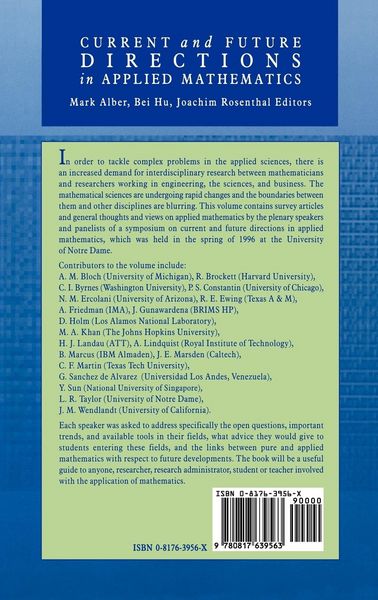
Current and Future Directions in Applied Mathematics
-
- Hardcover ausgewählt
- Taschenbuch
-
Sprache:Englisch
Fr. 72.90
inkl. gesetzl. MwSt.,
Beschreibung
Produktdetails
Einband
Gebundene Ausgabe
Erscheinungsdatum
20.03.1997
Herausgeber
Mark Alber + weitereVerlag
Birkhäuser BostonSeitenzahl
261
Maße (L/B/H)
24.1/16/2.1 cm
Gewicht
567 g
Auflage
1997
Sprache
Englisch
ISBN
978-0-8176-3956-3
Mark Alber, Bei Hu and Joachim Rosenthal . . . . . . . . . . . . . . . . . . . . . . vii Part I Some Remarks on Applied Mathematics Roger Brockett . . . . . . . . . . . . . . . . . . . . . . . . . . . . . . . . . . . . . . . . . . . . . . . . . . . . 1 Mathematics is a Profession Christopher 1. Byrnes . . . . . . . . . . . . . . . . . . . . . . . . . . . . . . . . . . . . . . . . . . . . 4 Comments on Applied Mathematics Avner Friedman . . . . . . . . . . . . . . . . . . . . . . . . . . . . . . . . . . . . . . . . . . . . . . . . . . 9 Towards an Applied Mathematics for Computer Science Jeremy Gunawardena . . . . . . . . . . . . . . . . . . . . . . . . . . . . . . . . . . . . . . . . . . . . 11 Infomercial for Applied Mathematics Darryl Holm . . . . . . . . . . . . . . . . . . . . . . . . . . . . . . . . . . . . . . . . . . . . . . . . . . . . 15 On Research in Mathematical Economics M. Ali Khan . . . . . . . . . . . . . . . . . . . . . . . . . . . . . . . . . . . . . . . . . . . . . . . . . . . . 21 Applied Mathematics in the Computer and Communications Industry Brian Marcus . . . . . . . . . . . . . . . . . . . . . . . . . . . . . . . . . . . . . . . . . . . . . . . . . . . 25 'frends in Applied Mathematics Jerrold E. Marsden . . . . . . . . . . . . . . . . . . . . . . . . . . . . . . . . . . . . . . . . . . . . . . 28 Applied Mathematics as an Interdisciplinary Subject Clyde F. Martin . . . . . . . . . . . . . . . . . . . . . . . . . . . . . . . . . . . . . . . . . . . . . . . . . 31 vi Contents Panel Discussion on Future Directions in Applied Mathe matics Laurence R. Taylor . . . . . . . . . . . . . . . . . . . . . . . . . . . . . . . . . . . . . . . . . . . . . . 38 Part II Feedback Stabilization of Relative Equilibria for Mechanical Systems with Symmetry A. M. Bloch, J. E. Marsden and G. Sanchez . . . . . . . . . . . . . . . . . . . . . . . 43 Oscillatory Descent for Function Minimization R. Brockett . . . . . . . . . . . . . . . . . . . . . . . . . . . . . . . . . . . . . . . . . . . . . . . . . . . . . . 65 On the Well-Posedness of the Rational Covariance Extension Problem C. l. Byrnes, H. J. Landau and A. Lindquist . . . . . . . . . . . . . . . . . . . . . . 83 Singular Limits in Fluid Mechanics P. Constantin . . . . . . . . . . . . . . . . . . . . . . . . . . . . . . . . . . . . . . . . . . . . . . . . . . . 109 Singularities and Defects in Patterns Far from Threshold N. M. Ercolani . . . . . . . . . . . . . . . . . . . . . . . . . . . . . . . . . . . . . . . . . . . . . . . . . . . 137 Mathematical Modeling and Simulation for Applications of Fluid Flow in Porous Media R. E. Ewing . . . . . . . . . . . . . . . . . . . . . . . . . . . . . . . . . . . . . . . . . . . . . . . . . . . . . 161 On Loeb Measure Spaces and their Significance for N on Cooperative Game Theory M. A. Khan and Y. Sun . . . . . . . . . . . . . . . . . . . . . . . . . . . . . . . . . . . . . . . . . 183 Mechanical Systems with Symmetry, Variational Principles, and Integration Algorithms J. E. Marsden and J. M. Wendlandt . . . . . . . . . . . . . . . . . . . . . . . . . . . . . . 219 Preface The applied sciences are faced with increasingly complex problems which call for sophisticated mathematical models.
Noch keine Bewertungen vorhanden
Verfassen Sie die erste Bewertung zu diesem Artikel
Helfen Sie anderen Kundinnen und Kunden durch Ihre Meinung.