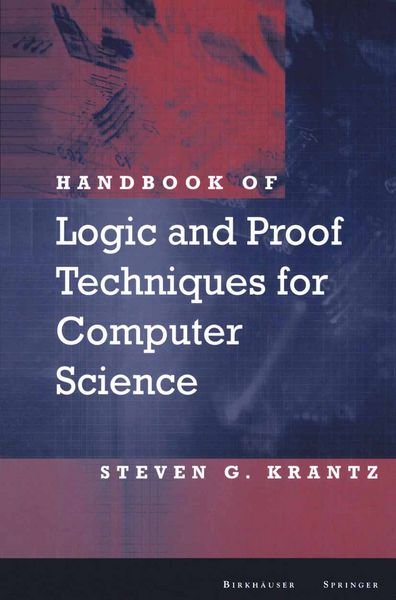
• Produktbild: Handbook of Logic and Proof Techniques for Computer Science
  • Produktbild: Handbook of Logic and Proof Techniques for Computer Science

Handbook of Logic and Proof Techniques for Computer Science

Fr. 73.90

inkl. gesetzl. MwSt., Versandkostenfrei


Beschreibung

Produktdetails

Einband

Gebundene Ausgabe

Erscheinungsdatum

17.01.2002

Abbildungen

XIX, 16 schwarzweisse Abbildungen, 16 schwarzweisse Zeichnungen 235 mm

Verlag

Birkhäuser Boston

Seitenzahl

245

Maße (L/B/H)

24.1/15.9/1.8 cm

Gewicht

576 g

Auflage

2002

Sprache

Englisch

ISBN

978-0-8176-4220-4

Beschreibung

Rezension

"This is really what it promises to be—a good handbook: supple, self-contained, providing the necessary and sufficient working resources . . . it is more than [one] expect[s]: the rigor of usefulness and conciseness exceeds or equals . . . the pleasure of reading it."


—Zentralblatt Math

Produktdetails

Einband

Gebundene Ausgabe

Erscheinungsdatum

17.01.2002

Abbildungen

XIX, 16 schwarzweisse Abbildungen, 16 schwarzweisse Zeichnungen 235 mm

Verlag

Birkhäuser Boston

Seitenzahl

245

Maße (L/B/H)

24.1/15.9/1.8 cm

Gewicht

576 g

Auflage

2002

Sprache

Englisch

ISBN

978-0-8176-4220-4

Herstelleradresse

Libri GmbH
Europaallee 1
36244 Bad Hersfeld
DE

Email: gpsr@libri.de

Kundinnen und Kunden meinen

0 Bewertungen

Informationen zu Bewertungen

Zur Abgabe einer Bewertung ist eine Anmeldung im Konto notwendig. Die Authentizität der Bewertungen wird von uns nicht überprüft. Wir behalten uns vor, Bewertungstexte, die unseren Richtlinien widersprechen, entsprechend zu kürzen oder zu löschen.

Die Bewertungen sind nach Format, Anzahl Sterne und Datum sortiert.

Verfassen Sie die erste Bewertung zu diesem Artikel

Helfen Sie anderen Kund*innen durch Ihre Meinung

Kundinnen und Kunden meinen

0 Bewertungen filtern

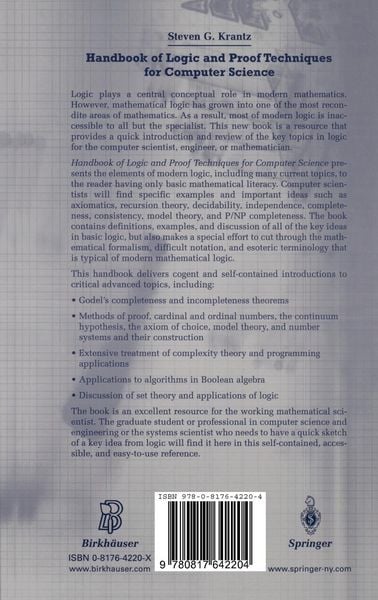
  • Produktbild: Handbook of Logic and Proof Techniques for Computer Science
  • Produktbild: Handbook of Logic and Proof Techniques for Computer Science
  • 1 Notation and First-Order Logic.- 1.1 The Use of Connectives.- 1.2 Truth Values and Truth Tables.- 1.3 The Use of Quantifiers.- 1.4 Gödel’s Completeness Theorem.- 1.5 Second-Order Logic.- 2 Semantics and Syntax.- 2.1 Elementary Symbols.- 2.2 Well-Formed Formulas or wffs [Syntax].- 2.3 Free and Bound Variables (Syntax).- 2.4 The Semantics of First-Order Logic.- 3 Axiomatics and Formalism in Mathematics.- 3.1 Basic Elements.- 3.2 Models.- 3.3 Consistency.- 3.4 Gödel’s Incompleteness Theorem.- 3.5 Decidability and Undecidability.- 3.6 Independence.- 4 The Axioms of Set Theory.- 4.1 Introduction.- 4.2 Axioms and Discussion.- 4.3 Concluding Remarks.- 5 Elementary Set Theory.- 5.1 Set Notation.- 5.2 Sets, Subsets, and Elements.- 5.3 Binary Operations on Sets.- 5.4 Relations and Equivalence Relation.- 5.5 Equivalence Relations.- 5.6 Number Systems.- 5.7 Functions.- 5.8 Cardinal Numbers.- 5.9 A Word About Classes.- 5.10 Fuzzy Set Theory.- 5.11 The Lambda Calculus.- 5.12 Sequences.- 5.13 Bags.- 6 Recursive Functions.- 6.1 Introductory Remarks.- 6.2 Primitive Recursive Functions.- 6.3 General Recursive Functions.- 7 The Number Systems.- 7.1 The Natural Numbers.- 7.2 The Integers.- 7.3 The Rational Numbers.- 7.4 The Real Numbers.- 7.5 The Complex Numbers.- 7.6 The Quaternions.- 7.7 The Cayley Numbers.- 7.8 Nonstandard Analysis.- 8 Methods of Mathematical Proof.- 8.1 Axiomatics.- 8.2 Proof by Induction.- 8.3 Proof by Contradiction.- 8.4 Direct Proof.- 8.5 Other Methods of Proof.- 9 The Axiom of Choice.- 9.1 Enunciation of the Axiom.- 9.2 Examples of the Use of the Axiom of Choice.- 9.3 Consequences of the Axiom of Choice.- 9.4 Paradoxes.- 9.5 The Countable Axiom of Choice.- 9.6 Consistency of the Axiom of Choice.- 9.7 Independence of the Axiom of Choice.- 10 Proof Theory.-10.1 General Remarks.- 10.2 Cut Elimination.- 10.3 Propositional Resolution.- 10.4 Interpolation.- 10.5 Finite Type.- 10.6 Beth’s Definability Theorem.- 11 Category Theory.- 11.1 Introductory Remarks.- 11.2 Metacategories and Categories.- 12 Complexity Theory.- 12.1 Preliminary Remarks.- 12.2 Polynomial Complexity.- 12.3 Exponential Complexity.- 12.4 Two Tables for Complexity Theory.- 12.5 Problems of Class P.- 12.6 Problems of Class NP.- 12.7 NP-Completeness.- 12.8 Cook’s Theorem.- 12.9 Examples of NP-Complete Problems.- 12.10 More on P/NP.- 12.11 Descriptive Complexity Theory.- 13 Boolean Algebra.- 13.1 Description of Boolean Algebra.- 13.2 Axioms of Boolean Algebra.- 13.3 Theorems in Boolean Algebra.- 13.4 Illustration of the Use of Boolean Logic.- 14 The Word Problem.- 14.1 Introductory Remarks.- 14.2 What Is a Group?.- 14.3 What Is a Free Group?.- 14.4 The Word Problem.- 14.5 Relations and Generators.- 14.6 Amalgams.- 14.7 Description of the Word Problem.- List of Notation from Logic.- Glossary of Terms from Mathematical and Sentential Logic.- A Guide to the Literature.