Gutscheinbedingungen

*Gültig bis 21.06.2026 auf (fast) alles. Ausgeschlossen sind Smartboxen, Zeitschriften, Tickets, Lebensmittel, Gaming-Elektroartikel, Tinte/Toner, Gutscheine, Geschenkkarten, Blumen und Abos | Einlösbar in allen Buchhandlungen von Orell Füssli, Barth Bücher, Buchladen Rapunzel, Schuler Orell Füssli, Stauffacher und ZAP unter Vorweisung des Gutscheins, auf www.orellfüssli.ch durch Eingabe des Gutscheincodes. Beim Service „eBooks verschenken“ und bei eBook-Käufen via eReader nicht einlösbar | Mindesteinkaufswert: Fr. 30.- | Nicht mit anderen Rabatten kumulierbar.

Produktbild: The Transition to Chaos

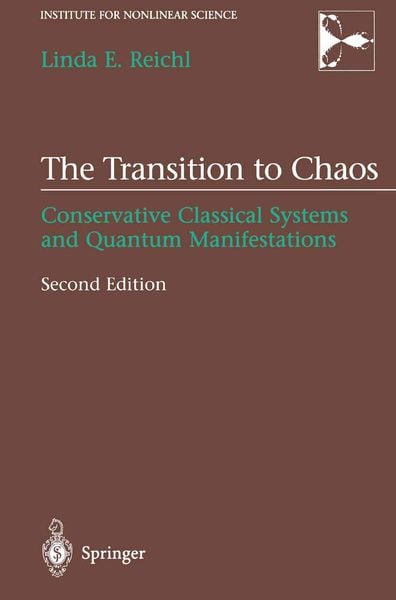
The Transition to Chaos Conservative Classical Systems and Quantum Manifestations

Fr. 73.90

inkl. gesetzl. MwSt., Versandkostenfrei


Beschreibung

Produktdetails

Einband

Gebundene Ausgabe

Erscheinungsdatum

13.05.2004

Abbildungen

XVIII, 154 illus., schwarz-weiss Illustrationen

Verlag

Springer Us

Seitenzahl

675

Maße (L/B/H)

24.2/16.4/3.7 cm

Gewicht

1096 g

Auflage

2. Auflage

Sprache

Englisch

ISBN

978-0-387-98788-0

Beschreibung

Rezension

From the reviews of the second edition:


"This book is an expanded and updated version … from a previous edition and reviews results on the manifestation of chaos in classical and quantum mechanics. … A very wide range of topics is covered in the book, which thus can be used as preliminary reading for research areas … . The book can also be considered as a helpful companion both for mathematicians and for physicists. … Many technical details and background notions can be found in a rich complement of appendices." (Guido Gentile, Mathematical Reviews, Issue 2006 c)

Produktdetails

Einband

Gebundene Ausgabe

Erscheinungsdatum

13.05.2004

Abbildungen

XVIII, 154 illus., schwarz-weiss Illustrationen

Verlag

Springer Us

Seitenzahl

675

Maße (L/B/H)

24.2/16.4/3.7 cm

Gewicht

1096 g

Auflage

2. Auflage

Sprache

Englisch

ISBN

978-0-387-98788-0

Herstelleradresse

Springer US, New York, N.Y.
Heidelberger Platz 3
14197 Berlin
Deutschland
Email: sdc-bookservice@springer.com
Fax: +49 6221 3454229

Kundinnen und Kunden meinen

0 Bewertungen

Informationen zu Bewertungen

Zur Abgabe einer Bewertung ist eine Anmeldung im Konto notwendig. Die Authentizität der Bewertungen wird von uns nicht überprüft. Wir behalten uns vor, Bewertungstexte, die unseren Richtlinien widersprechen, entsprechend zu kürzen oder zu löschen.

Die Bewertungen sind nach Format, Anzahl Sterne und Datum sortiert.

Verfassen Sie die erste Bewertung zu diesem Artikel

Helfen Sie anderen Kund*innen durch Ihre Meinung

Kundinnen und Kunden meinen

0 Bewertungen filtern

  • Produktbild: The Transition to Chaos
  • 1 Overview.- 2 Fundamental Concepts.- 3 Area-Preserving Maps.- 4 Global Properties.- 5 Random Matrix Theory.- 6 Bounded Quantum Systems.- 7 Manifestations of Chaos in Quantum Scattering Processes.- 8 Semiclassical Theory—Path Integrals.- 9 Time-Periodic Systems.- 10 Stochastic Manifestations of Chaos.- A Classical Mechanics.- A.1 Newton’s Equations.- A.2 Lagrange’s Equations.- A.3 Hamilton’s Equations.- A.4 The Poisson Bracket.- A.5 Phase Space Volume Conservation.- A.6 Action-Angle Coordinates.- A.7 Hamilton’s Principal Function.- A.8 References.- B Simple Models.- B.1 The Pendulum.- B.2 Double-Well Potential.- B.3 Infinite Square-Well Potential.- B.4 One-Dimensional Hydrogen.- B.4.1 Zero Stark Field.- B.4.2 Nonzero Stark Field.- C Renormalization Integral.- C.3 References.- D Moyal Bracket.- D.1 The Wigner Function.- D.2 Ordering of Operators.- D.3 Moyal Bracket.- D.4 References.- E Symmetries and the Hamiltonian Matrix.- E.1 Space-Time Symmetries.- E.1.1 Continuous Symmetries.- E.1.2 Discrete Symmetries.- E.2 Structure of the Hamiltonian Matrix.- E.2.1 Space-Time Homogeneity and Isotropy.- E.2.2 Time Reversal Invariance.- E.3 References.- F Invariant Measures.- F.1 General Definition of Invariant Measure.- F.1.1 Invariant Metric (Length).- F.1.2 Invariant Measure (Volume).- F.2 Hermitian Matrices.- F.2.1 Real Symmetric Matrix.- F.2.2 Complex Hermitian Matrices.- F.2.3 Quaternion Real Matrices.- F.2.4 General Formula for Invariant Measure of Hermitian Matrices.- F.3 Unitary Matrices.- F.3.1 Symmetric Unitary Matrices.- F.3.2 General Unitary Matrices.- F.3.3 Symplectic Unitary Matrices.- F.3.4 General Formula for Invariant Measure of Unitary Matrices.- F.3.5 Orthogonal Matrices.- F.4 References.- G Quaternions.- G.1 References.- H Gaussian Ensembles.- H.1Vandermonde Determinant.- H.2 Gaussian Unitary Ensemble (GUE).- H.3 Gaussian Orthogonal Ensemble (GOE).- H.4 Gaussian Symplectic Ensemble (GSE).- H.5 References.- I Circular Ensembles.- 1.1 Vandermonde Determinant.- 1.2 Circular Unitary Ensemble (CUE).- 1.3 Circular Orthogonal Ensemble (COE).- 1.4 Circular Symplectic Ensemble (COE).- 1.5 References.- J Volume of Invariant Measure for Unitary Matrices.- J.1 References.- K Lorentzian Ensembles.- K.1 Normalization of AOE.- K.2 Relation Between COE and AOE.- K.4 Invariance of AOE under Inversion.- K.4.1 Robustness of AOE under Integration.- K.5 References.- L Grassmann Variables and Supermatrices.- L.1 Grassmann Variables.- L.2 Supermatrices.- L.2.1 Transpose of a Supermatrix.- L.2.2 Hermitian Adjoint of a Supermatrix.- L.2.3 Supertrace of a Supermatrix.- L.2.4 Determinant of a Supermatrix.- L.3 References.- M Average Response Function (GOE).- M.3 Gaussian Integral for Response Function Generating Function.- M.4 Expectation Value of the Generating Function (Part 1).- M.5 The Hubbard-Stratonovitch Transformation.- M.6 Expectation Value of the Generating Function (Part 2).- M.7 Average Response Function Density.- M.7.1 Saddle Points for the Integration over a.- M.7.2 Saddle Points for the Integration over ?.- M.7.4 Wigner Semicircle Law.- M.8 References.- N Average S-Matrix (GOE).- N.1 S-Matrix Generating Function.- N.2 Average S-Matrix Generating Function.- N.3 Saddle Point Approximation.- N.4 Integration over Grassmann Variables.- N.5 References.- O Maxwell’s Equations for 2-d Billiards.- O.1 References.- P Lloyd’s Model.- P.1 Localization Length.- P.2 References.- Q Hydrogen in a Constant Electric Field.- Q.1 The Schrödinger Equation.- Q.1.1 Equation for Relative Motion.- Q.2 One-Dimensional Hydrogen.- Q.3References.- Author Index.