Band 151
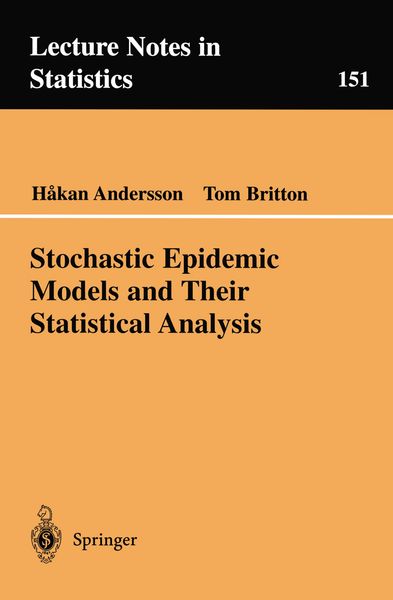
Stochastic Epidemic Models and Their Statistical Analysis
Aus der Reihe
Lecture Notes in Statistics
-
- Englisch ausgewählt
Fr. 171.00
inkl. gesetzl. MwSt.,
Beschreibung
Produktdetails
Einband
Taschenbuch
Erscheinungsdatum
19.07.2000
Verlag
Springer UsSeitenzahl
156
Maße (L/B/H)
23.5/15.5/0.9 cm
Gewicht
228 g
Auflage
2000
Sprache
Englisch
ISBN
978-0-387-95050-1
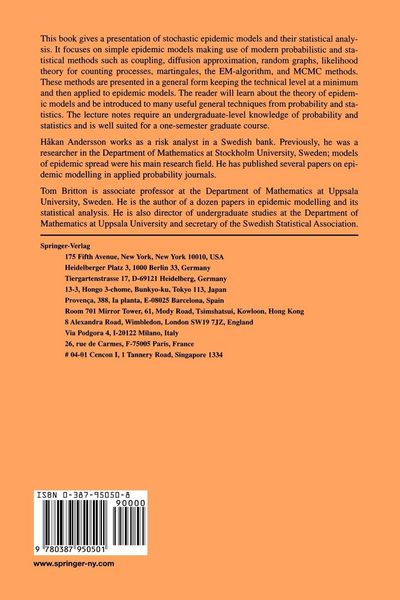
The present lecture notes describe stochastic epidemic models and methods for their statistical analysis. Our aim is to present ideas for such models, and methods for their analysis; along the way we make practical use of several probabilistic and statistical techniques. This will be done without focusing on any specific disease, and instead rigorously analyzing rather simple models. The reader of these lecture notes could thus have a two-fold purpose in mind: to learn about epidemic models and their statistical analysis, and/or to learn and apply techniques in probability and statistics. The lecture notes require an early graduate level knowledge of probability and They introduce several techniques which might be new to students, but our statistics. intention is to present these keeping the technical level at a minlmum. Techniques that are explained and applied in the lecture notes are, for example: coupling, diffusion approximation, random graphs, likelihood theory for counting processes, martingales, the EM-algorithm and MCMC methods. The aim is to introduce and apply these techniques, thus hopefully motivating their further theoretical treatment. A few sections, mainly in Chapter 5, assume some knowledge of weak convergence; we hope that readers not familiar with this theory can understand the these parts at a heuristic level. The text is divided into two distinct but related parts: modelling and estimation.
Noch keine Bewertungen vorhanden
Verfassen Sie die erste Bewertung zu diesem Artikel
Helfen Sie anderen Kundinnen und Kunden durch Ihre Meinung.