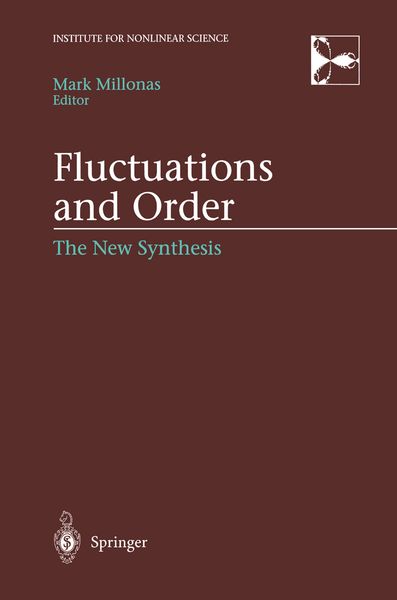
• Produktbild: Fluctuations and Order
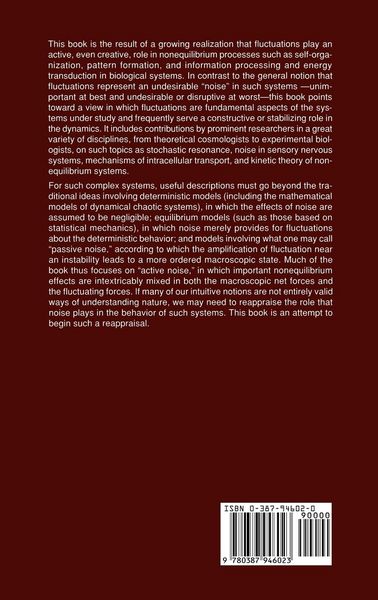
  • Produktbild: Fluctuations and Order
  • Produktbild: Fluctuations and Order

Fluctuations and Order The New Synthesis

Fr. 137.00

inkl. gesetzl. MwSt., Versandkostenfrei


Beschreibung

Produktdetails

Einband

Gebundene Ausgabe

Erscheinungsdatum

08.03.1996

Abbildungen

XX, 136 schwarzweisse Abbildungen, 136 schwarzweisse Zeichnungen

Herausgeber

Mark Millonas

Verlag

Springer Us

Seitenzahl

456

Maße (L/B/H)

24.1/16/3.1 cm

Gewicht

848 g

Auflage

1996

Sprache

Englisch

ISBN

978-0-387-94602-3

Beschreibung

Produktdetails

Einband

Gebundene Ausgabe

Erscheinungsdatum

08.03.1996

Abbildungen

XX, 136 schwarzweisse Abbildungen, 136 schwarzweisse Zeichnungen

Herausgeber

Mark Millonas

Verlag

Springer Us

Seitenzahl

456

Maße (L/B/H)

24.1/16/3.1 cm

Gewicht

848 g

Auflage

1996

Sprache

Englisch

ISBN

978-0-387-94602-3

Herstelleradresse

Springer-Verlag GmbH
Tiergartenstr. 17
69121 Heidelberg
DE

Email: ProductSafety@springernature.com

Kundinnen und Kunden meinen

0 Bewertungen

Informationen zu Bewertungen

Zur Abgabe einer Bewertung ist eine Anmeldung im Konto notwendig. Die Authentizität der Bewertungen wird von uns nicht überprüft. Wir behalten uns vor, Bewertungstexte, die unseren Richtlinien widersprechen, entsprechend zu kürzen oder zu löschen.

Die Bewertungen sind nach Format, Anzahl Sterne und Datum sortiert.

Verfassen Sie die erste Bewertung zu diesem Artikel

Helfen Sie anderen Kund*innen durch Ihre Meinung

Kundinnen und Kunden meinen

0 Bewertungen filtern

  • Produktbild: Fluctuations and Order
  • Produktbild: Fluctuations and Order
  • Produktbild: Fluctuations and Order
  • 1 State-Dependent Noise and Interface Propagation.- 1.1 Introduction.- 1.2 The Blowtorch Theorem.- 1.3 Kink Motion.- 1.4 Temperature Inhomogeneity and Kink Motion.- 1.5 Conclusion.- 1.6 References.- 2 Stochastic Resonance and Its Precursors.- 2.1 Introduction.- 2.2 A Historical Overview.- 2.2.1 Ice-Ages Prelude.- 2.2.2 Stochastic Resonance in a Ring Laser.- 2.3 Linear-Response Theory.- 2.4 Precursors of Stochastic Resonance in Condensed Matter Physics.- 2.5 Stochastic Resonance in Periodically Driven Systems.- 2.6 Conclusions.- 2.7 Acknowledgments.- 2.8 References.- 3 Generation of Higher Harmonics in Noisy Nonlinear Systems.- 3.1 Introduction.- 3.2 Linear and Nonlinear Response of a Noisy Nonlinear System, General Theory.- 3.2.1 Linear Response Function.- 3.2.2 Nonlinear Response: Generation of Higher Harmonics.- 3.3 Noise-Induced Effects in the Generation of Higher Harmonics.- 3.3.1 Hopping-Induced Higher Harmonics Generation.- 3.3.2 Higher Harmonics Generation in Continuous Systems.- 3.4 Conclusions.- 3.5 Acknowledgments.- 3.6 References.- 4 Noise-Induced Linearization and Delinearization.- 4.1 Introduction.- 4.2 Physical Basis of Noise-Induced Linearization and Delinearization.- 4.3 Noise-Induced Linearization in an Overdamped Bistable System.- 4.4 Noise-Induced Delinearization in an Underdamped Monostable System.- 4.5 Conclusion.- 4.6 Acknowledgments.- 4.7 References.- 5 The Effect of Chaos on a Mean First-Passage Time.- 5.1 Introduction.- 5.2 Periodically Driven Rotor.- 5.3 The Hamiltonian.- 5.4 Mean First-Passage Time.- 5.5 Conclusions.- 5.6 Acknowledgments.- 5.7 References.- 6 Noise-Induced Sensitivity to Initial Conditions.- 6.1 Introduction.- 6.2 One-Degree-of-Freedom Systems.- 6.2.1 Dynamical Systems and the GMF.- 6.2.2 Additive Gaussian Noise.- 6.2.3 Other Forms of Noise.- 6.2.4 Average Flux Factor.- 6.2.5 Probability of Exit from a Safe Region.- 6.3 Mean Time Between Peaks—Brundsen-Holmes Oscillator.- 6.4 Higher-Degree-of-Freedom Systems.- 6.4.1 Slowly Varying Oscillators.- 6.4.2 A Spatially Extended System.- 6.5 Conclusions.- 6.6 Acknowledgment.- 6.7 References.- 7 Stabilization Through Fluctuations in Chaotic Systems.- 7.1 Introduction.- 7.2 Background.- 7.3 Chaos in Fast-Oscillating Frame of Reference.- 7.4 Closure of Reynolds-Type Equations Using the Stabilization Principle.- 7.5 Stable Representation of Chaotic Attractors.- 7.6 Acknowledgments.- 7.7 References.- 8 The Weak-Noise Characteristic Boundary Exit Problem: Old and New Results.- 8.1 Acknowledgments.- 8.2 References.- 9 Some Novel Features of Nonequilibrium Systems.- 9.1 References.- 10 Using Path-Integral Methods to Calculate Noise-Induced Escape Rates in Bistable Systems: The Case of Quasi-Monochromatic Noise.- 10.1 References.- 11 Noise-Facilitated Critical Behavior in Thermal Ignition of Energetic Media.- 11.1 Introduction and Review of Model Equations.- 11.2 Deterministic Model Equations for Thermal Ignition of Energetic Media.- 11.3 Stochastic Model Equations for Thermal Ignition of Energetic Media.- 11.4 Some Experimental Results and Discussion.- 11.5 Conclusions.- 11.6 References.- 12 The Hierarchies of Nonclassical Regimes for Diffusion-Limited Binary Reactions.- 12.1 Introduction.- 12.2 Initial Conditions and Difference Equation.- 12.2.1 Random and Correlated Initial Conditions.- 12.2.2 Solution of Difference Equations.- 12.2.3 Discretization.- 12.3 Method of Simulations.- 12.4 Kinetic Behavior for Random Initial Conditions.- 12.4.1 Kinetic Regimes.- 12.4.2 Crossovers.- 12.4.3 Comparison With Monte Carlo Simulations.- 12.5 Kinetic Behavior for Correlated Initial Conditions.- 12.5.1 Kinetic Regimes and Crossovers.- 12.5.2 Comparison With Monte Carlo Simulations.- 12.6 Summary.- 12.7 Appendix: Solution of Difference Equations.- 12.8 Appendix: Initial Averages.- 12.9 Acknowledgments.- 12.10 References.- 13 Scale Invariance in Epitaxial Growth.- 13.1 Introduction.- 13.2 The Lattice Model.- 13.3 Scaling in the Submonolayer Regime.- 13.4 Scaling in the Multilayer Regime.- 13.5 Summary and Conclusions.- 13.6 Acknowledgments.- 13.7 References.- 14 Toward a Theory of Growing Surfaces: Mapping Two-Dimensional Laplacian Growth Onto Hamiltonian Dynamics and Statistics.- 14.1 Introduction.- 14.2 Formulation of the Problem and Hamiltonian Dynamics.- 14.3 A Case Study: N-Symmetric Growth.- 14.4 Introduction of Surface Tension.- 14.5 Effects of Noise and a Statistical Formulation of the Theory.- 14.6 Discussion and Concluding Remarks.- 14.7 Acknowledgment.- 14.8 References.- 15 Noise, Fractal Growth, and Exact Integrability in Nonequilibrium Pattern Formation.- 15.1 General Things.- 15.1.1 We Live in a Dissipative and Nonlinear World.- 15.1.2 Dissipation Comes From Averaging of Noise.- 15.1.3 Pattern Formation Results From a Multitude of Instabilities, that is, From a High Sensitivity to Noise.- 15.2 Concrete Things.- 15.2.1 Freezing of a Liquid (Stefan Problem), Solidification in a Supersaturated Solution, Bacterial Growth, Electrodeposition, and Viscous Fingering (Saffman-Taylor Problem).- 15.2.2 Two Dimensions: Laplacian Growth Equation.- 15.2.3 Remarkable Properties of LGE.- 15.2.4 Laplacian Growth on the Lattice.- 15.2.5 Recent Extensions and Elaborations of Results Concerning an Infinite Number of Conservation Laws in These (and Related) Processes.- 15.3 Conclusions and Speculations.- 15.3.1 List of Results.- 15.3.2 List of Possible Connections With Different Branches of Mathematics.- 15.3.3 List of Possible Connections With Different Branches of Physics.- 15.3.4 List of Possible Applications.- 15.4 Acknowledgments.- 15.5 Afterword.- 15.6 References.- 16 Order by Disorder and Topology in Frustrated Magnetic Systems.- 16.1 Introduction.- 16.2 Order by Disorder in a Heisenberg Magnet With One Additional Zero Mode (n0 = 1).- 16.2.1 Order by Quantum Disorder.- 16.3 Order by Thermal Fluctuations.- 16.4 Systems With More Than One Zero Mode.- 16.5 A System With a Macroscopic Number of Zero Modes: The Classical Kagomé Antiferromagnet.- 16.5.1 Ground State Manifold and Spin Origami.- 16.6 Selection of Coplanar States by Order by Disorder.- 16.7 Does the Question “What Particular Coplanar State Is Selected?” Make Sense.- 16.8 An Effective Hamiltonian and Description as a Fluctuating Surface.- 16.9 Magnetic Field Effects.- 16.10 Effect of Spatial Disorder.- 16.11 Quantum Kagomé Antiferromagnets.- 16.12 Conclusion.- 16.13 Acknowledgments.- 16.14 References.- 17 Noise-Induced Abnormal Growth.- 17.1 Introduction.- 17.2 A Computer Model.- 17.3 Computer Results.- 17.3.1 Effects of ? and ?.- 17.3.2 Effects of s.- 17.3.3 Effects of L.- 17.4 Discussion.- 17.5 Acknowledgments.- 17.6 References.- 18 Clustering of Active Walkers: Phase Transition from Local Interactions.- 18.1 Introduction.- 18.2 Equations of Motion for the Active Walker.- 18.3 Stability Analysis for Homogeneous Distributions.- 18.4 Estimation of an Effective Diffusion Coefficient.- 18.5 Results of Computer Simulations.- 18.6 Conclusions.- 18.7 Acknowledgments.- 18.8 References.- 19 Brownian Combustion Engines.- 19.1 Introduction.- 19.2 The Feynman Ratchet.- 19.3 Forced Ratchets.- 19.4 Forced Thermal Ratchets.- 19.5 Source of Time Correlations.- 19.6 Discussion.- 19.7 Outlook.- 19.8 Acknowledgments.- 19.9 References.- 20 A Depolymerization Ratchet for Intracellular Transport.- 20.1 Introduction.- 20.2 A Model for Intracellular Transport by Microtubule Depolymerization.- 20.3 Discussion.- 20.4 Acknowledgment.- 20.5 References.- 21 Order From Randomness: Spontaneous Firing From Stochastic Properties of Ion Channels.- 21.1 Introduction.- 21.2 Theory.- 21.3 Methods.- 21.4 Results.- 21.5 Discussion.- 21.6 Acknowledgments.- 21.7 References.- 22 Simple Noise-Induced Transitions in Models of Neural Systems.- 22.1 Noise and Bifurcations in the Nervous System.- 22.1.1 Studying Biological Noise Near a Bifurcation.- 22.2 Noise-Induced Transitions in the Pupil Light Reflex.- 22.3 Additive Noise-Induced Transitions in One Dimension?.- 22.4 Sensory Detection Through Noise-Induced Firing.- 22.5 Bursting and Noise in Cold Receptors.- 22.5.1 Summary of the Relevant Electrophysiology.- 22.5.2 Plant’s Model With Stochastic Forcing.- 22.6 Conclusion.- 22.7 Acknowledgments.- 22.8 References.- 23 Noise and Nonlinearity in Neuron Modeling.- 23.1 Introduction.- 23.2 Coupled Neurodendrite Processes.- 23.2.1 The Reduced Neuron.- 23.2.2 Stochastic Resonance.- 23.3 Statistical Analysis of Firing Events.- 23.3.1 Bistability and the Interspike Interval Histogram.- 23.3.2 More Experiments: The Crayfish of Missouri and the SNR-ISIH Connection.- 23.3.3 The Perfect Integrator Revisited: All Cats Are Not Grey in the Dark.- 23.4 Concluding Remarks.- 23.5 Acknowledgments.- 23.6 References.- 24 Physiological Singularities Modeled by Nondeterministic Equations of Motion and the Effect of Noise.- 24.1 Introduction.- 24.2 Theory.- 24.3 Methods.- 24.4 Examples.- 24.4.1 Respiratory System.- 24.4.2 Cardiovascular System.- 24.5 Conclusion.- 24.6 Acknowledgments.- 24.7 References.- 25 Temporal Stochasticity Leads to Nondeterministic Chaos in a Model for Blood Cell Production.- 25.1 Introduction.- 25.2 The Dynamics of Blood Cell Production.- 25.3 A Computer Model of the Stem Cell Dynamics.- 25.4 Chaos in Biological Systems.- 25.5 Acknowledgments.- 25.6 References.- 26 Quantum Noise in Gravitation and Cosmology.- 26.1 Introduction.- 26.2 Quantum Noise From the Influence Functional.- 26.3 Fluctuation-Dissipation Relation for Systems With Colored and Multiplicative Noise.- 26.4 Brownian Particle in a Bath of Parametric Oscillators.- 26.4.1 Bogolubov Transformation and Particle Creation.- 26.4.2 Noise and Decoherence.- 26.5 Particle-Field Interaction.- 26.5.1 Accelerated Observer.- 26.5.2 Thermal Radiance in de Sitter Space.- 26.6 Field-Space-time Coupling: Backreaction in Semiclassical Cosmology.- 26.7 Discussion.- 26.8 Acknowledgment.- 26.9 References.