Gutscheinbedingungen

*Gültig bis 20.07.2026 auf alle Bücher. Ausgeschlossen sind Zeitschriften, Prozentbücher und Abos | Einlösbar in allen Buchhandlungen von Orell Füssli, Barth Bücher, Buchladen Rapunzel, Papeterie Köhler, Schuler Orell Füssli, Stauffacher und ZAP unter Vorweisung des Gutscheins, auf www.orellfüssli.ch durch Eingabe des Gutscheincodes. Beim Service „eBooks verschenken“ und bei eBook-Käufen via eReader nicht einlösbar | Mindesteinkaufswert: Fr. 30.- | Nicht mit anderen Rabatten kumulierbar.

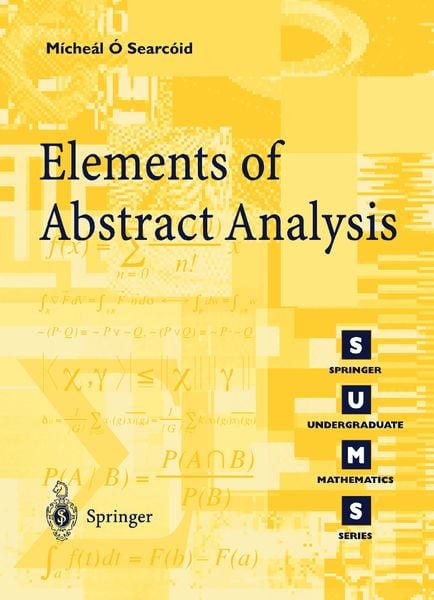
  • Produktbild: Elements of Abstract Analysis
  • Produktbild: Elements of Abstract Analysis

Elements of Abstract Analysis

Fr. 52.90

inkl. gesetzl. MwSt., Versandkostenfrei


Beschreibung

Produktdetails

Einband

Taschenbuch

Erscheinungsdatum

09.11.2001

Verlag

Springer London

Seitenzahl

300

Maße (L/B/H)

23.5/17.8/1.8 cm

Gewicht

553 g

Auflage

2002

Sprache

Englisch

ISBN

978-1-85233-424-6

Beschreibung

Rezension

From the reviews of the first edition:


BULLETIN OF MATHEMATICS BOOKS


"…an interesting mix of algebra, topology and functional analysis, with chapter titles like Algebraic Structure, Linear Structure, Geometric Structure and Topological Structure."


"Michael O’Searcoid’s book ‘Element of Abstract Analysis’ is a book that deals with the fundamental principles of mathematics in a broad framework of set-theoretic approach. The book is written with a deep insight. … The contents are conceptually useful to students. … The book is a nice readable treat for every student of mathematics and is highly recommended for one semester course at M.Sc. level." (Madhu Tiwari, Journal of the Indian Academy of Mathematics, Vol. 25 (1), 2003)


"This book covers the elements of abstract analysis, treated mostly within the context of topological spaces. … This is a carefully written book, starting from set-theoretic axioms, and containing about 180 problems and exercises with hints and solutions. It is an ideal source of information for independent student study. There is a comprehensive index." (European Mathematical Society Newsletter, September, 2002)


"The book presents some concepts of analysis and the mathematical structures which enfold them. … the reviewer recommends the book to everyone interested in analysis, especially those scholars interested in studying more advanced areas like Functional Analysis, or Operator Theory." (Catalin Badea, Zentralblatt MATH, Vol. 999 (24), 2002)


"The book is written specifically for final-year undergraduate students who should already be familiar with most of the mathematical structures discussed … . It reviews the concepts at a slightly greater level of abstraction and enables students to understand their place within the broad framework of set-based mathematics. This book is a rigorous, self-contained introduction to functional analysis that will also serve as a text onabstract mathematics." (L’Enseignement Mathematique, Vol. 48 (1-2), 2002)


"This is a book about a few elementary concepts of analysis and the mathematical structures which enfold them. … The book is written specifically for final-year and undergraduate students who should already be familiar with most of the mathematical structures discussed … and with many of the principal analytical concepts … . It reviews the concepts at a slightly greater level of abstraction and enables students to understand their place within the broad framework of set-based mathematics." (Zentralblatt für Didaktik der Mathematik, February, 2002)

Produktdetails

Einband

Taschenbuch

Erscheinungsdatum

09.11.2001

Verlag

Springer London

Seitenzahl

300

Maße (L/B/H)

23.5/17.8/1.8 cm

Gewicht

553 g

Auflage

2002

Sprache

Englisch

ISBN

978-1-85233-424-6

Herstelleradresse

Springer-Verlag KG
Sachsenplatz 4-6
1201 Wien
AT

Email: GPSR Kontakt

Noch keine Bewertungen vorhanden

Verfassen Sie die erste Bewertung zu diesem Artikel

Helfen Sie anderen Kundinnen und Kunden durch Ihre Meinung.

Kundinnen und Kunden meinen

Bewertungen (0)

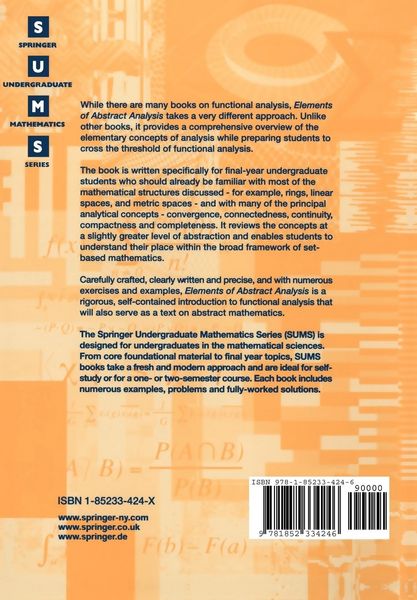
  • Produktbild: Elements of Abstract Analysis
  • Produktbild: Elements of Abstract Analysis
  • 1. Sets.- 1.1 Set Theory.- 1.2 Relations and Functions.- 1.3 Ordered Sets.- 1.4 Ordinals.- 1.5 The Axiom of Choice.- 2. Counting.- 2.1 Counting Numbers.- 2.2 Cardinality.- 2.3 Enumeration.- 2.4 Cardinality of Unions and Products.- 3. Algebraic Structure.- 3.1 Elementary Algebraic Structures.- 3.2 Vector Spaces.- 3.3 Algebras.- 3.4 Preservation of Algebraic Structure.- 4. Analytic Structure.- 4.1 Ordered Algebraic Structure.- 4.2 Number Systems.- 4.3 Real and Complex Functions.- 4.4 Inequalities.- 5. Linear Structure.- 5.1 Linear Spaces and Algebras.- 5.2 Linear Shapes.- 5.3 Linear Functionals.- 6. Geometric Structure.- 6.1 Semimetrics and Metrics.- 6.2 Seminorms and Norms.- 6.3 Sesquilinear Forms and Inner Products.- 7. Topological Structure.- 7.1 Topologies.- 7.2 Neighbourhoods.- 7.3 Cardinality and Topology.- 7.4 Separation.- 8. Continuity and Openness.- 8.1 Preservation of Topological Structure.- 8.2 Topologies Denned by Functions.- 8.3 Derived Topological Spaces.- 8.4 Topologies on Linear Spaces.- 9. Connectedness.- 9.1 Connected Spaces.- 9.2 Pathwise Connectedness.- 10. Convergence.- 10.1 Filters.- 10.2 Limits.- 11. Compactness.- 11.1 Compact Topological Spaces.- 11.2 Compact Hausdorff Spaces.- 11.3 Local Compactness.- 12. Completeness.- 12.1 Complete Metric Spaces.- 12.2 Banach Spaces.- 12.3 Hilbert Spaces.- 12.4 Banach Algebras.- Solutions.