• Produktbild: Mathematical Models in Photographic Science
  • Produktbild: Mathematical Models in Photographic Science
Band 3

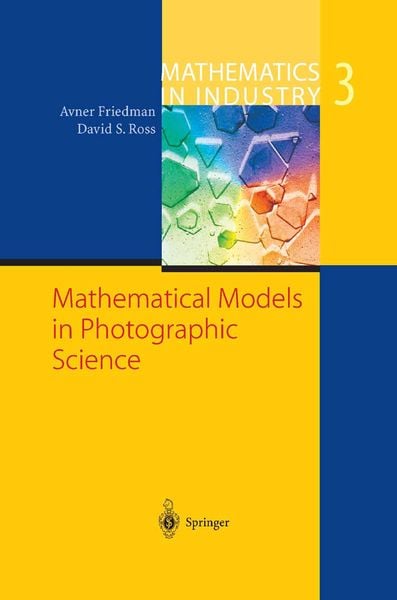
Mathematical Models in Photographic Science

Aus der Reihe Mathematics in Industry

Fr. 73.90

inkl. gesetzl. MwSt., Versandkostenfrei


Beschreibung

Produktdetails

Einband

Gebundene Ausgabe

Erscheinungsdatum

11.12.2002

Verlag

Springer Berlin

Seitenzahl

184

Maße (L/B/H)

24.1/16/1.6 cm

Gewicht

484 g

Auflage

Repr. d. Ausg. v. 2002

Sprache

Englisch

ISBN

978-3-540-44219-6

Beschreibung

Rezension

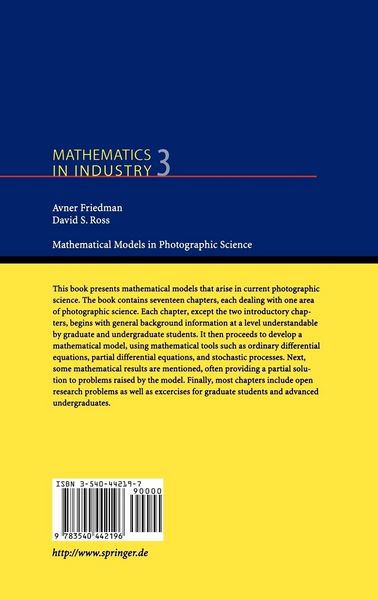
This book provides an interesting and well documented presentation of mathematical topics related to photographic sciences. [...] This is an attractive and easy to read book, which is characterized by a valuable (in the reviewer¿s opinion) feature: each chapter covers the whole path from the phenomenological analysis and interpretation of the real system, to modeling, statement of problems related to the application of models, an outline of qualitative analysis, and finally to perspectives and open problems.


This book is recommended to applied mathematicians interested in industrial mathematics and is intended for applications and the development of mathematical methods for problems generated from technology. It is also a good text for advanced university courses on mathematical modeling to be joined to courses on computational methods.


Applied mathematicians will find a description of open problems which are definitely challenging even for experienced mathematicians.


MathSciNet 2004. Nicola Bellomo (I-TRNP)

Produktdetails

Einband

Gebundene Ausgabe

Erscheinungsdatum

11.12.2002

Verlag

Springer Berlin

Seitenzahl

184

Maße (L/B/H)

24.1/16/1.6 cm

Gewicht

484 g

Auflage

Repr. d. Ausg. v. 2002

Sprache

Englisch

ISBN

978-3-540-44219-6

Herstelleradresse

Springer-Verlag GmbH
Tiergartenstr. 17
69121 Heidelberg
DE

Email: ProductSafety@springernature.com

Kundinnen und Kunden meinen

0 Bewertungen

Informationen zu Bewertungen

Zur Abgabe einer Bewertung ist eine Anmeldung im Konto notwendig. Die Authentizität der Bewertungen wird von uns nicht überprüft. Wir behalten uns vor, Bewertungstexte, die unseren Richtlinien widersprechen, entsprechend zu kürzen oder zu löschen.

Die Bewertungen sind nach Format, Anzahl Sterne und Datum sortiert.

Verfassen Sie die erste Bewertung zu diesem Artikel

Helfen Sie anderen Kund*innen durch Ihre Meinung

Kundinnen und Kunden meinen

0 Bewertungen filtern

  • Produktbild: Mathematical Models in Photographic Science
  • Produktbild: Mathematical Models in Photographic Science
  • 1. History of Photography.- References.- I. The Components of a Film.- 2. An Overview.- 3. Crystal Growth — Ostwald Ripening.- 3.1 The Model.- 3.2 Mathematical Analysis.- 3.3 A More General Model.- 3.4 Open Problems.- 3.5 Ostwald Ripening in a Colloidal Dispersion.- 3.6 Exercises.- References.- 4. Crystal Growth-Sidearm Precipitation.- 4.1 The Physical Model.- 4.2 Mathematical Model for CSTR Mixer.- 4.3 Mathematical Model for PFR Mixer.- 4.4 Mathematical Analysis.- 4.5 Open Problems.- 4.6 Exercises.- References.- 5. Gelatin Swelling.- 5.1 Introduction.- 5.2 A Mathematical Model.- 5.3 Mathematical Results.- 5.4 Open Problems.- References.- 6. Gelation.- 6.1 Introduction.- 6.2 The Model.- 6.3 Mathematical Analysis.- 6.4 Open Problems.- 6.5 Exercises.- References.- 7. Polymeric Base.- 7.1 Bending Recovery of Elastic Film.- 7.2 Viscoelastic Material.- 7.3 The Bending Recovery Function for t > tw.- 7.4 Exercises.- References.- II. The Role of Surfactants.- 8. Limited Coalescence.- 8.1 Introduction.- 8.2 The Model.- 8.3 Mathematical Results.- 8.4 Open Problems.- References.- 9. Measuring Coalescence.- 9.1 The Coalescence Problem.- 9.2 Introducing Chemiluminescent Species.- 9.3 Mathematical Results.- 9.4 Open Problems.- References.- III. Coating.- 10. Newtonian Coating Flows.- 10.1 The Mathematical Model.- 10.2 The Dynamic Contact Angle.- 10.3 Mathematical Results.- 10.4 Open Problems.- 10.5 Exercise.- References.- 11. Coating Configurations.- 11.1 An Extrusion Die.- 11.2 The Basic Model.- 11.3 Fluid Flow in the Slot.- 11.4 Design Problems.- 11.5 Exercise.- References.- 12. Curtain Coating.- 12.1 Reducing the Surface Tension.- 12.2 Measuring DST.- 12.3 Potential Flow Model of a Curtain.- 12.4 Time-Dependent Liquid Curtains.- 12.5 Open Problems.- 12.6 Exercises.- References.- 13. Shear Thinning.- 13.1 Motivation.- 13.2 Viscosity Divergence.- 13.3 Brownian Dynamics.- 13.4 Numerical Results.- 13.5 Future Directions.- References.- IV. Image Capture.- 14. Latent Image Formation.- 14.1 The Physical Model.- 14.2 Monte Carlo Simulation.- 14.3 An Alternative Approach.- References.- 15. Granularity.- 15.1 Transmittance and Granularity.- 15.2 Moments of the Transmission.- 15.3 Open Problems.- References.- V. Development.- 16. A Reaction-Diffusion System.- 16.1 The Development Process.- 16.2 A Mathematical Model.- 16.3 Homogenization.- 16.4 Edge Enhancement.- 16.5 Acutance.- 16.6 Open Problems.- 16.7 Exercises.- References.- 17. Parameter Identification.- 17.1 The Direct Problem.- 17.2 The Inverse Problems.- 17.3 A Solution to an Inverse Problem.- 17.4 Open Problems.- 17.5 Exercises.- References.