Band 1
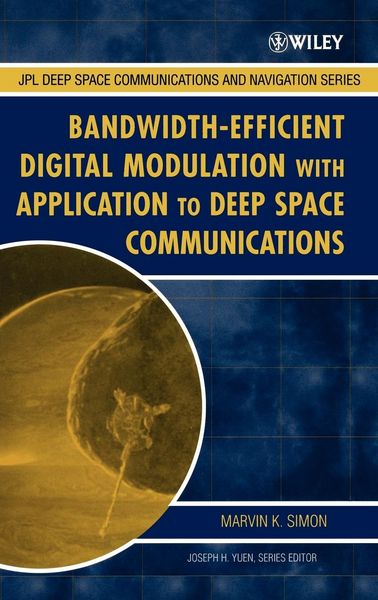
Bandwidth-Efficient Digital Modulation with Application to Deep-Space Communications Space Communication
Aus der Reihe
JPL Deep-Space Communications and Navigation Series
Fr. 303.00
inkl. gesetzl. MwSt.,
Beschreibung
Produktdetails
Einband
Gebundene Ausgabe
Erscheinungsdatum
05.02.2003
Herausgeber
Joseph H. YuenVerlag
John Wiley & SonsSeitenzahl
248
Maße (L/B/H)
24/16.1/1.8 cm
Gewicht
536 g
Auflage
1. Auflage
Sprache
Englisch
ISBN
978-0-471-44536-4
An important look at bandwidth-efficient modulations with applications to today's Space program
Based on research and results obtained at the California Institute of Technology's Jet Propulsion Laboratory, this timely book defines, describes, and then delineates the performance (power and bandwidth) of digital communication systems that incorporate a wide variety of bandwidth-efficient modulations appropriate for the design and implementation of space communications systems.
The author compares the performance of these systems in the presence of a number of practical (non-ideal) transmitter and receiver characteristics such as modulator and phase imbalance, imperfect carrier synchronization, and transmitter nonlinearity. Although the material focuses on the deep space applications developed at the Jet Propulsion Laboratory, the presentation is sufficiently broad as to be applicable to a host of other applications dealing with RF communications.
An important contribution to the scientific literature, Bandwidth-Efficient Digital Modulation with Application to Deep Space Communications
* was commissioned by the JPL Deep Space Communications and Navigation System Center of Excellence
* highlights many NASA-funded technical contributions pertaining to deep space communications systems
* is a part of the prestigious Deep Space Communications and Navigation Series
The Deep Space Communications and Navigation Series is authored by scientists and engineers with extensive experience in astronautics, communications, and related fields. It lays the foundation for innovation in the areas of deep space navigation and communications by disseminating state-of-the-art knowledge in key technologies.
Based on research and results obtained at the California Institute of Technology's Jet Propulsion Laboratory, this timely book defines, describes, and then delineates the performance (power and bandwidth) of digital communication systems that incorporate a wide variety of bandwidth-efficient modulations appropriate for the design and implementation of space communications systems.
The author compares the performance of these systems in the presence of a number of practical (non-ideal) transmitter and receiver characteristics such as modulator and phase imbalance, imperfect carrier synchronization, and transmitter nonlinearity. Although the material focuses on the deep space applications developed at the Jet Propulsion Laboratory, the presentation is sufficiently broad as to be applicable to a host of other applications dealing with RF communications.
An important contribution to the scientific literature, Bandwidth-Efficient Digital Modulation with Application to Deep Space Communications
* was commissioned by the JPL Deep Space Communications and Navigation System Center of Excellence
* highlights many NASA-funded technical contributions pertaining to deep space communications systems
* is a part of the prestigious Deep Space Communications and Navigation Series
The Deep Space Communications and Navigation Series is authored by scientists and engineers with extensive experience in astronautics, communications, and related fields. It lays the foundation for innovation in the areas of deep space navigation and communications by disseminating state-of-the-art knowledge in key technologies.
Noch keine Bewertungen vorhanden
Verfassen Sie die erste Bewertung zu diesem Artikel
Helfen Sie anderen Kundinnen und Kunden durch Ihre Meinung.