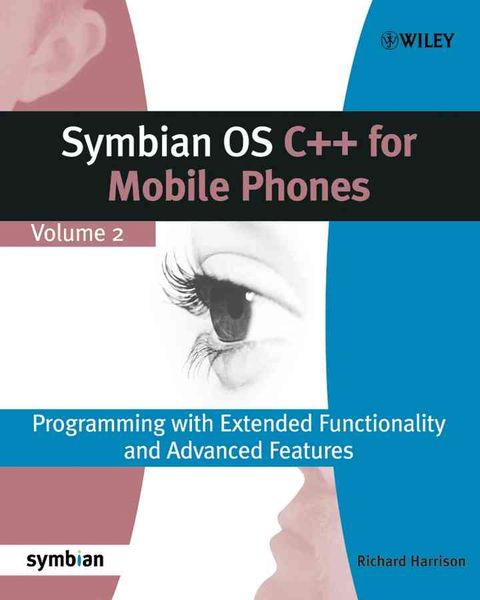
Produktbild: Symbian OS C++ for Mobile Phones, Volume 2
Band 1

Symbian OS C++ for Mobile Phones, Volume 2 Programming with Extended Functionality and Advanced Features

Aus der Reihe Symbian Press

Fr. 69.90

inkl. gesetzl. MwSt., Versandkostenfrei


Beschreibung

Produktdetails

Einband

Taschenbuch

Erscheinungsdatum

13.08.2004

Verlag

John Wiley & Sons

Seitenzahl

256

Maße (L/B/H)

23.4/18.9/2.6 cm

Gewicht

900 g

Auflage

1. Auflage

Sprache

Englisch

ISBN

978-0-470-87108-9

Beschreibung

Produktdetails

Einband

Taschenbuch

Erscheinungsdatum

13.08.2004

Verlag

John Wiley & Sons

Seitenzahl

256

Maße (L/B/H)

23.4/18.9/2.6 cm

Gewicht

900 g

Auflage

1. Auflage

Sprache

Englisch

ISBN

978-0-470-87108-9

Kundinnen und Kunden meinen

0 Bewertungen

Informationen zu Bewertungen

Zur Abgabe einer Bewertung ist eine Anmeldung im Konto notwendig. Die Authentizität der Bewertungen wird von uns nicht überprüft. Wir behalten uns vor, Bewertungstexte, die unseren Richtlinien widersprechen, entsprechend zu kürzen oder zu löschen.

Die Bewertungen sind nach Format, Anzahl Sterne und Datum sortiert.

Verfassen Sie die erste Bewertung zu diesem Artikel

Helfen Sie anderen Kund*innen durch Ihre Meinung

Kundinnen und Kunden meinen

0 Bewertungen filtern

  • Produktbild: Symbian OS C++ for Mobile Phones, Volume 2
  • Foreword.

    About this book.

    Innovation Through Openness.

    About the Authors.

    Acknowledgements.

    1. Symbian OS Fundamentals.

    1.1 Object Creation and Destruction.

    1.2 Error Handling and Cleanup.

    1.3 Naming Conventions.

    1.4 Descriptors.

    1.5 Active Objects.

    1.6 Summary.

    2. Symbian OS User Interfaces.

    2.1 Introduction.

    2.2 The Common Framework.

    2.3 The Screen Layout.

    2.4 Common UI Components.

    2.5 UI-specific Components.

    2.6 Skins.

    2.7 Handling User Input.

    2.8 Summary.

    3. A Running Application.

    3.1 Introduction.

    3.2 System Calls.

    3.3 Summary.

    4. Using Controls and Dialogs.

    4.1 What is a Control?

    4.2 Simple Controls.

    4.3 Compound Controls.

    4.4 Control Layout.

    4.5 Handling Key and Pointer Events.

    4.6 Observing a Control.

    4.7 Drawing a Control.

    4.8 Dialogs.

    4.9 More Complex Dialogs.

    4.10 Interface Class Usage in Dialogs.

    4.11 Custom Controls in Dialogs.

    4.12 Summary.

    5. Views and the View Architecture.

    5.1 Controlling Your Application with Views.

    5.2 View Architecture Components.

    5.3 Implementing Views.

    5.4 Creating Views.

    5.5 Registering Views.

    5.6 Switching Between Views.

    5.7 Deregistering Views.

    5.8 More on Views.

    5.9 View Specific Behavior on UIQ and Series 60 Platforms.

    5.10 Conclusion.

    5.11 Summary.

    6. Files and the Filing System.

    6.1 Filing System Services.

    6.2 Streams.

    6.3 Stores.

    6.4 Using INI Files.

    6.5 Resource Files and Bitmaps.

    7. Multimedia Services.

    7.1 The Multimedia Component Architecture.

    7.2 The Multimedia Framework (MMF).

    7.3 Using the MMF.

    7.4 Using Audio.

    7.5 Using Video.

    7.6 Controller Framework API.

    7.7 Using the ICL.

    7.8 Using Ecam.

    8. Comms and Messaging.

    7.1 Introduction.

    8.2 Overview of Symbian OS Comms Architecture.

    8.3 Protocol Support.

    8.4 MMS.

    8.5 Summary.

    9. Testing on Symbian OS.

    9.1 Code Coverage Analysis.

    9.2 Binary Compatibility Tool.

    9.3 Test Driver.

    9.4 Analyzing the Results.

    9.5 Sampling Profiler.

    9.6 Countloc - Measuring Source Code Size.

    9.7 Summary.

    Appendix 1. Example Projects.

    Appendix 2. Symbian OS System Model.

    Appendix 3. Writing Good Symbian OS Code.

    Appendix 4. Developer Resources.

    Appendix 5. Build Process Overview.

    Appendix 6. Specifications of Symbian OS Phones.

    Index.