• Produktbild: Patterns of Resource Allocation Decisions in Organisations
  • Produktbild: Patterns of Resource Allocation Decisions in Organisations
Band 53

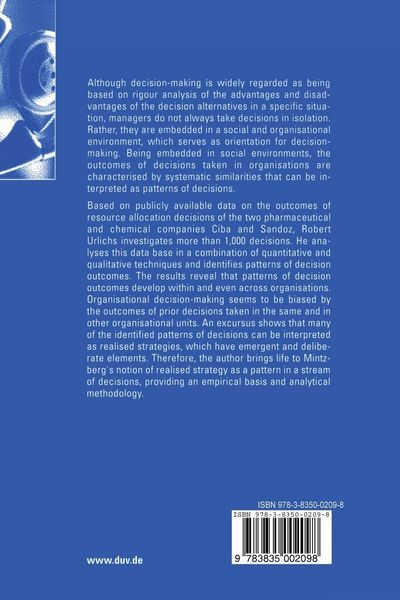
Patterns of Resource Allocation Decisions in Organisations Diss.

Fr. 73.90

inkl. gesetzl. MwSt., Versandkostenfrei


Beschreibung

Produktdetails

Einband

Taschenbuch

Erscheinungsdatum

25.11.2005

Abbildungen

XXI, 8 illus., schwarz-weiss Illustrationen

Verlag

Deutscher Universitätsverlag

Seitenzahl

246

Maße (L/B/H)

22.5/15.5/1.5 cm

Gewicht

400 g

Auflage

Softcover reprint of the original 1st edition 2005

Sprache

Englisch

ISBN

978-3-8350-0209-8

Beschreibung

Produktdetails

Einband

Taschenbuch

Erscheinungsdatum

25.11.2005

Abbildungen

XXI, 8 illus., schwarz-weiss Illustrationen

Verlag

Deutscher Universitätsverlag

Seitenzahl

246

Maße (L/B/H)

22.5/15.5/1.5 cm

Gewicht

400 g

Auflage

Softcover reprint of the original 1st edition 2005

Sprache

Englisch

ISBN

978-3-8350-0209-8

Herstelleradresse

Deutscher Universitätsvlg
Abraham-Lincoln-Str. 46
65189 Wiesbaden
DE

Email: ProductSafety@springernature.com

Kundinnen und Kunden meinen

0 Bewertungen

Informationen zu Bewertungen

Zur Abgabe einer Bewertung ist eine Anmeldung im Konto notwendig. Die Authentizität der Bewertungen wird von uns nicht überprüft. Wir behalten uns vor, Bewertungstexte, die unseren Richtlinien widersprechen, entsprechend zu kürzen oder zu löschen.

Die Bewertungen sind nach Format, Anzahl Sterne und Datum sortiert.

Verfassen Sie die erste Bewertung zu diesem Artikel

Helfen Sie anderen Kund*innen durch Ihre Meinung

Kundinnen und Kunden meinen

0 Bewertungen filtern

  • Produktbild: Patterns of Resource Allocation Decisions in Organisations
  • Produktbild: Patterns of Resource Allocation Decisions in Organisations
  • 1 Introduction.- 1.1 Problem and research objective.- 1.2 Research design.- 1.3 Structure of the thesis.- 2 Classical and behavioural perspectives on decisions-making.- 2.1 The classical perspective on individual decision-making.- 2.1.1 Assumptions in the classical perspective on decision-making.- 2.1.2 The decision-making process in the classical perspective.- 2.2 The behavioural perspective on individual decision-making.- 2.2.1 Bounded rationality.- 2.2.2 The behavioural process model of individual decision-making.- 2.2.3 Problem identification and information acquisition.- 2.2.3.1 Availability heuristic.- 2.2.3.2 Selective perception.- 2.2.4 Information processing and choice.- 2.2.4.1 Representativeness heuristic.- 2.2.4.2 Anchoring and adjustment and reasoning by analogy.- 2.2.4.3 Schemata and resolving cognitive dissonance.- 2.2.5 Decision-specific factors.- 2.2.6 Organisational and environmental factors.- 2.2.7 Summary and critical evaluation.- 2.3 The behavioural perspective on organisational decision-making.- 2.3.1 The behavioural process model of organisational decision-making.- 2.3.2 Problem identification and information acquisition.- 2.3.2.1 Problem sensitisation.- 2.3.2.2 Organisational attention.- 2.3.3 Information processing and choice.- 2.3.3.1 Decision-making in groups.- 2.3.3.2 Standard decision-making processes.- 2.3.3.3 Schemata in organisations.- 2.3.4 Decision-specific factors.- 2.3.5 Organisational and environmental factors.- 2.3.5.1 Organisational structures.- 2.3.5.2 Political forces.- 2.3.6 Summary and critical evaluation.- 3 Similarity and patterns of decision outcomes.- 3.1 Definitions of decision outcome, similarity and pattern.- 3.1.1 Definition of decision outcomes and their characteristics.- 3.1.2 Definition of similarity of decision outcomes.- 3.1.3 Definition of pattern of decision outcomes.- 3.1.4 Definition of development of patterns over time.- 3.2 Similarity and patterns in the classical perspective on decision-making.- 3.2.1 Similarity in the classical perspective on decision-making.- 3.2.1.1 Problem identification.- 3.2.1.2 Information acquisition, information processing and choice.- 3.2.1.3 Development of propositions.- 3.2.2 Patterns in the classical perspective on decision-making.- 3.2.2.1 Problem identification.- 3.2.2.2 Information acquisition, information processing and choice.- 3.2.2.3 Development of propositions.- 3.2.3 Development of patterns over time in the classical perspective on decision-making.- 3.2.3.1 Problem identification.- 3.2.3.2 Information acquisition, information processing and choice.- 3.2.3.3 Development of propositions.- 3.3 Similarity and patterns in the behavioural perspective on decision-making.- 3.3.1 Similarity in the behavioural perspective on decision-making.- 3.3.1.1 Problem identification.- 3.3.1.2 Information acquisition.- 3.3.1.3 Information processing and choice.- 3.3.1.4 Development of propositions.- 3.3.2 Patterns in the behavioural perspective on decision-making.- 3.3.2.1 Problem identification.- 3.3.2.2 Information acquisition.- 3.3.2.3 Information processing and choice.- 3.3.2.4 Development of propositions.- 3.3.3 Development of patterns over time in the behavioural perspective on decision-making.- 3.3.3.1 Problem identification.- 3.3.3.2 Information acquisition.- 3.3.3.3 Information processing and choice.- 3.3.3.4 Development of propositions.- 3.4 Excursus: Strategy and the perspectives on decision-making.- 3.4.1 Definition of strategy.- 3.4.2 Interpretation of patterns of decision outcomes as realised strategy.- 3.5 Summary.- 4 Research design, data and methods.- 4.1 Design of the case illustration.- 4.1.1 Research design.- 4.1.2 Introduction to the cases of Ciba and Sandoz.- 4.2 Data gathering and variables in the outside perspective on decisions.- 4.2.1 Introduction to the content analysis.- 4.2.2 Identification of resource allocation decisions.- 4.2.3 Variables and coding of data.- 4.2.3.1 Importance of coding of data.- 4.2.3.2 Variables and coding rules.- 4.2.3.3 Storing in database.- 4.2.4 Reliability and validity of data gathering.- 4.2.4.1 Reliability.- 4.2.4.2 Validity.- 4.3 Perspective of decision-makers on patterns of decisions.- 4.4 Analytical methods.- 4.4.1 Analysis of similarity of decision outcomes.- 4.4.1.1 Choice of similarity measure.- 4.4.1.2 Choice of variables to be included.- 4.4.1.3 Analysis of differences in level of similarity.- 4.4.2 Cluster analysis for identification of patterns of decision outcomes.- 4.4.2.1 Relevance of cluster analysis for the research question.- 4.4.2.2 Choice of similarity measure and variables to be included.- 4.4.2.3 Choice of clustering algorithm.- 4.4.2.4 Choice of number of clusters.- 4.4.2.5 Sensitivity analysis.- 4.4.3 Analysis of patterns of decision outcomes.- 4.4.3.1 Interpretation of clusters as patterns of decision outcomes.- 4.4.3.2 Patterns of decision outcomes across environmental and organisational factors.- 4.4.3.3 Analysis of development of patterns of decision outcomes over time.- 4.4.4 Analysis of interview transcripts.- 4.5 Summary and critical evaluation.- 5 Results.- 5.1 Results of similarity analysis.- 5.2 Results of cluster analysis.- 5.2.1 Cluster results.- 5.2.2 Results of the sensitivity analysis.- 5.3 Results of analysis of patterns of decision outcomes.- 5.3.1 Interpretation of clusters as patterns of decision outcomes.- 5.3.2 Patterns of decision outcomes across organisational and environmental factors.- 5.3.2.1 Environmental factors.- 5.3.2.2 Organisational factors.- 5.3.3 Development of patterns of decision outcomes over time.- 5.3.3.1 Frequency of decision outcomes over time.- 5.3.3.2 Similarity of decision outcomes over time.- 5.4 Summary of results.- 6 Discussion and implications.- 6.1 Discussion of results.- 6.1.1 Discussion of the classical perspective on decision-making.- 6.1.2 Discussion of the behavioural perspective on decision-making.- 6.1.3 Discussion of other perspectives on patterns of decision outcomes.- 6.2 Excursus: Discussion of strategy and the perspectives on decision-making.- 6.3 Theoretical and managerial implications.- 6.3.1 Theoretical implications.- 6.3.2 Managerial implications.- 7 Conclusion.- 7.1 Summary.- 7.2 Limitations of the research and options for future research.- Appendix A. Intercoder reliability for Novartis.- Appendix B. Means, standard deviations and correlations.- Appendix C. Interview guide.- References.