Band 61
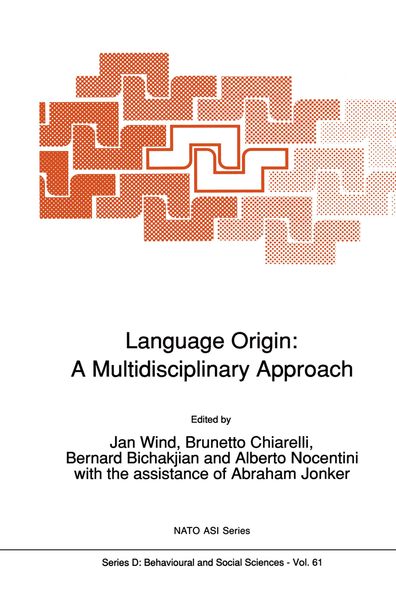
Language Origin: A Multidisciplinary Approach
Aus der Reihe
NATO Science Series D:
-
- Hardcover ausgewählt
- Taschenbuch
- eBook
-
Sprache:Englisch
Fr. 358.00
inkl. gesetzl. MwSt.,
Beschreibung
Produktdetails
Einband
Gebundene Ausgabe
Erscheinungsdatum
31.03.1992
Herausgeber
Jan Wind + weitereVerlag
Springer NetherlandSeitenzahl
558
Maße (L/B/H)
24.6/16.5/3.4 cm
Gewicht
998 g
Auflage
1991
Sprache
Englisch
ISBN
978-0-7923-1369-4
Language Origin: A Multidisciplinary Approach presents a synthesis of viewpoints and data on linguistic, psychological, anatomical and behavioral studies on living species of Primates and provides a comparative framework for the evaluation of paleoanthropological studies. This double endeavor makes it possible to direct new research on the nature and evolution of human language and cognition.
The book is directed to students of linguistics, biology, anthropoloy, anatomy, physiology, neurology, psychology, archeology, paleontology, and other related fields. A better understanding of speech pathology may stem from a better understanding of the relationship of human communication to the evolution of our species. The book is conceived as a timely contribution to such knowledge since it allows, for the first time, a systematic assessment of the origins of human language from a comprehensive array of scientific viewpoints.
The book is directed to students of linguistics, biology, anthropoloy, anatomy, physiology, neurology, psychology, archeology, paleontology, and other related fields. A better understanding of speech pathology may stem from a better understanding of the relationship of human communication to the evolution of our species. The book is conceived as a timely contribution to such knowledge since it allows, for the first time, a systematic assessment of the origins of human language from a comprehensive array of scientific viewpoints.
Kundinnen und Kunden meinen
Verfassen Sie die erste Bewertung zu diesem Artikel
Helfen Sie anderen Kund*innen durch Ihre Meinung