Band 422
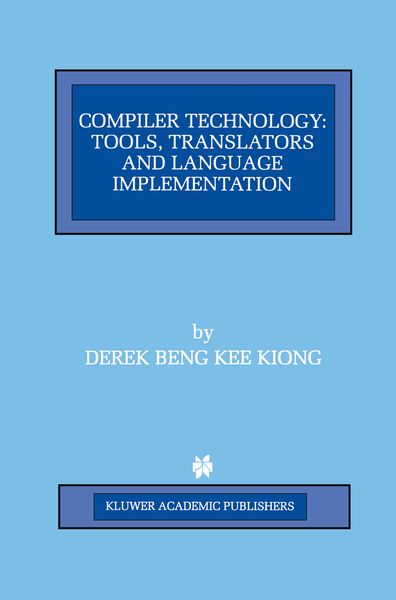
Compiler Technology Tools, Translators and Language Implementation
-
- Hardcover ausgewählt
- Taschenbuch
- eBook
-
Sprache:Englisch
Fr. 196.00
inkl. gesetzl. MwSt.,
Beschreibung
Produktdetails
Einband
Gebundene Ausgabe
Erscheinungsdatum
31.10.1997
Verlag
Springer UsSeitenzahl
210
Maße (L/B/H)
24.1/16/1.8 cm
Gewicht
518 g
Auflage
1. Auflage
Sprache
Englisch
ISBN
978-0-7923-8018-4
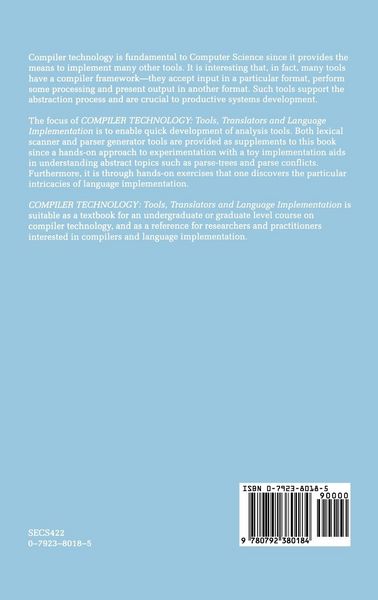
Compiler technology is fundamental to computer science since it provides the means to implement many other tools. It is interesting that, in fact, many tools have a compiler framework - they accept input in a particular format, perform some processing and present output in another format. Such tools support the abstraction process and are crucial to productive systems development.
The focus of Compiler Technology: Tools, Translators and Language Implementation is to enable quick development of analysis tools. Both lexical scanner and parser generator tools are provided as supplements to this book, since a hands-on approach to experimentation with a toy implementation aids in understanding abstract topics such as parse-trees and parse conflicts. Furthermore, it is through hands-on exercises that one discovers the particular intricacies of language implementation.
Compiler Technology: Tools, Translators and Language Implementation is suitable as a textbook for an undergraduate or graduate level course on compiler technology, and as a reference for researchers and practitioners interested in compilers and language implementation.
The focus of Compiler Technology: Tools, Translators and Language Implementation is to enable quick development of analysis tools. Both lexical scanner and parser generator tools are provided as supplements to this book, since a hands-on approach to experimentation with a toy implementation aids in understanding abstract topics such as parse-trees and parse conflicts. Furthermore, it is through hands-on exercises that one discovers the particular intricacies of language implementation.
Compiler Technology: Tools, Translators and Language Implementation is suitable as a textbook for an undergraduate or graduate level course on compiler technology, and as a reference for researchers and practitioners interested in compilers and language implementation.
Kundinnen und Kunden meinen
Verfassen Sie die erste Bewertung zu diesem Artikel
Helfen Sie anderen Kund*innen durch Ihre Meinung