Homogeneous Catalysis Understanding the Art
-
- Hardcover ausgewählt
- Taschenbuch
- eBook
-
Sprache:Englisch
Fr. 242.00
inkl. gesetzl. MwSt.,
Beschreibung
Produktdetails
Einband
Gebundene Ausgabe
Erscheinungsdatum
29.02.2004
Verlag
Springer NetherlandSeitenzahl
408
Maße (L/B/H)
24.1/16/2.8 cm
Gewicht
795 g
Auflage
2004
Sprache
Englisch
ISBN
978-1-4020-1999-9
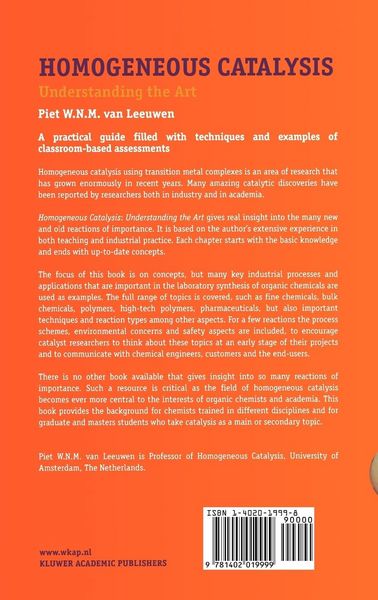
Homogeneous catalysis using transition metal complexes is an area of research that has grown enormously in recent years. Many amazing catalytic discoveries have been reported by researchers both in industry and in academia.
Homogeneous Catalysis: Understanding the Art gives real insight in the many new and old reactions of importance. It is based on the author's extensive experience in both teaching and industrial practice. Each chapter starts with the basic knowledge and ends with up-to-date concepts.
The focus of this book is on concepts, but many key industrial processes and applications that are important in the laboratory synthesis of organic chemicals are used as examples. The full range of topics is covered, such as fine chemicals, bulk chemicals, polymers, high-tech polymers, pharmaceuticals, but also important techniques and reaction types among other aspects. For a few reactions the process schemes, environmental concerns and safety aspects are included, to encourage catalyst researchers to think about these topics at an early stage of their projects and to communicate with chemical engineers, customers and the end-users.
Homogeneous Catalysis: Understanding the Art provides a balanced overview of the vibrant and growing field of homogeneous catalysis to chemists trained in different disciplines and to graduate students who take catalysis as a main or secondary subject. This book is an invaluable tool for practising professionals and academia, including:
- Chemists in academia with an inorganic, organic, catalytic, etc., chemistry background;
- PhD-students in these fields, and advanced students;
- Research Institutes of Petrochemical industries;
- Fine-chemical industries;
- Pharmaceutical industries;
- Chemical Laboratories of Universities for Organic, Industrial, Inorganic, and Physical Chemistry, and Catalysis;
- Graduate schools.
Currently, there is no other book available that gives insight into so many reactions of importance, while the field of homogeneous catalysis is becoming more and more important to organic chemists, industrial chemists, and academia. This book will provide this background to chemists trained in a different discipline and graduate and masters students who take catalysis as a main or secondary topic.
Noch keine Bewertungen vorhanden
Verfassen Sie die erste Bewertung zu diesem Artikel
Helfen Sie anderen Kundinnen und Kunden durch Ihre Meinung.