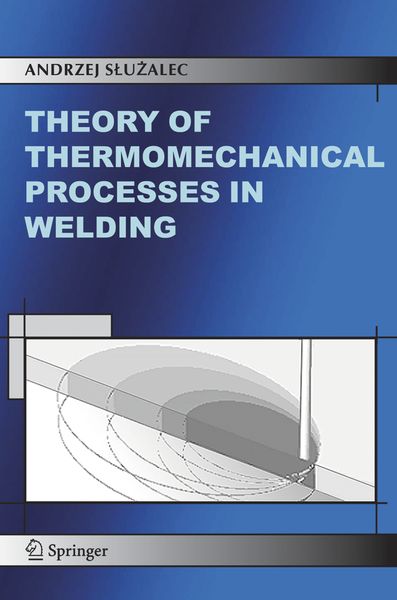
Theory of Thermomechanical Processes in Welding
-
- Hardcover ausgewählt
- Taschenbuch
-
Sprache:Englisch
Fr. 137.00
inkl. gesetzl. MwSt.,
Beschreibung
Produktdetails
Einband
Gebundene Ausgabe
Erscheinungsdatum
11.03.2005
Abbildungen
X, 85 illus., schwarz-weiss Illustrationen
Verlag
Springer NetherlandSeitenzahl
174
Maße (L/B/H)
24.1/16/1.5 cm
Gewicht
453 g
Auflage
2005
Sprache
Englisch
ISBN
978-1-4020-2990-5
The main purpose of this book is to provide a unified and systematic continuum approach to engineers and applied physicists working on models of deformable welding material. The key concept is to consider the welding material as an thennodynamic system. Significant achievements include thermodynamics, plasticity, fluid flow and numerical methods. Having chosen point of view, this work does not intend to reunite all the information on the welding thermomechanics. The attention is focused on the deformation of welding material and its coupling with thermal effects. Welding is the process where the interrelation of temperature and deformation appears throughout the influence of thermal field on material properties and modification of the extent of plastic zones. Thermal effects can be studied with coupled or uncoupled theories of thermomechanical response. A majority of welding problems can be satisfactorily studied within an uncoupled theory. In such an approach the temperature enters the stress-strain relation through the thennal dilatation and influences the material constants. The heat conduction equation and the relations governing the stress field are considered separately. In welding a material is either in solid or in solid and liquid states. The flow of metal and solidification phenomena make the welding process very complex. The automobile, aircraft, nuclear and ship industries are experiencing a rapidly-growing need for tools to handle welding problems. The effective solutions of complex problems in welding became possible in the last two decades, because of the vigorous development of numerical methods for thermal and mechanical analysis.
Noch keine Bewertungen vorhanden
Verfassen Sie die erste Bewertung zu diesem Artikel
Helfen Sie anderen Kundinnen und Kunden durch Ihre Meinung.