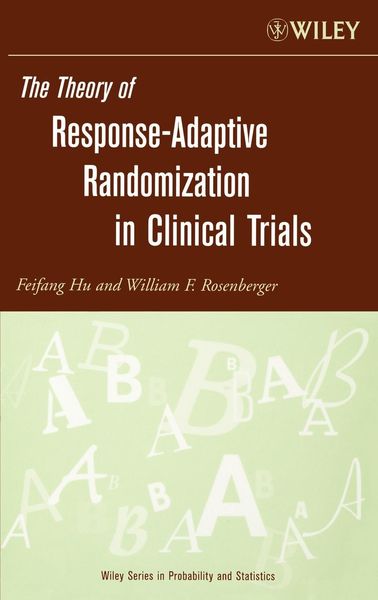
The Theory of Response-Adaptive Randomization in Clinical Trials
Aus der Reihe
Wiley Series in Probability and Statistics
Fr. 213.00
inkl. gesetzl. MwSt.,
Beschreibung
Produktdetails
Einband
Gebundene Ausgabe
Erscheinungsdatum
01.08.2006
Verlag
John Wiley & SonsSeitenzahl
256
Maße (L/B/H)
24/16.1/1.7 cm
Gewicht
522 g
Auflage
1. Auflage
Sprache
Englisch
ISBN
978-0-471-65396-7
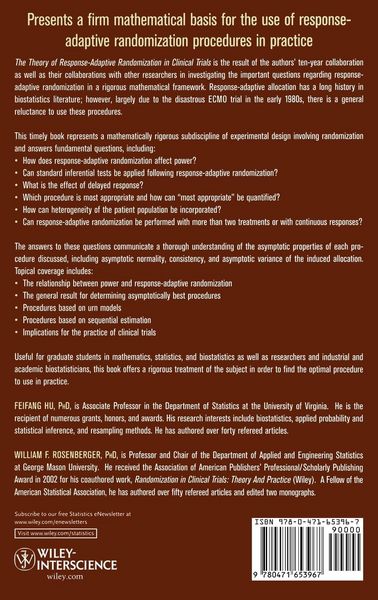
Presents a firm mathematical basis for the use of response-adaptive randomization procedures in practice
The Theory of Response-Adaptive Randomization in Clinical Trials is the result of the authors' ten-year collaboration as well as their collaborations with other researchers in investigating the important questions regarding response-adaptive randomization in a rigorous mathematical framework. Response-adaptive allocation has a long history in biostatistics literature; however, largely due to the disastrous ECMO trial in the early 1980s, there is a general reluctance to use these procedures.
This timely book represents a mathematically rigorous subdiscipline of experimental design involving randomization and answers fundamental questions, including:
* How does response-adaptive randomization affect power?
* Can standard inferential tests be applied following response-adaptive randomization?
* What is the effect of delayed response?
* Which procedure is most appropriate and how can "most appropriate" be quantified?
* How can heterogeneity of the patient population be incorporated?
* Can response-adaptive randomization be performed with more than two treatments or with continuous responses?
The answers to these questions communicate a thorough understanding of the asymptotic properties of each procedure discussed, including asymptotic normality, consistency, and asymptotic variance of the induced allocation. Topical coverage includes:
* The relationship between power and response-adaptive randomization
* The general result for determining asymptotically best procedures
* Procedures based on urn models
* Procedures based on sequential estimation
* Implications for the practice of clinical trials
Useful for graduate students in mathematics, statistics, and biostatistics as well as researchers and industrial and academic biostatisticians, this book offers a rigorous treatment of the subject in order to find the optimal procedure to use in practice.
The Theory of Response-Adaptive Randomization in Clinical Trials is the result of the authors' ten-year collaboration as well as their collaborations with other researchers in investigating the important questions regarding response-adaptive randomization in a rigorous mathematical framework. Response-adaptive allocation has a long history in biostatistics literature; however, largely due to the disastrous ECMO trial in the early 1980s, there is a general reluctance to use these procedures.
This timely book represents a mathematically rigorous subdiscipline of experimental design involving randomization and answers fundamental questions, including:
* How does response-adaptive randomization affect power?
* Can standard inferential tests be applied following response-adaptive randomization?
* What is the effect of delayed response?
* Which procedure is most appropriate and how can "most appropriate" be quantified?
* How can heterogeneity of the patient population be incorporated?
* Can response-adaptive randomization be performed with more than two treatments or with continuous responses?
The answers to these questions communicate a thorough understanding of the asymptotic properties of each procedure discussed, including asymptotic normality, consistency, and asymptotic variance of the induced allocation. Topical coverage includes:
* The relationship between power and response-adaptive randomization
* The general result for determining asymptotically best procedures
* Procedures based on urn models
* Procedures based on sequential estimation
* Implications for the practice of clinical trials
Useful for graduate students in mathematics, statistics, and biostatistics as well as researchers and industrial and academic biostatisticians, this book offers a rigorous treatment of the subject in order to find the optimal procedure to use in practice.
Noch keine Bewertungen vorhanden
Verfassen Sie die erste Bewertung zu diesem Artikel
Helfen Sie anderen Kundinnen und Kunden durch Ihre Meinung.