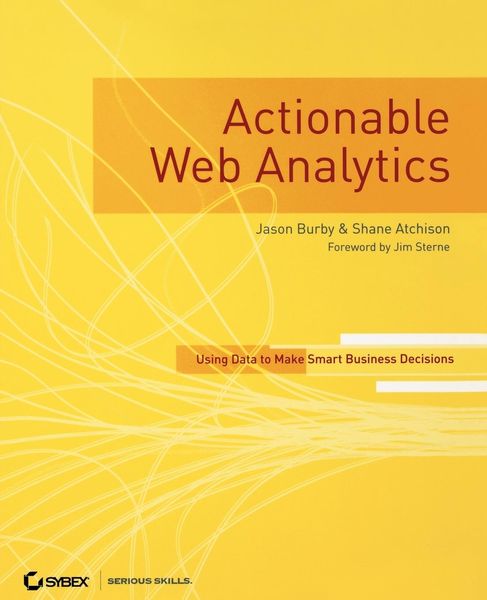
Actionable Web Analytics Using Data to Make Smart Business Decisions
-
- Taschenbuch ausgewählt
- eBook
-
Sprache:Englisch
Fr. 56.90
inkl. gesetzl. MwSt.,
Beschreibung
Produktdetails
Einband
Taschenbuch
Erscheinungsdatum
11.05.2007
Verlag
John Wiley & SonsSeitenzahl
288
Maße (L/B/H)
23.5/19.1/1.6 cm
Gewicht
546 g
Auflage
1. Auflage
Sprache
Englisch
ISBN
978-0-470-12474-1
Getting ROI from the Web Is Everyone's Job
Right now someone is clicking on your website, and knowing everything you can about those clicks and the people that make them is a business imperative. That's the first of a set of compelling business lessons distilled from the authors' decade of experience with the world's most powerful online brands. These lessons help executives, marketers, web managers, designers, and developers take action based on the actual behavior of site visitors.
This book is about the why, not just the how, of web analytics and the rules for developing a "culture of analysis" inside your organization. Why you should collect various types of data. Why you need a strategy. Why it must remain flexible. Why your data must generate meaningful action. Inside you'll learn to demonstrate real ROI from your website.
* Learn to use web analytics data to help make strategic decisions and set corporate goals
*
Ask the right questions when planning your website
*
Recognize how your data reflects the perceptions of your customers, information on your competitors, and your marketing costs
*
Develop criteria for choosing an agency to help you interpret your data
*
Discover how successful your marketing efforts have been
*
Create a culture of analysis within your organization
"Relationship marketing continues to evolve in new and exciting ways, and Actionable Web Analytics provides a clear and concise guidebook for the marketing executive. Burby and Atchison have captured the essence of creating relationships online, which lead to meaningful customer dialogues, and then measuring the success of those efforts."
--Lester Wunderman, Founder and Chairman Emeritus, Wunderman
"We have been fortunate enough during the past decade to see our business grow in parallel with and in partnership with the team at ZAAZ. As true thought leaders in the web analytics and marketing space, Burby and Atchison have captured the important issues facing marketers and business people every day and explained them eloquently in Actionable Web Analytics."
--Josh James, CEO and Co-Founder, Omniture
"Burby and Atchison have spent close to a decade helping a wide variety of companies optimize their advertising spend, supersize their website value, and maximize their online marketing ROI. These guys are in an amazing position to help you figure out all of the above. But that's just the half of it. While their position is nice, their scary IQ, their awesome curiosity, and their uncanny ability to drill down to bona fide business value make this book a must read."
--Jim Sterne, President of the Web Analytics Association and Producer of Emetrics Summit
Right now someone is clicking on your website, and knowing everything you can about those clicks and the people that make them is a business imperative. That's the first of a set of compelling business lessons distilled from the authors' decade of experience with the world's most powerful online brands. These lessons help executives, marketers, web managers, designers, and developers take action based on the actual behavior of site visitors.
This book is about the why, not just the how, of web analytics and the rules for developing a "culture of analysis" inside your organization. Why you should collect various types of data. Why you need a strategy. Why it must remain flexible. Why your data must generate meaningful action. Inside you'll learn to demonstrate real ROI from your website.
* Learn to use web analytics data to help make strategic decisions and set corporate goals
*
Ask the right questions when planning your website
*
Recognize how your data reflects the perceptions of your customers, information on your competitors, and your marketing costs
*
Develop criteria for choosing an agency to help you interpret your data
*
Discover how successful your marketing efforts have been
*
Create a culture of analysis within your organization
"Relationship marketing continues to evolve in new and exciting ways, and Actionable Web Analytics provides a clear and concise guidebook for the marketing executive. Burby and Atchison have captured the essence of creating relationships online, which lead to meaningful customer dialogues, and then measuring the success of those efforts."
--Lester Wunderman, Founder and Chairman Emeritus, Wunderman
"We have been fortunate enough during the past decade to see our business grow in parallel with and in partnership with the team at ZAAZ. As true thought leaders in the web analytics and marketing space, Burby and Atchison have captured the important issues facing marketers and business people every day and explained them eloquently in Actionable Web Analytics."
--Josh James, CEO and Co-Founder, Omniture
"Burby and Atchison have spent close to a decade helping a wide variety of companies optimize their advertising spend, supersize their website value, and maximize their online marketing ROI. These guys are in an amazing position to help you figure out all of the above. But that's just the half of it. While their position is nice, their scary IQ, their awesome curiosity, and their uncanny ability to drill down to bona fide business value make this book a must read."
--Jim Sterne, President of the Web Analytics Association and Producer of Emetrics Summit
Noch keine Bewertungen vorhanden
Verfassen Sie die erste Bewertung zu diesem Artikel
Helfen Sie anderen Kundinnen und Kunden durch Ihre Meinung.