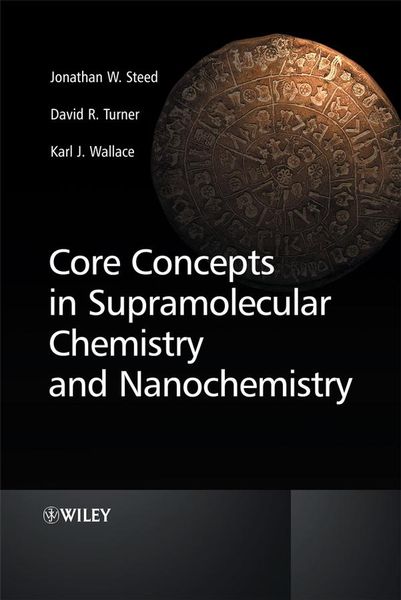
Core Concepts in Supramolecular Chemistry and Nanochemistry From Supramolecules to Nanotechnology
-
- Hardcover ausgewählt
- Taschenbuch
- eBook
-
Sprache:Englisch
Fr. 213.00
inkl. gesetzl. MwSt.,
Beschreibung
Produktdetails
Einband
Gebundene Ausgabe
Erscheinungsdatum
01.05.2007
Verlag
John Wiley & SonsSeitenzahl
320
Maße (L/B/H)
24.8/17.4/2.4 cm
Gewicht
744 g
Auflage
1. Auflage
Sprache
Englisch
ISBN
978-0-470-85866-0
Supramolecular chemistry and nanochemistry are two strongly interrelated cutting edge frontiers in research in the chemical sciences. The results of recent work in the area are now an increasing part of modern degree courses and hugely important to researchers.
Core Concepts in Supramolecular Chemistry and Nanochemistry clearly outlines the fundamentals that underlie supramolecular chemistry and nanochemistry and takes an umbrella view of the whole area. This concise textbook traces the fascinating modern practice of the chemistry of the non-covalent bond from its fundamental origins through to it expression in the emergence of nanochemistry.
Fusing synthetic materials and supramolecular chemistry with crystal engineering and the emerging principles of nanotechnology, the book is an ideal introduction to current chemical thought for researchers and a superb resource for students entering these exciting areas for the first time. The book builds from first principles rather than adopting a review style and includes key references to guide the reader through influential work.
* supplementary website featuring powerpoint slides of the figures in the book
* further references in each chapter
* builds from first principles rather than adopting a review style
* includes chapter on nanochemistry clear diagrams to highlight basic principles.
Core Concepts in Supramolecular Chemistry and Nanochemistry clearly outlines the fundamentals that underlie supramolecular chemistry and nanochemistry and takes an umbrella view of the whole area. This concise textbook traces the fascinating modern practice of the chemistry of the non-covalent bond from its fundamental origins through to it expression in the emergence of nanochemistry.
Fusing synthetic materials and supramolecular chemistry with crystal engineering and the emerging principles of nanotechnology, the book is an ideal introduction to current chemical thought for researchers and a superb resource for students entering these exciting areas for the first time. The book builds from first principles rather than adopting a review style and includes key references to guide the reader through influential work.
* supplementary website featuring powerpoint slides of the figures in the book
* further references in each chapter
* builds from first principles rather than adopting a review style
* includes chapter on nanochemistry clear diagrams to highlight basic principles.
Noch keine Bewertungen vorhanden
Verfassen Sie die erste Bewertung zu diesem Artikel
Helfen Sie anderen Kundinnen und Kunden durch Ihre Meinung.