Gutscheinbedingungen

*Gültig bis 05.07.2026 auf (fast) alles. Ausgeschlossen sind Smartboxen, Zeitschriften, Tickets, Lebensmittel, Gaming-Elektroartikel, Tinte/Toner, Gutscheine, Geschenkkarten, Blumen und Abos | Einlösbar in allen Buchhandlungen von Orell Füssli, Barth Bücher, Buchladen Rapunzel, Papeterie Köhler, Schuler Orell Füssli, Stauffacher und ZAP unter Vorweisung des Gutscheins, auf www.orellfüssli.ch durch Eingabe des Gutscheincodes. Beim Service „eBooks verschenken“ und bei eBook-Käufen via eReader nicht einlösbar | Mindesteinkaufswert: Fr. 30.- | Nicht mit anderen Rabatten kumulierbar.

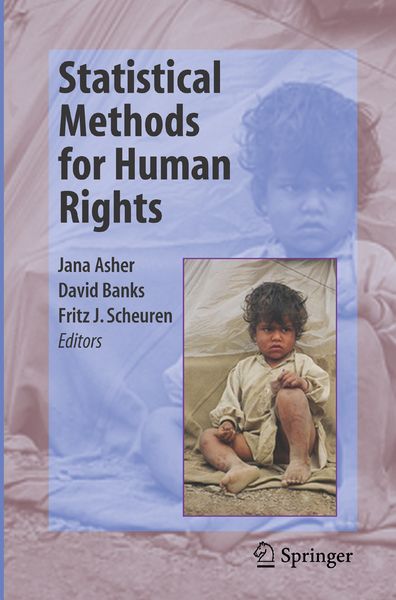
Produktbild: Statistical Methods for Human Rights

Statistical Methods for Human Rights

Fr. 73.90

inkl. gesetzl. MwSt., Versandkostenfrei


Beschreibung

Produktdetails

Einband

Taschenbuch

Erscheinungsdatum

14.12.2007

Herausgeber

Jana Asher + weitere

Verlag

Springer Us

Seitenzahl

339

Maße (L/B/H)

23.5/15.5/2 cm

Gewicht

506 g

Auflage

2008

Sprache

Englisch

ISBN

978-0-387-72836-0

Beschreibung

Rezension

From the reviews:


"A good compilation of representative work in the area of large-scale human rights violations. It offers interested readers the background knowledge needed to understand some historical events, as well as some successful applications or new developments in addressing the analysis of these types of events. Although written more for statisticians and social scientists interested in documenting and detecting human rights violations, this book can be useful reading for those more interested in ethical or political advocacy for known victims of these violations." (Francis C. Staskon, PsycCRITIQUES, Vol. 53 (39), 2008)


"This book describes the statistics that underlie the social science research in human rights. It includes case studies, methodology, and research papers that discuss the fundamental measurement issues. It is intended as an introduction to applied human rights research." (Alette Smeulers and Lotte Hoek, Criminology and International Crimes Newsletter,
3,
1, p.6)


"The book is full of interesting and useful examples to use when teaching statistics, particularly for the social science students. The chapters contain a summary/conclusion at the end and a wealth of references for the reader to pursue.… A useful book with statistics that helps researchers in their approach to present and measure human rights issues with clarity. (Susan Starkings, International Statistical Review,
76
, 2, p. 328)


"While the stories are fascinating, the book also contains a remarkable collection of innovative methods, most likely applicable to many other topics.... They advocate the development of new statistical techniques to estimate program impacts;... encompassing the larger topics of evidence-based decision-making. Their bibliography and listing of Web resources is extensive.... (Douglas Samuelson, ORMS Today,
35
, 1, p. 36-39)


"This collection of 13 articles(chapters) by 29 authors provides, from a statistician’s vantage point, a historical overview plus a contemporary snapshot of international human-rights issues. … For a novice, the book may also serve as a general introduction to historical, organizational, and conceptual human rights matters; for an expert, it is a fine general reference work … . Everyone interested in the statistics of human rights needs a copy of this work." (Paul L. Zador, Journal of the American Statistical Association, Vol. 103 (484), December, 2008)

Produktdetails

Einband

Taschenbuch

Erscheinungsdatum

14.12.2007

Herausgeber

Verlag

Springer Us

Seitenzahl

339

Maße (L/B/H)

23.5/15.5/2 cm

Gewicht

506 g

Auflage

2008

Sprache

Englisch

ISBN

978-0-387-72836-0

Herstelleradresse

Springer-Verlag KG
Sachsenplatz 4-6
1201 Wien
AT

Email: GPSR Kontakt

Noch keine Bewertungen vorhanden

Verfassen Sie die erste Bewertung zu diesem Artikel

Helfen Sie anderen Kundinnen und Kunden durch Ihre Meinung.

Kundinnen und Kunden meinen

Bewertungen (0)

  • Produktbild: Statistical Methods for Human Rights
  • Statistical Thinking on Human Rights Topics.- The Statistics of Genocide.- Why Estimate Direct and Indirect Casualties from War? The Rule of Proportionality and Casualty Estimates.- Statistical Thinking and Data Analysis: Enhancing Human Rights Work.- Recent Projects.- Hidden in Plain Sight: X.X. Burials and the Desaparecidos in the Department of Guatemala, 1977–1986.- The Demography of Conflict-Related Mortality in Timor-Leste (1974–1999): Reflections on Empirical Quantitative Measurement of Civilian Killings, Disappearances, and Famine-Related Deaths.- Afghan Refugee Camp Surveys in Pakistan, 2002.- Metagora: An Experiment in the Measurement of Democratic Governance.- History and Future Possibilities.- Human Rights of Statisticians and Statistics of Human Rights: Early History of the American Statistical Association’s Committee on Scientific Freedom and Human Rights.- Obtaining Evidence for the International Criminal Court Using Data and Quantitative Analysis.- New Issues in Human Rights Statistics.- Statistics and the Millennium Development Goals.- A FinalWord of Warning.- Using Population Data Systems to Target Vulnerable Population Subgroups and Individuals: Issues and Incidents.