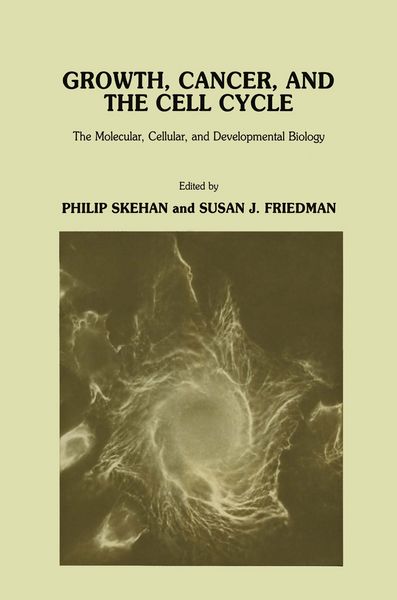
Growth, Cancer, and the Cell Cycle The Molecular, Cellular, and Developmental Biology
-
- Hardcover ausgewählt
- Taschenbuch
-
Sprache:Englisch
Fr. 143.00
inkl. gesetzl. MwSt.,
Beschreibung
Produktdetails
Einband
Gebundene Ausgabe
Erscheinungsdatum
30.11.1984
Verlag
Humana PressSeitenzahl
354
Maße (L/B/H)
23.4/15.6/2.2 cm
Gewicht
698 g
Auflage
1984
Sprache
Englisch
ISBN
978-0-89603-071-8
Cell growth, one of the most fundamental of biological processes, has long been among the least understood. On April 24-28, 1984 sci entists convened from around the world in Canada's Banff National Park for The International Cell Cycle Society's 10th Conference. Their purpose was to evaluate recent developments in the field of cell prolif eration and to explore the interrelationship between cell growth, de velopment, and differentiation, and proliferative diseases such as can cer. Growth, Cancer, and the Cell Cycle collects those conference papers that present the most recent advances in this field. The first section of the book is Gene Expression and Development During Growth. It examines the structure and function of chromatin, DNA unwinding proteins, and nonhistone nuclear proteins, then ex plores transcriptional, translational, and post-translational regulation during the cell cycle and the interrelationship and coordinate regula tion of cell growth, differentiation, and gene expression. The second section, Growth Activation and Dormancy, focuses upon the events that occur during the transition between active cell growth and proliferative quiescence. The role of DNA strand breaks, protein kinase activity, growth regulatory factors, and the cytoskeleton are examined. Section three discusses The Topology of the Cell Cycle. It reviews genetic approaches for determining the sequence of events and cau sality relationships that comprise and coordinate the many separate processes involved in cell cycle progression and describes the use of multipara meter flow cytometry to characterize the mammalian cell cy cle and intracellular metabolic and transitional growth states.
Kundinnen und Kunden meinen
Verfassen Sie die erste Bewertung zu diesem Artikel
Helfen Sie anderen Kund*innen durch Ihre Meinung