Gutscheinbedingungen

*Gültig bis 05.07.2026 auf (fast) alles. Ausgeschlossen sind Smartboxen, Zeitschriften, Tickets, Lebensmittel, Gaming-Elektroartikel, Tinte/Toner, Gutscheine, Geschenkkarten, Blumen und Abos | Einlösbar in allen Buchhandlungen von Orell Füssli, Barth Bücher, Buchladen Rapunzel, Papeterie Köhler, Schuler Orell Füssli, Stauffacher und ZAP unter Vorweisung des Gutscheins, auf www.orellfüssli.ch durch Eingabe des Gutscheincodes. Beim Service „eBooks verschenken“ und bei eBook-Käufen via eReader nicht einlösbar | Mindesteinkaufswert: Fr. 30.- | Nicht mit anderen Rabatten kumulierbar.

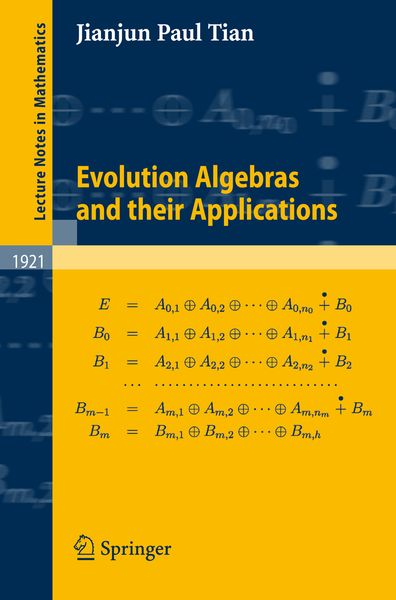
  • Produktbild: Evolution Algebras and their Applications
  • Produktbild: Evolution Algebras and their Applications
Band 1921

Evolution Algebras and their Applications

Fr. 73.90

inkl. gesetzl. MwSt., Versandkostenfrei


Beschreibung

Produktdetails

Einband

Taschenbuch

Erscheinungsdatum

18.10.2007

Verlag

Springer Berlin

Seitenzahl

133

Maße (L/B/H)

23.5/15.5/0.9 cm

Gewicht

230 g

Auflage

2008

Sprache

Englisch

ISBN

978-3-540-74283-8

Beschreibung

Rezension

From the reviews:


"The book introduces a new class of nonassociative algebras, called evolution algebras, and discusses in detail many applications of evolution algebras in stochastic processes and genetics. … The book under review is suitable both for graduate students and researchers with interest in the theoretical biology, genetics, Markov process, graph theory, and nonassociative algebras and their applications. The text contains a clear, detailed and self-contained exposition of evolution algebras."(Fouad Zitan, Zentralblatt MATH, Vol. 1136 (14), 2008)

Produktdetails

Einband

Taschenbuch

Erscheinungsdatum

18.10.2007

Verlag

Springer Berlin

Seitenzahl

133

Maße (L/B/H)

23.5/15.5/0.9 cm

Gewicht

230 g

Auflage

2008

Sprache

Englisch

ISBN

978-3-540-74283-8

Herstelleradresse

Springer-Verlag KG
Sachsenplatz 4-6
1201 Wien
AT

Email: GPSR Kontakt

Noch keine Bewertungen vorhanden

Verfassen Sie die erste Bewertung zu diesem Artikel

Helfen Sie anderen Kundinnen und Kunden durch Ihre Meinung.

Kundinnen und Kunden meinen

Bewertungen (0)

  • Produktbild: Evolution Algebras and their Applications
  • Produktbild: Evolution Algebras and their Applications
  • 1. Introduction 2. Motivations 2.1. Examples from Biology 2.1.1 Asexual propagation 2.1.2. Gametic algebras in asexual inheritance 2.1.3. The Wright-Fisher model 2.2. Examples from Physics 2.2.1. Particles moving in a discrete space 2.2.2. Flows in a discrete space (networks) 2.2.3. Feynman graphs 2.3. Examples from Topology 2.3.1. Motions of particles in a 3-manifold 2.3.2. Random walks on braids with negative probabilities 2.4. Examples from Probability Theory 2.4.1. Stochastic processes 3. Evolution Algebras 3.1. Definitions and Basic Properties 3.1.1. Departure point 3.1.2. Existence of unity elements 3.1.3. Basic definitions 3.1.4. Ideals of an evolution algebra 3.1.5. Quotients of an evolution algebra 3.1.6. Occurrence relations 3.1.7. Several interesting identities 3.2. Evolution Operators and Multiplication Algebras 3.2.1. Evolution operators 3.2.2. Change of generator sets (Transformations of natural bases) 3.2.3. 'Rigidness' of generator sets of an evolution algebra 3.2.4. The automorphism group of an evolution algebra 3.2.5. The multiplication algebra of an evolution algebra 3.2.6. The derived Lie algebra of an evolution algebra 3.2.7. The centroid of an evolution algebra 3.3. Non-associative Banach Algebras 3.3.1. Definition of a norm over an evolution algebra 3.3.2. An evolution algebra as a Banach space 3.4. Periodicity and Algebraic Persistency 3.4.1. Periodicity of a generator in an evolution algebra 3.4.2. Algebraic persistency and algebraic transiency 3.5. Hierarchy of an Evolution Algebra 3.5.1. Periodicity of a simple evolution algebra 3.5.2. Semi-direct-sum decomposition of an evolution algebra 3.5.3. Hierarchy of an evolution algebra 3.5.4. Reducibility of an evolution algebra 4. Evolution Algebras and Markov Chains 4.1. Markov Chain and Its Evolution Algebra 4.1.1. Markov chains (discrete time) 4.1.2. The evolution algebra determined by a Markov chain 4.1.3. The Chapman-Kolmogorov equation 4.1.4. Concepts related to evolution operators 4.1.5. Basic algebraic properties of Markov chains 4.2. Algebraic Persistency and Probabilistic Persistency 4.2.1. Destination operator of evolution algebra M(X) 4.2.2. On the loss of coefficients (probabilities) 4.2.3. On the conservation of coefficients (probabilities) 4.2.4. Certain interpretations 4.2.5. Algebraic periodicity and probabilistic periodicity 4.3. Spectrum Theory of Evolution Algebras 4.3.1. Invariance of a probability flow 4.3.2. Spectrum of a simple evolution algebra 4.3.3. Spectrum of an evolution algebra at zero-th level 4.4. Hierarchies of General Markov Chains and Beyond 4.4.1. Hierarchy of a general Markov chain 4.4.2. Structure at the 0-th level in a hierarchy 4.4.3. 1-th structure of a hierarchy 4.4.4. k-th structure of a hierarchy 4.4.5. Regular evolution algebras 4.4.6. Reduced structure of evolution algebra M(X) 4.4.7. Examples and applications 5. Evolution Algebras and Non-Mendelian Genetics 5.1. History of General Genetic Algebras 5.2. Non-Mendelian Genetics and Its Algebraic Formulation 5.2.1. Some terms in population genetics 5.2.2. Mendelian versus non-Mendelian genetics 5.2.3. Algebraic formulation of non-Mendelian genetics 5.3. Algebras of Organelle Population Genetics 5.3.1. Heteroplasmy and homoplasmy 5.3.2. Coexistence of triplasmy 5.4. Algebraic Structures of Asexual Progenies of Phytophthora infestans 5.4.1. Basic bi