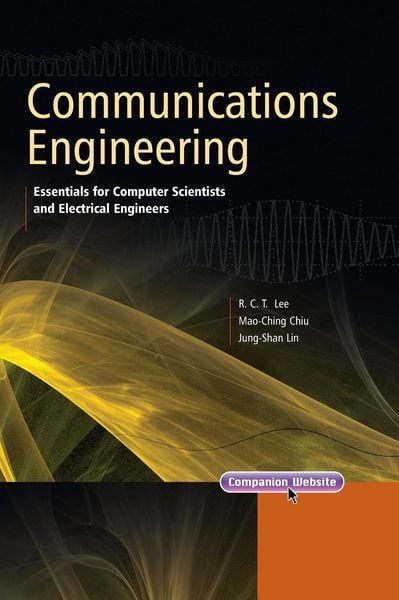
Communications Engineering Essentials for Computer Scientists and Electrical Engineers
Fr. 119.00
inkl. gesetzl. MwSt.,
Beschreibung
Produktdetails
Einband
Gebundene Ausgabe
Erscheinungsdatum
01.01.2008
Verlag
John Wiley & Sons IncSeitenzahl
240
Maße (L/B/H)
26/18.3/1.9 cm
Gewicht
626 g
Auflage
1. Auflage
Sprache
Englisch
ISBN
978-0-470-82245-6
Communications technologies increasingly pervade our everyday lives, yet the underlying principles are a mystery to most. Even among engineers and technicians, understanding of this complex subject remains limited. However, there is undeniably a growing need for all technology disciplines to gain intimate awareness of how their fields are affected by a more densely networked world.
The computer science field in particular is profoundly affected by the growing dominance of communications, and computer scientists must increasingly engage with electrical engineering concepts. Yet communications technology is often perceived as a challenging subject with a steep learning curve.
To address this need, the authors have transformed classroom-tested materials into this accessible textbook to give readers an intimate understanding of fundamental communications concepts. Readers are introduced to the key essentials, and each selected topic is discussed in detail to promote mastery. Engineers and computer scientists will gain an understanding of concepts that can be readily applied to their respective fields, as well as provide the foundation for more advanced study of communications.
* Provides a thorough grounding in the basics by focusing on select key concepts
* Clarifies comprehension of the subject via detailed explanation and illustration
* Helps develop an intuitive sense of both digital and analog principles
* Introduces key broadcasting, wireless and wired systems
* Helps bridge the knowledge gap between software and electrical engineering
* Requires only basic calculus and trigonometry skills
* Classroom tested in undergraduate CS and EE programs
Communications Engineering by Lee, Chiu, and Lin will give advanced undergraduates in computer science and beginning students of electrical engineering a rounded understanding of communications technologies. The book also serves as a key introduction to specialists in industry, or anyone who desires a working understanding of communications technologies.
The computer science field in particular is profoundly affected by the growing dominance of communications, and computer scientists must increasingly engage with electrical engineering concepts. Yet communications technology is often perceived as a challenging subject with a steep learning curve.
To address this need, the authors have transformed classroom-tested materials into this accessible textbook to give readers an intimate understanding of fundamental communications concepts. Readers are introduced to the key essentials, and each selected topic is discussed in detail to promote mastery. Engineers and computer scientists will gain an understanding of concepts that can be readily applied to their respective fields, as well as provide the foundation for more advanced study of communications.
* Provides a thorough grounding in the basics by focusing on select key concepts
* Clarifies comprehension of the subject via detailed explanation and illustration
* Helps develop an intuitive sense of both digital and analog principles
* Introduces key broadcasting, wireless and wired systems
* Helps bridge the knowledge gap between software and electrical engineering
* Requires only basic calculus and trigonometry skills
* Classroom tested in undergraduate CS and EE programs
Communications Engineering by Lee, Chiu, and Lin will give advanced undergraduates in computer science and beginning students of electrical engineering a rounded understanding of communications technologies. The book also serves as a key introduction to specialists in industry, or anyone who desires a working understanding of communications technologies.
Kundinnen und Kunden meinen
Verfassen Sie die erste Bewertung zu diesem Artikel
Helfen Sie anderen Kund*innen durch Ihre Meinung