• Produktbild: Medial Representations
  • Produktbild: Medial Representations
Band 37

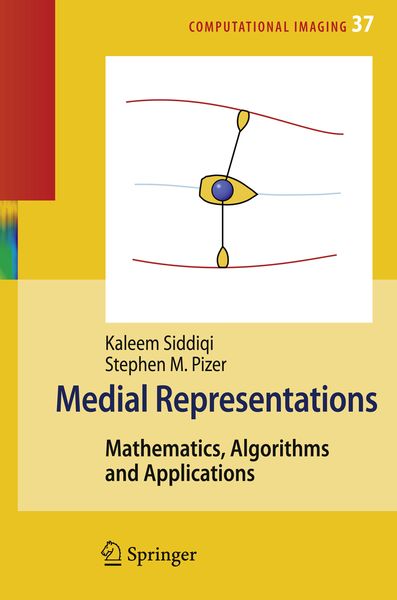
Medial Representations Mathematics, Algorithms and Applications

Fr. 73.90

inkl. gesetzl. MwSt., Versandkostenfrei


Beschreibung

Produktdetails

Einband

Gebundene Ausgabe

Erscheinungsdatum

29.10.2008

Herausgeber

Kaleem Siddiqi + weitere

Verlag

Springer Netherland

Seitenzahl

439

Maße (L/B/H)

24.1/16/3.3 cm

Gewicht

795 g

Auflage

2008

Sprache

Englisch

ISBN

978-1-4020-8657-1

Beschreibung

Produktdetails

Einband

Gebundene Ausgabe

Erscheinungsdatum

29.10.2008

Herausgeber

Verlag

Springer Netherland

Seitenzahl

439

Maße (L/B/H)

24.1/16/3.3 cm

Gewicht

795 g

Auflage

2008

Sprache

Englisch

ISBN

978-1-4020-8657-1

Herstelleradresse

Springer-Verlag GmbH
Tiergartenstr. 17
69121 Heidelberg
DE

Email: ProductSafety@springernature.com

Kundinnen und Kunden meinen

0 Bewertungen

Informationen zu Bewertungen

Zur Abgabe einer Bewertung ist eine Anmeldung im Konto notwendig. Die Authentizität der Bewertungen wird von uns nicht überprüft. Wir behalten uns vor, Bewertungstexte, die unseren Richtlinien widersprechen, entsprechend zu kürzen oder zu löschen.

Die Bewertungen sind nach Format, Anzahl Sterne und Datum sortiert.

Verfassen Sie die erste Bewertung zu diesem Artikel

Helfen Sie anderen Kund*innen durch Ihre Meinung

Kundinnen und Kunden meinen

0 Bewertungen filtern

  • Produktbild: Medial Representations
  • Produktbild: Medial Representations
  • 1. Introduction
    Stephen Pizer and Kaleem Siddiqi and Paul Yushkevich 1.1 Object representations 1.2 Medial representations of objects 1.2.1 The Definition of the Medial Locus 1.2.2 Structural Geometry of Medial Loci 1.2.3 Local Geometry of Medial Loci 1.2.4 Medial Atoms and M-Reps 1.3 Psychophysical and Neurophysiological Evidence for Medial Loci 1.4 Extracting Medial Loci of Objects 1.4.1 Distance Transforms, the Hessian, Thinning and Pruning 1.4.2 Skeletons via Shocks of Boundary Evolution 1.4.3 Greyscale Skeletons 1.4.4 Core Tracking 1.4.5 Skeletons from Digital Distance Transforms 1.4.6 Voronoi Skeletons 1.4.7 Skeletonization by Deformable Medial Models 1.5 Applications of medial loci in computer vision Part I Mathematics 2. Local Forms and Transitions of the Medial Axis
    Peter J. Giblin and Benjamin B. Kimia 2.1 Introduction 2.2 Definitions 2.3 Contact 2.4 Local forms of the symmetry set and medial axis in 2D 2.5 Local forms of the medial axis in 3D 2.6 Local reconstruction from the symmetry set or medial axis in 2D 2.7 Local reconstruction from the symmetry set or medial axis in 3D 2.8 Symmetry sets and medial axes of families of curves 2.9 Medial axes of families of surfaces 2.10 Consistency conditions at branches 2.11 Summary 3.Geometry and Medial Structure
    James Damon 3.1 Introduction 3.2 Medial Data on Skeletal Structures 3.2.1 Blum Medial Axis and General Skeletal Structures 3.2.2 Radial Flow Defined for a Skeletal Structure 3.2.3 Radial and Edge Shape Operators for 1D and 2D Medial Structures 3.2.4 Level Set Structure of a Region and Smoothness of the Boundary 3.3 Local and Relative Geometry of the Boundary 3.3.1 Intrinsic Differential Geometry of the Boundary 3.3.2 Geometric Medial Map 3.3.3 Deformations of Skeletal Structures and Boundary Smoothness and Geometry 3.4 Global Geometry of a Region and its Boundary 3.4.1 Skeletal and Medial Integrals 3.4.2 Global Integrals as Skeletal and Medial Integrals 3.4.3 Consequences for Global Geometry 3.4.4 Expansion of Integrals in terms of Moment Integrals 3.4.5 Divergence Theorem for Fluxes with Discontinuities across the Medial Axis 3.4.6 Computing the Average Outward Flux for the Grassfire Flow 3.5 Global Structure of the Medial Axis 3.5.1 Graph Structure for Decomposition into Irreducible Medial Components 3.5.2 Graph Structure of a Single Irreducible Medial Component 3.5.3 Consequences for the Topology of the Medial Axis and Region 3.6 Summary Part II Algorithms 4. Skeletons Via Shocks of Boundary Evolution
    Kaleem Siddiqi and Sylvain Bouix and Jayant Shah 4.1 Overview 4.2 Optics, Mechanics and Hamilton-Jacobi Skeletons 4.2.1 Medial Loci and the Eikonal Equation 4.2.2 Hamiltonian Derivation of the Eikonal Equation 4.2.3 Divergence, Average Outward Flux and Object Angle 4.3 Homotopy Preserving Medial Loci 4.3.1 2D Simple Points 4.3.2 3D Simple Points 4.3.3 Average Outward Flux Ordered Thinning 4.3.4 The Algorithm and its Complexity 4.3.5 Labeling the Medial Set 4.3.6 Examples 4.4 An Object Angle Approach 4.4.1 Examples 4.5 Discussion and Conclusion Discrete Skeletons from Distance Transforms in 2D and 3D
    Gunilla Borgefors and Ingela Nystrom and Gabriella Sanniti di Baja 5.1 Introduction 5.2 Definitions and Notions 5.3 Distance Transforms 5.3.1 2D Distance Transforms 5.3.2 3D Distance Transforms 5.3.3 Eu