• Produktbild: Who One Is
  • Produktbild: Who One Is
Band 190

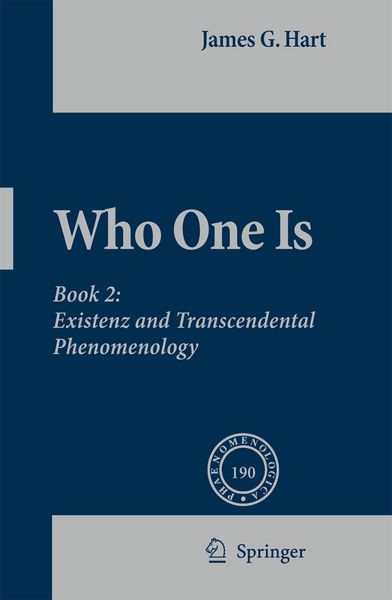
Who One Is Book 2: Existenz and Transcendental Phenomenology

Aus der Reihe Phaenomenologica

Fr. 242.00

inkl. gesetzl. MwSt., Versandkostenfrei


Beschreibung

Produktdetails

Einband

Gebundene Ausgabe

Erscheinungsdatum

08.05.2009

Verlag

Springer Netherland

Seitenzahl

649

Maße (L/B/H)

24.1/16/4.2 cm

Gewicht

1156 g

Auflage

2009

Sprache

Englisch

ISBN

978-1-4020-9177-3

Beschreibung

Rezension

From the reviews:
“James G. Hart’s … presents the results of several decades of research on self- and personhood, combining transcendental phenomenology and existential philosophy. … focuses on the core of the personal ‘I.’ Hart calls this core Existenz. … Hart has undoubtedly given us a thought-provoking study that enriches many ongoing debates and deserves increasing scholarly attention.Its two volumes belong to the most impressive, comprehensive, and innovative works in this field. I appreciate the breadth and insight of this work and heartily recommend it to anyone who wishes to learn more about who one is … .” (Claudia Welz, Philosophy Today, 2010)
" In this large two-volume book, James Hart offers the reader an insightful and comprehensive treatment of the perplexing manner in which we, each of us, are aware of our own selves. The book is comprehensive in two senses: in regard to the topics treated, and in regard to the authorities invoked. (...) His book could serve as a reference work for someone who wished to explore this topic and wanted to know how it has been treated in philosophical and theological traditions other than his own." (Robert Sokolowski, School of Philosophy, Catholic University of America)

Produktdetails

Einband

Gebundene Ausgabe

Erscheinungsdatum

08.05.2009

Verlag

Springer Netherland

Seitenzahl

649

Maße (L/B/H)

24.1/16/4.2 cm

Gewicht

1156 g

Auflage

2009

Sprache

Englisch

ISBN

978-1-4020-9177-3

Herstelleradresse

Springer-Verlag KG
Sachsenplatz 4-6
1201 Wien
AT

Email: GPSR Kontakt

Noch keine Bewertungen vorhanden

Verfassen Sie die erste Bewertung zu diesem Artikel

Helfen Sie anderen Kundinnen und Kunden durch Ihre Meinung.

Kundinnen und Kunden meinen

Bewertungen (0)

  • Produktbild: Who One Is
  • Produktbild: Who One Is
  • Preface: Transition from Book 1 and Prologue to Book 2
    Chapter I: Assenting to My Death and that of the Other

    1. My Death

    2. Inherent Obstacles to the Real Assent to My Mortality

    3. Death as Danger and Destiny

    4. The Meaning of the Annihilation of an Individual Essence

    5. The Secret of Death

    6. Ghosts, Corpses, and Homer on the Secret of Death
    Chapter II. Transcendental Attitude and the Mystery of Death

    1. The Mystery of Death and Ipseity

    2. Transcendental Attitude and the Mystery of “My Death”

    3. “My Death” and the Prospective Retrospection of “My Life”

    4. “My Death” as a Gathering Experience

    5. Transcendental Phenomenological Reflection on the Realization of “My Death”

    6. The Question of the Appropriateness of the Transcendental Attitude in the Realization of “My Death”

    7. Philosophy as Theoretic Analysis and as Preparation for Death
    Chapter III: Existenz, Conscience, and the Transcendental I

    1. Existenz as a Third-Person Reference to First-Person Experience

    2. Limit-Situations and Existenz

    3. Conscience and Ought

    4. The Problem of the Pure Conscience

    5. Conscience and the Center of the I

    6. Conscience, Existenz, and the Transcendental I

    7. Excursus: “I myself” and my Daimonion

    8. Excursus: The Illumination of Existenz and the Proustian-Stoic “Cataleptic Impression”
    Chapter IV: Ipseity and Teleology

    1. Freedom to Do and Not to Do What Must Be Done

    2. The Self-Inadequation of the Person

    3. Position-Taking Acts as the Medium of Personhood

    4. Self-Identifying Acts and the Moral Person

    5. Ipseity and Freedom

    6.Summary: Teleology of Personal Being

    7. A Sense in Which Who One Is Equates With What Sort of Person One Is

    8. The Sort of Person One Is and Freedom

    9. Who One Is and One’s Story
    Chapter V: The Calling of Existenz

    1. The Ideal True Self and the Metaphor of Vocation

    2. Truths of Will

    3. Love and Existenz

    4. Existenz, Love, and Communication

    5. Evidence for a Unique Calling: Husserl’s Example

    6. The Calling as Limit-Situation

    7. The Ontological End and the Purposes of the Person

    8. The Calling and the Analogous Love of the Self’s Essence
    Chapter VI: Philosophical Theology of Vocation. Part One: Historical Setting

    1. Plotinus: The Form of Socrates and the True Self

    2. Christianity: A Calling Before the Creation of the World

    3. Excursus: The Spiral of Spiritual Ascent in Sufism

    4. Some More Differences between Neo-Platonism and Christianity
    Chapter VII: Philosophical Theology of Vocation. Part Two: Systematic-Theological Synthesis

    1. Analogy, Exemplarism, and the Dogma of God the Creator

    2. Analogy, Exemplarism, and the Divine Master Builder

    3. Beginning Reflections on the Metaphysics of the Divine Exemplarity of the “Myself”

    4. Three Aspects Under Which An Eternal Idea or Essence Can Be Made Present

    5. Divine Awareness of the Unique Ipseity

    6. The Theological Distinction

    7. Wholes and Parts of The Theological Distinction

    8. The Absurd, Paradox, and The Theological Distinction

    9. Excursus on Prayer and the Stance of Faith

    10. The Analogy of Divine Self-Awareness and Intentionality

    11. Three Alternatives Avoided: Correlationism, Process Philosophy, and Monism

    12. Conclusion