Gutscheinbedingungen

*Gültig bis 05.07.2026 auf (fast) alles. Ausgeschlossen sind Smartboxen, Zeitschriften, Tickets, Lebensmittel, Gaming-Elektroartikel, Tinte/Toner, Gutscheine, Geschenkkarten, Blumen und Abos | Einlösbar in allen Buchhandlungen von Orell Füssli, Barth Bücher, Buchladen Rapunzel, Papeterie Köhler, Schuler Orell Füssli, Stauffacher und ZAP unter Vorweisung des Gutscheins, auf www.orellfüssli.ch durch Eingabe des Gutscheincodes. Beim Service „eBooks verschenken“ und bei eBook-Käufen via eReader nicht einlösbar | Mindesteinkaufswert: Fr. 30.- | Nicht mit anderen Rabatten kumulierbar.

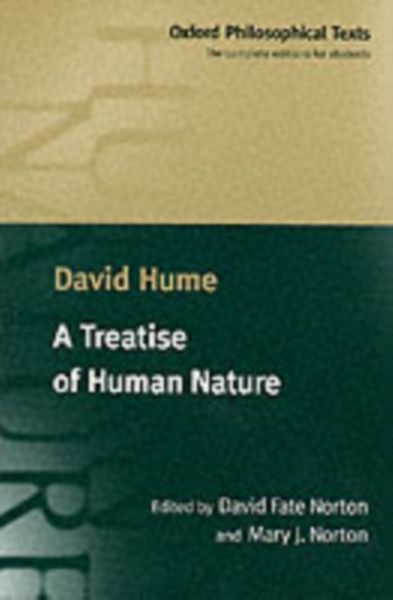
Produktbild: A Treatise of Human Nature

A Treatise of Human Nature Being an Attempt to Introduce the Experimental Method of Reasoning into Moral Subjects

Fr. 55.90

inkl. gesetzl. MwSt., Versandkostenfrei


Beschreibung

Produktdetails

Einband

Taschenbuch

Erscheinungsdatum

27.01.2000

Abbildungen

2 line illustrations

Herausgeber

Norton David Fate + weitere

Verlag

Oxford University Press

Seitenzahl

744

Maße (L/B/H)

23.4/15.5/3.8 cm

Gewicht

1104 g

Sprache

Englisch

ISBN

978-0-19-875172-4

Beschreibung

Rezension

These new Oxford University Press editions have been meticulously collated from various exatant versions. Each text has an excellent introduction including an overview of Hume's thought and an account of his life and times. Even the difficult, and rarely commented-on, chapters on space and time are elucidated. There are also useful notes on the text and glossary. These scholarly new editions are ideally adapted for a whole range of readers, from beginners to experts. Jane O'Grady, Catholic Herald,

Produktdetails

Einband

Taschenbuch

Erscheinungsdatum

27.01.2000

Abbildungen

2 line illustrations

Herausgeber

Verlag

Oxford University Press

Seitenzahl

744

Maße (L/B/H)

23.4/15.5/3.8 cm

Gewicht

1104 g

Sprache

Englisch

ISBN

978-0-19-875172-4

Noch keine Bewertungen vorhanden

Verfassen Sie die erste Bewertung zu diesem Artikel

Helfen Sie anderen Kundinnen und Kunden durch Ihre Meinung.

Kundinnen und Kunden meinen

Bewertungen (0)

  • Produktbild: A Treatise of Human Nature
    • PART 1: INTRODUCTORY MATERIAL

    • How to Use this Book

    • List of Abbreviations

    • Editor's Introduction

    • Hume's Early years and Education

    • A Treatise of Human Nature

    • The Experimental Method and the Science of Human Nature

    • Book 1: Of the Understanding

    • Book 1 part 1: The Elements of the Mental World

    • Perceptions

    • Relations

    • Abstract Ideas

    • Book 1 Part 2: The Ideas of Space and Time

    • Book 1 Part 3: Knowledge, Probability, Belief, and Causation

    • Relations Revisited

    • The Relation of Causation

    • Causes and Causal Reasoning

    • Experience and Belief

    • Belief in the Uniformity of Nature

    • The Idea of Necessary Connection

    • Book 1 Part 4: Forms of Scepticism

    • External Objects

    • Enduring Selves and Personal Identity

    • The Conclusion of Book 1

    • Book 2: Of the passions

    • The Productive Passions

    • The Responsive Passions

    • Book 2 Part 1: The Indirect Passions of Pride and Humility

    • The 'very essence' of Virtue and Beauty

    • Unexercised Powers

    • Sympathy

    • Book 2 Part 2: The Indirect Passions of Love and Hatred

    • Passions and the Principles of Association

    • The Compound Passions

    • Passions and Relations

    • Dispositions

    • Book 2 part 3: The Direct Passions and the Will

    • The Will and its Influences

    • The Direct Passions

    • Book 3: Of Morals

    • Book 3 Part 1: The Source of Moral Distinctions

    • The Failure of Reason

    • Moral Sentiments

    • Book 3 Part 2: The Artificial Virtues

    • Motives and Moral Qualities

    • Justice

    • Additional Artificial Virtues

    • Book 3 Part 3: Natural Virtues and Natural Abilities

    • Natural Virtues

    • Natural Abilities

    • The Conclusion of Book 3

    • The Abstract and the Early Reception of the Treatise

    • Supplementary Reading

    • A Note on the Texts of this Edition

    • PART 2: THE TEXT

    • Advertisement

    • Introduction

    • Book 1: Of the Understanding

    • Part 1: Of ideas, their origin, composition, connexion, abstraction, etc.

    • Sect. 1: Of the origin of our ideas

    • Sect. 2: Division of the subject

    • Sect. 3: Of the ideas of the memory and imagination

    • Sect. 4: Of the connexion of association of ideas

    • Sect. 5. Of relations

    • Sect. 6 Of modes and substances

    • Sect. 7: Of abstract ideas

    • Part 2: Of ideas of space and time

    • Sect. 1: Of the infinite divisibility of our ideas of space and time

    • Sect. 2: Of the infinite divisibility of space and time

    • Sect. 3. Of the other qualities of our ideas of space and time

    • Sect. 4. Objections answered

    • Sect. 5: The same subject continued

    • Sect. 6: Of the idea of existence and of external existence

    • Part 3: of knowledge and probability

    • Sect. 1: Of knowledge

    • Sect. 2. Of probability; and of the idea of cause and effect

    • Sect. 3: Why a cause is always necessary

    • Sect. 4: Of the component parts of our reasonings concerning cause and effect

    • Sect. 5: Of the impressions of the senses and memory

    • Section. 6: Of the inference from the impression to the idea

    • Sect. 7: Of the nature of the idea or belief

    • Sect. 8: Of the causes of belief

    • Sect. 9: Of the effects of other relations and other habits

    • Sect 10. Of the influence of belief

    • Sect. 11: Of the probability of chances

    • Sect. 12: Of the probability of causes

    • Sect. 13: Of unphilosophical probability

    • Sect. 14: Of the idea of necessary connexion

    • Sect. 15: Rules by which to judge of causes and effects

    • Sect. 16: Of the reason of animals

    • Part 4: Of the sceptical and other systems of philosophy

    • Sect. 1: Of scepticism with regard to reason

    • Sect. 2: Of scepticism with regard to the senses

    • Sect. 3. Of the ancient philosophy

    • Sect 4. Of the modern philosophy

    • Sect. 5: Of the immateriality of the soul

    • Sect. 6: Of personal identity

    • Sect. 7: Conclusion of this book

    • Book 2: Of the Passions

    • Part 1: Of pride and humility

    • Sect. 1: Division of the subject

    • Sect. 2: Of pride and humility; their objects and causes

    • Sect. 3: Whence these objects and causes are derived

    • Sect. 4: Of the relations of impressions and ideas

    • Sect. 5: Of the influence of these relations on pride and humility

    • Sect. 6: Limitations of this system

    • Sect. 7: Of vice and virtue

    • Sect. 8: Of beauty and deformity

    • Sect. 9: Of external advantages and disadvantages

    • Sect. 10: Of property and riches

    • Sect. 11: Of the love of fame

    • Sect. 12: Of the pride and humility of animals

    • Part 2: Of love and hatred

    • Sect. 1: Of the objects and causes of love and hatred

    • Sect. 2: Experiments to confirm this system

    • Sect. 3: Difficulties solved

    • Sect. 4: Of the love of relations

    • Sect. 5: Of our esteem for the rich and powerful

    • Sect 6: Of benevolence and anger

    • Sect. 7: Of compassion

    • Sect. 8: Of malice and envy

    • Sect. 9: Of the mixture of benevolence and anger with compassion and malice

    • Sect. 10. Of respect and contempt

    • Sect. 11: Of the amorous passion, or love betwixt the sexes

    • Sect. 12: Of the love and hatred of animals

    • Part 3: Of the will and direct passions

    • Sect. 1: Of liberty and necessity

    • Sect. 2: The same subject continued

    • Sect. 3: Of the influencing motives of the will

    • Sect. 4: Of the causes of the violent passions

    • Sect. 5: Of the effects of custom

    • Sect. Of the influence of the imagination on passions

    • Sect. 7: Of contiguity and distance in space and time

    • Sect. 8: The same subject continued

    • Sect. 9: Of the direct passions

    • Sect. 10: Of curiosity, or the love of truth

    • Book 3: Of Morals

    • Advertisement

    • Part 1: Of virtue and vice in general

    • Sect. 1: Moral distinctions not derived from reason

    • Sect. 2: Moral distinctions derived from a moral sense

    • Part 2: Of justice and injustice

    • Sect. 1: Justice, whether a natural or artificial virtue?

    • Sect. 2: Of the origin of justice and property

    • Sect. 3: Of the rules, which determine property

    • Sect. 4: Of the transference of property by consent

    • Sect. 5: Of the obligation of Hume conference flyer, Cambridge Sept 00 AP 14/10/00

    • Sect. 6: Some farther reflections concerning justice and injustice

    • Sect. 7: Of the origin of government

    • Sect. 8: Of the source of allegiance

    • Sect. 9: Of the measures of allegiance

    • Sect. 10: Of the objects of allegiance

    • Sect. 11: Of the laws of nations

    • Sect. 12: Of chastity and modesty

    • Part 3: Of the other virtues and vices

    • Sect. 1: Of the origin of the natural virtues and vices

    • Sect. 2: Of greatness of mind

    • Sect. 3. Of goodness and benevolence

    • Sect. 4: Of natural abilities

    • Sect. 5: Some farther reflections concerning the natural virtues

    • Sect. 6: Conclusion of this book

    • Appendix

    • An Abstract of ... A Treatise of Human Nature

    • PART 3 SUPPLEMENTARY MATERIAL

    • Editors' Annotations

    • Annotations to the Treatise

    • Annotations to the Abstract

    • Glossary

    • References

    • Index