• Produktbild: The Third Wave of Democratization in Latin America
  • Produktbild: The Third Wave of Democratization in Latin America

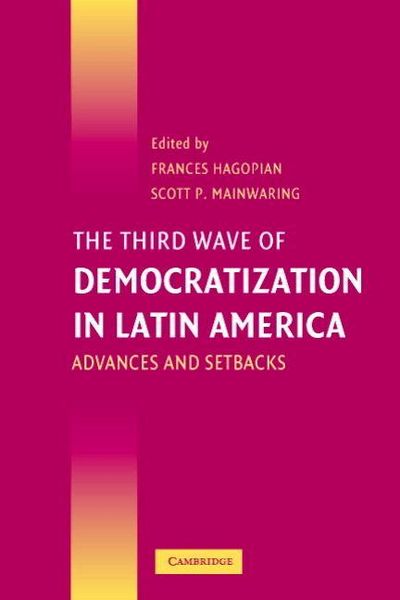
The Third Wave of Democratization in Latin America Advances and Setbacks

Fr. 48.90

inkl. gesetzl. MwSt., Versandkostenfrei


Beschreibung

Produktdetails

Einband

Taschenbuch

Erscheinungsdatum

18.01.2010

Herausgeber

Hagopian Frances + weitere

Verlag

Cambridge Academic

Seitenzahl

432

Maße (L/B/H)

23.4/15.6/2.3 cm

Gewicht

600 g

Sprache

Englisch

ISBN

978-0-521-61320-0

Beschreibung

Portrait

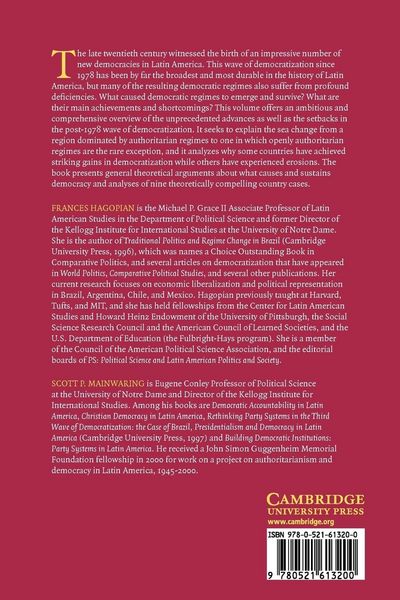
Frances Hagopian is the Michael P. Grace II Associate Professor of Latin American Studies in the Department of Political Science, and former Director of the Kellogg Institute for International Studies, at the University of Notre Dame. She is the author of Traditional Politics and Regime Change in Brazil (Cambridge University Press, 1996), which was named a Choice Outstanding Book in Comparative Politics, and several articles on democratization that have appeared in World Politics, Comparative Political Studies, and several other publications. Her current research focuses on economic liberalization and political representation in Brazil, Argentina, Chile, and Mexico. Hagopian previously taught at Harvard, Tufts, and MIT, and she has held fellowships from the Center for Latin American Studies and Howard Heinz Endowment of the University of Pittsburgh, the Social Science Research Council and the American Council of Learned Societies, and the U.S. Department of Education (the Fulbright-Hays program). She is a member of the Council of the American Political Science Association, and the editorial boards of PS: Political Science and Latin American Politics and Society.

Scott P. Mainwaring is Eugene Conley Professor of Political Science at the University of Notre Dame and Director of the Kellogg Institute for International Studies. Among his books are Democratic Accountability in Latin America, Christian Democracy in Latin America, Rethinking Party Systems in the Third Wave of Democratization: the Case of Brazil, Presidentialism and Democracy in Latin America (Cambridge University Press, 1997) and Building Democratic Institutions: Party Systems in Latin America. He received a John Simon Guggenheim Memorial Foundation fellowship in 2000 for work on a project on authoritarianism and democracy in Latin America, 1945–2000.

Produktdetails

Einband

Taschenbuch

Erscheinungsdatum

18.01.2010

Herausgeber

Verlag

Cambridge Academic

Seitenzahl

432

Maße (L/B/H)

23.4/15.6/2.3 cm

Gewicht

600 g

Sprache

Englisch

ISBN

978-0-521-61320-0

Herstelleradresse

Libri GmbH
Europaallee 1
36244 Bad Hersfeld
DE

Email: gpsr@libri.de

Noch keine Bewertungen vorhanden

Verfassen Sie die erste Bewertung zu diesem Artikel

Helfen Sie anderen Kundinnen und Kunden durch Ihre Meinung.

Kundinnen und Kunden meinen

Bewertungen (0)

  • Produktbild: The Third Wave of Democratization in Latin America
  • Produktbild: The Third Wave of Democratization in Latin America
  • Introduction: the third wave of democratization in Latin America Scott Mainwaring and Frances Hagopian; 1. Latin American democratization since 1978: democratic transitions, breakdowns, and erosions Scott Mainwaring and Aníbal Pérez-Liñán; Part I. Three Democratic Giants with Authoritarian Pasts: Argentina, Brazil, and Mexico: 2. Argentina: democratic survival amidst economic failure Steven Levitsky; 3. The growing sustainability of Brazil's low-quality democracy Kurt Weyland; 4. The demise of Mexico's one-party dominant regime: elite choices and the masses in the establishment of democracy Beatriz Magaloni; Part II. Unexpected Democracies in Unlikely Countries: Bolivia, El Salvador, and Guatemala: 5. Bolivia's democracy at the crossroads René Antonio Mayorga; 6. Challenges to political democracy in El Salvador Elisabeth Jean Wood; 7. Democracy on ice: the multiple challenges of Guatemala's peace process Mitchell A. Seligson; Part III. Democratic Erosion in The Third Wave: Colombia, Peru, and Venezuela: 8. From 'restricted' to 'besieged': the changing nature of the limits to democracy in Colombia Ana María Bejarano and Eduardo Pizarro; 9. Peru 1980-2000: chronicle of a death foretold? determinism, political decisions, and open outcomes Martín Tanaka; 10. Explaining democratic deterioration in Venezuela through nested inference Michael Coppedge; Part IV. Conclusions: 11. Conclusions: Government performance, political representation, and public perceptions of contemporary democracy in Latin America Frances Hagopian.