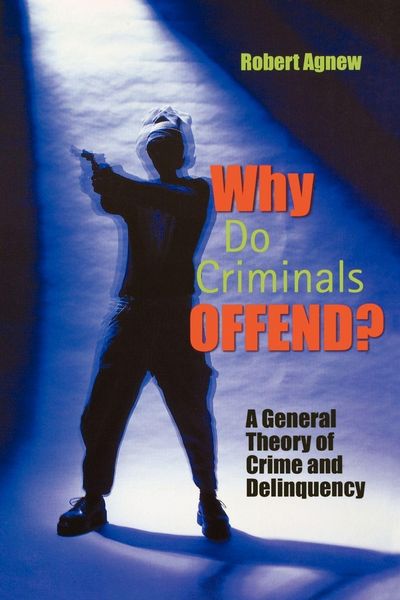
Produktbild: Why Do Criminals Offend?

Why Do Criminals Offend? A General Theory of Crime and Delinquency

Fr. 209.00

inkl. gesetzl. MwSt., Versandkostenfrei


Beschreibung

Produktdetails

Einband

Taschenbuch

Erscheinungsdatum

01.08.2004

Verlag

Oxford Academic

Seitenzahl

256

Maße (L/B/H)

22.9/15.2/1.5 cm

Gewicht

381 g

Sprache

Englisch

ISBN

978-0-19-533046-5

Beschreibung

Produktdetails

Einband

Taschenbuch

Erscheinungsdatum

01.08.2004

Verlag

Oxford Academic

Seitenzahl

256

Maße (L/B/H)

22.9/15.2/1.5 cm

Gewicht

381 g

Sprache

Englisch

ISBN

978-0-19-533046-5

Herstelleradresse

Libri GmbH
Europaallee 1
36244 Bad Hersfeld
DE

Email: gpsr@libri.de

Kundinnen und Kunden meinen

0 Bewertungen

Informationen zu Bewertungen

Zur Abgabe einer Bewertung ist eine Anmeldung im Konto notwendig. Die Authentizität der Bewertungen wird von uns nicht überprüft. Wir behalten uns vor, Bewertungstexte, die unseren Richtlinien widersprechen, entsprechend zu kürzen oder zu löschen.

Die Bewertungen sind nach Format, Anzahl Sterne und Datum sortiert.

Verfassen Sie die erste Bewertung zu diesem Artikel

Helfen Sie anderen Kund*innen durch Ihre Meinung

Kundinnen und Kunden meinen

0 Bewertungen filtern

  • Produktbild: Why Do Criminals Offend?
    • 1. Introduction: A General Theory of Crime and Delinquency

    • Why I Wrote This Book and What I Hope to Accomplish

    • The Questions a General Theory of Crime Must Answer

    • A General Theory That Answers These Questions Runs the Risk of Being Too Complex

    • My Approach to Constructing a General Theory of Crime

    • What the Theory Is Designed to Explain

    • Testing and Applying the Theory

    • Acknowledgments: The General Theory Is Built on the Work of Numerous Others

    • Conclusion

    • Discussion and Study Questions

    • 2. Crime Is Most Likely When the Constraints Against Crime Are Low and the Motivations for Crime Are High

    • Constraints Against Crime

    • The Motivations for Crime

    • Long-lasting and Situational Constraints and Motivations

    • Is Crime Influenced by Factors Other Than Constraints and Motivations?

    • Conclusion

    • Discussion and Study Questions

    • 3. A Range of Individual and Social Variables Affect the Constraints

    • Against and the Motivations for Crime

    • The Dominant Strategy for Grouping the Causes of Crime Into a Smaller Number of Categories

    • An Alternative Strategy for Grouping the Causes of Crime Into a Smaller Number of Categories

    • The Key Variables in the Five Life Domains

    • The Relative Importance of the Life Domains at Different Stages in the Life Course

    • Conclusion

    • Discussion and Study Questions

    • 4. The Web of Crime: The Life Domains Affect One Another, Although Some Effects Are Stronger Than Others

    • The Effects of the Self (Irritability and Low Self-Control) on the Other Life Domains

    • The Effect of the Family (Poor Parenting and No/Bad Marriages) on the Other Life Domains

    • The Effect of School (Negative School Experiences and Limited Education) on the Other Life Domains

    • The Effect of Peers (Peer Delinquency) on the Other Life Domains

    • The Effect of Work (Unemployment and Bad Jobs) on the Other Life Domains

    • Summary: The Effects of the Life Domains on One Another Over the Individual's Life

    • Conclusion

    • Discussion and Study Questions

    • 5. Crime Affects Its 'Causes' and Prior Crime Affects Subsequent Crime

    • The Effect of Crime on the Life Domains

    • The Direct Effect of Prior Crime on Subsequent Crime

    • The Effect of Prior Crime on Subsequent Crime Depends on the Reaction to Crime and the Characteristics of the Criminal

    • Summary

    • Discussion and Study Questions

    • 6. The Causes of Crime Interact in Affecting Crime and One Another

    • The Core Propositions of the General Theory (Up to Now)

    • The Causes of Crime Interact in Affecting Crime and One Another

    • General Principle: A Cause Is More Likely to Lead to Crime When Other Causes Are Present

    • Some Illustrative Interactions

    • The Life Domains Interact in Affecting One Another

    • Summary

    • Discussion and Study Questions

    • 7. The Causes Tend to Have Contemporaneous and Nonlinear Effects on Crime and One Another

    • Effects Are Largely Contemporaneous in Nature, Although Each Cause Has a Large, Lagged Effect on Itself

    • Effects Are Nonlinear

    • Summary

    • Discussion and Study Questions

    • 8. The Life Domains Are Influenced by a Range of Outside Factors, Including Biological and Environmental Factors

    • Outside Factors That Affect the Life Domains

    • A Note on Larger Social and Cultural Influences

    • An Overview of the General Theory of Crime

    • Summary

    • Discussion and Study Questions

    • 9. Using the General Theory to Explain Group Differences in Crime

    • How Might the General Theory Explain Group Differences in Crime Rates

    • Explaining Age Differences in Crime

    • Explaining Sex Differences in Crime

    • Explaining 'Life-Course Persistent' and 'Adolescent-Limited' Offending

    • Summary

    • Discussion and Study Questions

    • 10. Testing the General Theory

    • Testing the Core Propositions of the General Theory

    • Summary

    • Discussion and Study Questions

    • 11. Recommendations for Controlling Crime

    • How Effective Is the 'Get Tough' Approach to Controlling Crime?

    • How to Make Arrest and Official Sanctions More Effective

    • Rehabilitation and Prevention Programs

    • Some General Guidelines for Rehabilitation and Prevention Programs

    • 12. The General Theory as an Integrated Theory of Crime

    • Considers a Broad Range of Variables

    • Considers a Broad Range of Intervening Mechanisms

    • Groups the Specific Causes of Crime Into Clusters Organized by Life Domain

    • Argues That the Life Domains Have Reciprocal Effects on One Another Which Vary Over the Life Course

    • Argues That Crime Affects the Life Domains and That Prior Crime Affects Subsequent Crime

    • Argues That the Life Domains Interact in Affecting Crime and One Another

    • Argues That the Life Domains Have Nonlinear and Largely Contemporaneous

    • Effects on Crime and One Another

    • Argues That Biological Factors and the Larger Social Environment Affect the Life Domains

    • Conclusion