KI-Beratung Beta

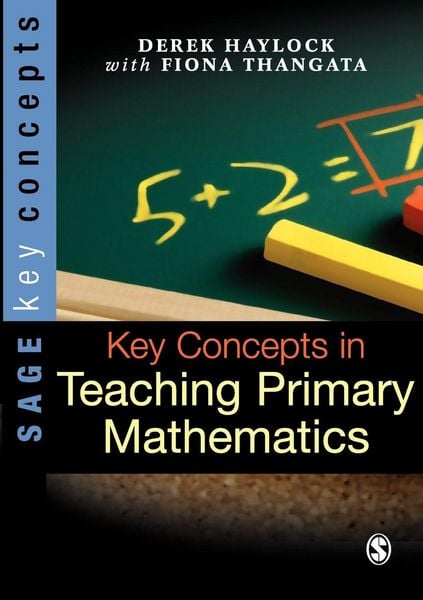
  • Produktbild: Key Concepts in Teaching Primary Mathematics
  • Produktbild: Key Concepts in Teaching Primary Mathematics

Key Concepts in Teaching Primary Mathematics

Aus der Reihe SAGE Key Concepts series

Fr. 83.90

inkl. gesetzl. MwSt., Versandkostenfrei


Beschreibung

Produktdetails

ISBN

978-1-4129-3410-7

Erscheinungsdatum

01.10.2007

Einband

Taschenbuch

Verlag

SAGE Publications

Seitenzahl

200

Maße (L/B/H)

21/14.8/1.1 cm

Gewicht

266 g

Sprache

Englisch

Beschreibung

Rezension

The book has some useful summaries and examples of important concepts in teaching. However I am not convinced by the separation of assessment into assessment for learning and assessment for teaching. It is hard, though, to do real justice to such a large field in a small section. Mrs Amanda O'Shea 20120419

Produktdetails

ISBN

978-1-4129-3410-7

Erscheinungsdatum

01.10.2007

Einband

Taschenbuch

Verlag

SAGE Publications

Seitenzahl

200

Maße (L/B/H)

21/14.8/1.1 cm

Gewicht

266 g

Sprache

Englisch

EU-Ansprechpartner

Kolibri 360 GmbH
Ettore-Bugatti-Straße 6-14
51149 Köln
DE
produktsicherheit@kolibri360.de

Herstelleradresse

SAGE Publications
1 Oliver's Yard 55 City Road
EC1Y 1SP London
GB
orders@sagepub.co.uk

Noch keine Bewertungen vorhanden

Verfassen Sie die erste Bewertung zu diesem Artikel

Helfen Sie anderen Kundinnen und Kunden durch Ihre Meinung.

Kundinnen und Kunden meinen

Bewertungen (0)

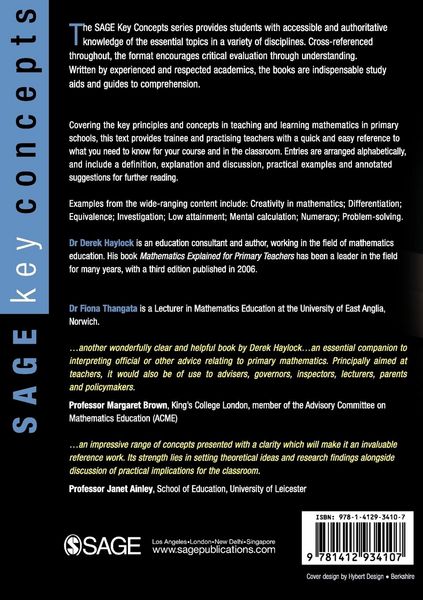
  • Produktbild: Key Concepts in Teaching Primary Mathematics
  • Produktbild: Key Concepts in Teaching Primary Mathematics
  • Introduction
    Aims of mathematics teaching
    Algorithm
    Anxiety about mathematics
    Assessment for learning
    Assessment for teaching
    Cognitive conflict
    Concept learning
    Conservation of quantity
    Constructivism
    Creativity in mathematics
    Cross-cultural mathematics
    Cross-curricular mathematics
    Deductive and inductive reasoning
    Differentiation
    Equivalence
    Errors
    Explanation
    Gender and mathematics
    Generalization
    Giftedness in mathematics
    Home as a context for numeracy
    Informal calculation method
    Investigation (enquiry)
    Language difficulties in mathematics
    Low attainment
    Making connections
    Match and mismatch
    Meaningful context
    Meaningful learning
    Mental calculation
    Modelling process (representing)
    Numeracy
    Play as a context for learning mathematics
    Principle learning
    Problem solving
    Purposeful activity
    Questioning
    Rote learning
    Skill learning
    Talk
    Transformation
    Transitivity
    Using and applying mathematics
    References