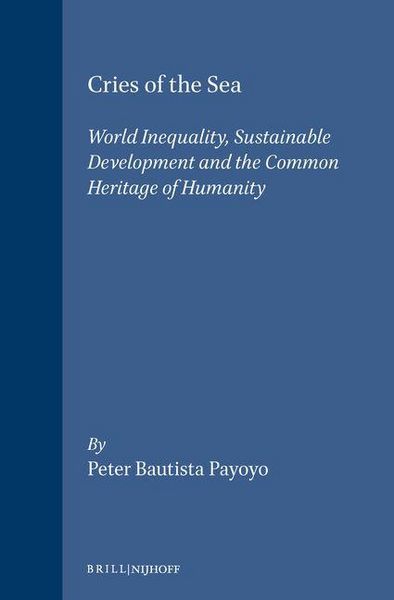
Cries of the Sea:World Inequality, Sustainable Development and the Common Heritage of Humanity World Inequality, Sustainable Development and the Common Heritage of Humanity
-
- Englisch ausgewählt
Fr. 440.00
inkl. gesetzl. MwSt.,
Beschreibung
Produktdetails
Einband
Gebundene Ausgabe
Erscheinungsdatum
30.10.1997
Verlag
Springer NetherlandSeitenzahl
568
Maße (L/B/H)
23.5/15.5/3.8 cm
Gewicht
993 g
Auflage
1
Sprache
Englisch
ISBN
978-90-411-0504-2
A treasure lies at the bottom of the oceans. This treasure takes the form of a legal and ethical principle which may illuminate the potential for an enriching international community in a world of growing disparities. It is the principle of the Common Heritage of Humanity.
The 1982 United Nations Convention on Law of the Sea delineated an Area and then proclaimed the Area and its resources `the common heritage of mankind'. The author suggests that the terms `common', `heritage', and `humanity' invite a larger perspective on the law underlying the Convention.
Cries of the Sea provides a unique view of `the deep blue sea' through the lens of the politics of international ocean law and policy and in particular through the exposition of the Common Heritage of Humanity as a fundamental principle of international law. The book explains why - and how - the Common Heritage principle constitutes an indispensable ingredient in any global programme for sustainable development. Legal philosophers and practitioners alike, in the ocean arena and beyond, will find that this work offers an intriguing intellectual and moral challenge.
This book received the first Arvid Pardo Prize for outstanding scholarship on the Law of the Sea.
Kundinnen und Kunden meinen
Verfassen Sie die erste Bewertung zu diesem Artikel
Helfen Sie anderen Kund*innen durch Ihre Meinung