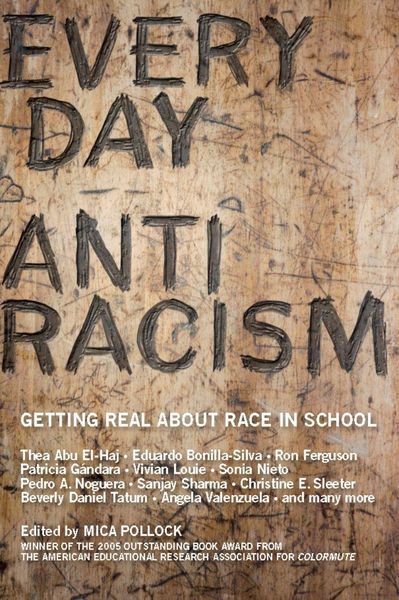
Produktbild: Everyday Antiracism

Everyday Antiracism Getting Real About Race in School

Fr. 34.90

inkl. gesetzl. MwSt., Versandkostenfrei


Beschreibung

Produktdetails

Einband

Taschenbuch

Erscheinungsdatum

01.06.2008

Herausgeber

Mica Pollock + weitere

Verlag

Ingram Publishers Services

Seitenzahl

389

Maße (L/B/H)

23.4/15.5/2 cm

Gewicht

454 g

Sprache

Englisch

ISBN

978-1-59558-054-2

Beschreibung

Produktdetails

Einband

Taschenbuch

Erscheinungsdatum

01.06.2008

Herausgeber

Verlag

Ingram Publishers Services

Seitenzahl

389

Maße (L/B/H)

23.4/15.5/2 cm

Gewicht

454 g

Sprache

Englisch

ISBN

978-1-59558-054-2

Herstelleradresse

Libri GmbH
Europaallee 1
36244 Bad Hersfeld
DE

Email: gpsr@libri.de

Kundinnen und Kunden meinen

0 Bewertungen

Informationen zu Bewertungen

Zur Abgabe einer Bewertung ist eine Anmeldung im Konto notwendig. Die Authentizität der Bewertungen wird von uns nicht überprüft. Wir behalten uns vor, Bewertungstexte, die unseren Richtlinien widersprechen, entsprechend zu kürzen oder zu löschen.

Die Bewertungen sind nach Format, Anzahl Sterne und Datum sortiert.

Verfassen Sie die erste Bewertung zu diesem Artikel

Helfen Sie anderen Kund*innen durch Ihre Meinung

Kundinnen und Kunden meinen

0 Bewertungen filtern

  • Produktbild: Everyday Antiracism
  • Contents

    Acknowledgments xi
    Suggestions for Using This Book xiii
    Introduction: Defining Everyday Antiracism xvii

    SECTION A
    RACE CATEGORIES: WE ARE ALL THE SAME,
    BUT OUR LIVES ARE DIFFERENT 1

    Part I: Remember That Racial Categories Are
    Not Biological Realities 3
      1. Exposing Race as an Obsolete Biological Concept
      Alan H. Goodman 4
      2. No Brain Is Racial
      Mica Pollock 9
      3. Getting Rid of the Word “Caucasian”
      Carol C. Mukhopadhyay 12

    Part II: Get Ready to Talk about a Racialized Society 17

      4. Beginning Courageous Conversations about Race
      Glenn E. Singleton and Cyndie Hays 18
      5. Talking Precisely about Equal Opportunity
      Mica Pollock 24
      6. Nice Is Not Enough: Defining Caring for Students of Color
      Sonia Nieto 28

    Part III: Remember That People Do Not Fit Neatly and
    Easily into Racial Groups 33
      7. Following Children's Leads in Conversations about Race
      Kimberly Chang and Rachel Conrad 34
      8. Observing Students Sharing Language
      Ben Rampton 39

    Part IV: Remember That People Are Treated as Racial Group
    Members and Need to Examine That Experience 43
      9. Strengthening Student Identity in School Programs
      Patricia Gándara 44
      10. Uncovering Internalized Oppression
      Angela Valenzuela 50
      11. Helping Students See Each Other's Humanity
      L. Janelle Dance 56

    Part V: Emphasize Individuality 61
      12. Constructing Colorblind Classrooms
      Samuel R. Lucas 62
      13. Knowing Students as Individuals
      Joshua Aronson 67
      14. Showing Students Who You Are
      Heather M. Pleasants 70

    SECTION B
    HOW OPPORTUNITIES ARE PROVIDED
    AND DENIED INSIDE SCHOOLS 75

    Part VI: Remember That Students Experience Racially
    Unequal Expectations about Their Brainpower 77
      15. Helping Students of Color Meet High Standards
      Ronald F. Ferguson 78
      16. Providing Supportive Feedback
      Geoffrey L. Cohen 82

    Part VII: Counter Racially Patterned Skill Gaps 85
      17. Teaching and Transcending Basic Skills
      Amanda Taylor 86
      18. Grouping in Detracked Classrooms
      Beth C. Rubin 90

    Part VIII: Help Students Gain Fluency in “Standard”
    Behaviors While Honoring the “Nonstandard”
    Behaviors They Already Have 97
      19. Standards vs.“Standard” Knowledge
      Edmund T. Hamann 98
      20. Valuing Nonstandard English
      John Baugh 102
      21. Teaching Students Fluency in Multiple Cultural Codes
      Prudence Carter 107

    Part IX: Defy Racially Based Notions of Potential
    Careers and Contributions 113
      22. Challenging Cultural Stereotypes of “Scientific Ability”
      Maria Ong 114
      23. Finding Role Models in the Community
      Meira Levinson 120

    Part X: Analyze Racial Disparities in Opportunities to Learn 125
      24. Providing Equal Access to “Gifted” Education
      Karolyn Tyson 126
      25. What Discipline Is For: Connecting Students to the
      Benefits of Learning
      Pedro A. Noguera 132


    SECTION C
    CURRICULUM THAT ASKS CRUCIAL
    QUESTIONS ABOUT RACE 139

    Part XI: Create Curriculum That Invites Students to
    Explore Complex Identities and Consider
    Racial Group Experiences 141
      26. Using Photography to Explore Racial Identity
      Alexandra Lightfoot 142
      27. Exploring Racial Identity Through Writing
      Jennifer A. Mott-Smith 146
      28. Involving Students in Selecting Reading Materials
      Christine E. Sleeter 150

    Part XII: Create Curriculum That Analyzes
    Opportunity Denial 155
      29. Teaching Critical Analysis of Racial Oppression
      Jeff Duncan-Andrade 156
      30. Using Critical Hip-Hop in the Curriculum
      Ernest Morrell 161
      31. Engaging Youth in Participatory Inquiry for Social Justice
      María Elena Torre and Michelle Fine 165

    Part XIII: Create Curriculum That Represents a
    Diverse Range of People Thoroughly and Complexly 173
      32. Arab Visibility and Invisibility
      Thea Abu El-Haj 174
      33. Evaluating Images of Groups in Your Curriculum
      Teresa L. McCarty 180
      34. Teaching Representations of Cultural Difference Through Film
      Sanjay Sharma 186
      35. What Is on Your Classroom Wall? Problematic Posters
      Donna Deyhle 191
      36. Teaching Racially Sensitive Literature
      Jocelyn Chadwick 195

    Part XIV: Create Curriculum That Discusses History
    Accurately and Thoroughly 199
      37. Making Race Relevant in All-White Classrooms:
      Using Local History
      Mara Tieken 200
      38. Teaching Facts, Not Myths, about Native Americans
      Paul Ongtooguk and Claudia S. Dybdahl 204

    SECTION D
    RACE AND THE SCHOOL EXPERIENCE:
    THE NEED FOR INQUIRY 209

    Part XV: Investigate Learning Experiences in Your Classroom 211
      39. Inviting Students to Analyze Their Learning Experience
      Makeba Jones and Susan Yonezawa 212
      40. Interrogating Students' Silences
      Katherine Schultz 217
      41. Questioning “Cultural” Explanations of Classroom Behaviors
      Doug Foley 222
      42. Creating Safe Spaces in Predominantly White Classrooms
      Pamela Perry 226
      43. On Spotlighting and Ignoring Racial Group Members
      in the Classroom
      Dorinda J. Carter 230

    Part XVI: Spearhead Conversations with Students about
    Racism in Their Lives and Yours 235
      44. Racial Incidents as Teachable Moments
      Lawrence Blum 236
      45. Debating Racially Charged Topics
      Ian F. Haney López 242
      46. Developing Antiracist School Policy
      David Gillborn 246

    Part XVII: Talk Thoroughly with Colleagues
    about Race and Achievement 253
      47. Focusing on Student Learning
      John B. Diamond 254
      48. Moving Beyond Quick “Cultural” Explanations
      Vivian Louie 257
      49. Naming the Racial Hierarchies That Arise During School Reforms
      Rosemary Henze 262
      50. Spearheading School-wide Reform
      Willis D. Hawley 267

    Part XVIII: Analyze, with Colleagues and Students, How
    Your Race Affects Your Teaching 273
      51. Responding to the “N-Word”
      Wendy Luttrell 274
      52. Engaging Diverse Groups of Colleagues in Conversation
      Alice McIntyre 279
      53. Locating Yourself for Your Students
      Priya Parmar and Shirley Steinberg 283
      54. Expanding Definitions of “Good Teaching”
      Lee Anne Bell 287

    SECTION E
    ENGAGING COMMUNITIES FOR REAL 291

    Part XIX: Inquire Fully about Home Communities 293
      55. Valuing Students' Home Worlds
      Eugene E. García 294
      56. Getting to Know Students' Communities
      Leisy Wyman and Grant Kashatok 299
      57. Helping Students Research Their Communities
      Kathleen Cushman 305

    Part XX: Discuss Parents' Experiences of Racially Unequal
    Opportunity 309
      58. Cultivating the Trust of Black Parents
      Beverly Daniel Tatum 310
      59. Helping Parents Fight Stereotypes about Their Children
      Janie Victoria Ward 314
      60. Informing Parents about Available Opportunities
      Roslyn Arlin Mickelson and Linwood H. Cousins 318

    SECTION F
    KEEPING IT GOING 325
    Part XXI: Struggle to Change a System That Is Unequal,
    While Working Within It 327
      61. Resisting the “Lone Hero” Stance
      Audrey Thompson 328
      62. Recognizing the Likelihood of Reproducing Racism
      Eduardo Bonilla-Silva and David G. Embrick 334
      63. Staying Hopeful
      Ronald David Glass 337
      64. What Is Next?
      Mica Pollock 341

      Complete List of Everyday Antiracist Strategies 343
      Notes 349
      Reference List 361
      Index 381