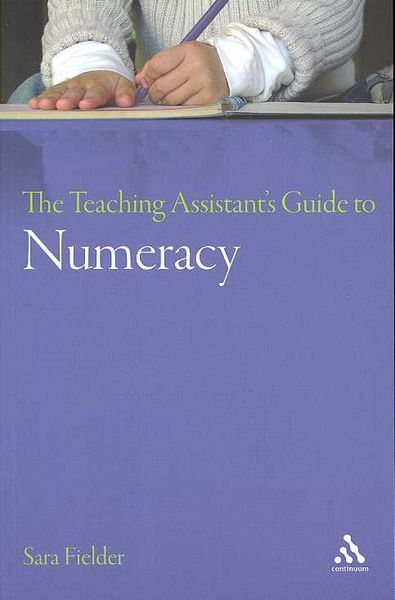
Produktbild: Teaching Assistant's Guide to Numeracy

Teaching Assistant's Guide to Numeracy

Fr. 31.90

inkl. gesetzl. MwSt., Versandkostenfrei


Beschreibung

Produktdetails

Einband

Taschenbuch

Erscheinungsdatum

Oktober 2007

Verlag

Bloomsbury

Seitenzahl

128

Maße (L/B/H)

1.2/13.2/19.8 cm

Gewicht

144 g

Sprache

Englisch

ISBN

978-0-8264-9606-5

Beschreibung

Produktdetails

Einband

Taschenbuch

Erscheinungsdatum

Oktober 2007

Verlag

Bloomsbury

Seitenzahl

128

Maße (L/B/H)

1.2/13.2/19.8 cm

Gewicht

144 g

Sprache

Englisch

ISBN

978-0-8264-9606-5

Noch keine Bewertungen vorhanden

Verfassen Sie die erste Bewertung zu diesem Artikel

Helfen Sie anderen Kundinnen und Kunden durch Ihre Meinung.

Kundinnen und Kunden meinen

Bewertungen (0)

Weitere Artikel finden Sie in

  • Produktbild: Teaching Assistant's Guide to Numeracy
  • Chapter 1 What is numeracy? What does it mean to be numerate? Numeracy and mathematics, mathematics and numeracy What is taught as 'mathematics'? So what is your role within the lesson? Blocks of work The Early Years Foundation Stage curriculum Looking at the levels of attainment Supporting children working below level 1 Chapter 2 Key mathematical skills Progression in mathematics Understanding and application of counting Understanding and application of the position of numbers Memory and retention Individual and group education plans Ideas for activities Chapter 3 Working with the teacher Your role in the mathematics lesson The mental and oral part of the lesson The main part of the lesson The plenary Using the teacher's planning Assessing pupils' learning Marking pupils' work Ways of feeding back to the teacher Chapter 4 The effective use of resources A feel for number - the 'fiveness' of five Recognition of the written number Number tracks and squares A blank or empty number line An understanding of place value Making a resources 'kit' Using ICT to motivate learners Chapter 5 Using intervention materials What is differentiation? Identifying specific learning difficulties in mathematics Published support/differentiated materials Supporting low attainers using Wave 3 materials Supporting EAL learners Chapter 6 The art of questioning - speaking and listening The importance of questioning The use of open and closed questions Turning a question into a problem to be solved Using role play Speaking and listening strategies Chapter 7 Towards an effective written calculation method Methods for calculation Written methods for addition Subtraction Multiplication Division Chapter 8 Working with more able mathematicians Your role as TA Asking the right questions Talking through and answering questions Acceleration, enrichment and extension Types of enrichment activities Chapter 9 Resources General qualifications and courses Mathematics-specific training - when supporting children Mathematics-specific training - for yourself Published materials and websites Glossary of terms