• Produktbild: Syntax
  • Produktbild: Syntax

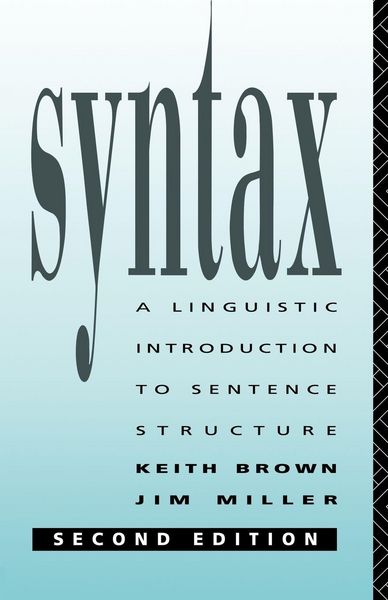
Syntax A Linguistic Introduction to Sentence Structure

Fr. 103.00

inkl. gesetzl. MwSt., Versandkostenfrei


Beschreibung

Produktdetails

Einband

Taschenbuch

Erscheinungsdatum

16.05.1991

Verlag

Taylor & Francis

Seitenzahl

396

Maße (L/B/H)

21.6/14/2.3 cm

Gewicht

720 g

Auflage

2. Auflage

Sprache

Englisch

ISBN

978-0-415-08421-5

Beschreibung

Produktdetails

Einband

Taschenbuch

Erscheinungsdatum

16.05.1991

Verlag

Taylor & Francis

Seitenzahl

396

Maße (L/B/H)

21.6/14/2.3 cm

Gewicht

720 g

Auflage

2. Auflage

Sprache

Englisch

ISBN

978-0-415-08421-5

Herstelleradresse

Libri GmbH
Europaallee 1
36244 Bad Hersfeld
DE

Email: gpsr@libri.de

Noch keine Bewertungen vorhanden

Verfassen Sie die erste Bewertung zu diesem Artikel

Helfen Sie anderen Kundinnen und Kunden durch Ihre Meinung.

Kundinnen und Kunden meinen

Bewertungen (0)

Die Leseprobe wird geladen.
  • Produktbild: Syntax
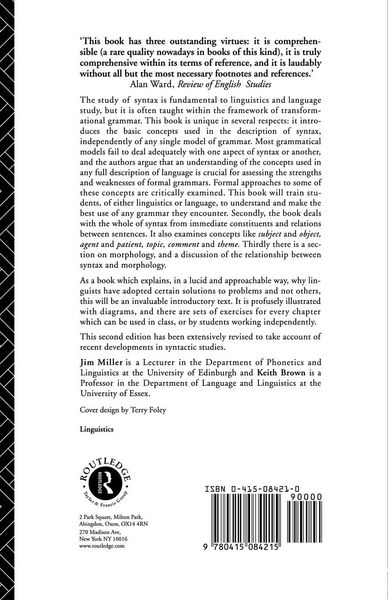
  • Produktbild: Syntax
  • Preface to the first edition -- Preface to the second edition -- Introduction -- Part one: Constituent structure -- 1 Constituent structure -- 1.1 Determining constituent structure -- 1.2 Representing and talking about constituent structure -- 1.3 Hierarchical structure -- 2 Form classes -- 2.1 Form classes -- 2.2 Widening the data base -- 3 Constituent structure grammar -- 3.1 A simple grammar -- 3.2 Generating and parsing sentences 3.3 Generative grammar -- 4 Formal grammars -- 5 Verbs and nouns -- 5.1 Some verb classes in English -- 5.2 Some noun classes in English -- 5.3 Selection restrictions -- 6 Adjectives and prepositions -- 6.1 Adjectives and adjective phrases -- 6.2 Prepositions and prepositional phrases -- 7 Optional constituents -- 7.1 Optional constituents -- 7.2 Modifiers and heads -- 7.3 Adverbs and adverbials -- 8 Intermediate levels of structure -- 8.1 Intermediate levels of structure -- 8.2 The specifiers, modifiers and complements of the major categories -- 9 Embedding, recursion and ambiguity -- 9.1 Embedding and recursion -- 9.2 Attachment and ambiguity -- 10 Relations between sentences -- 10.1 Introduction -- 10.2 Active and passive -- 10.3 Declarations and interrogatives -- 10.4 Wh movement and relative clauses -- 11 The sentence -- Part two: Morphology -- 12 Words and morphemes -- 12.1 Identifying words -- 12.2 'Inflectional' and 'derivational' morphology 12.3 Models of inflectional morphology -- 12.4 Some terminology -- 12.5 Lexical and grammatical morphemes -- 12.6 The morpheme as an abstract unit -- 13 Morphemes and morphs -- 3.1 Morphs -- 13.2 Morphs and allomorphs -- 13.3 Realization -- 14 The morphology of the English verb -- 14.1 Singular and plural: a problem in analysis -- 14.2 Subject-verb concord -- 14.3 Tense and aspect in the English verb -- 15 Lexical morphology -- 16 Form classes and grammatical categories -- 16.1 Form classes: nouns, adjectives and verbs -- 16.2 Grammatical categories -- Part three: Functional relations -- 17 Heads and modifiers: the encoding of dependency relations -- 17 .1 Heads and modifiers -- 17 .2 Encoding: word order and marking -- 17 .3 Linkage: agreement and government -- 18 Processes and participants -- 18.1 Introduction -- 18.2 Actions and states -- 18.3 Agent and patient: range, result and neutral -- 18.4 Location and motion: locative place, goal, source and path -- 18.5 Inchvative and causative-inchoative verbs -- 18.6 [State] propositions: description and identification; neutral and attribute -- 18.7 Conclusion -- 19 Grammatical functions -- 19.1 Subject -- 19.2 Object -- 19.3 Indirect object -- 19 .4 Complement -- 19.5 Adjuncts -- 19.6 Conclusion -- 20 Sentences in texts -- 20.1 Theme, rheme and end focus -- 20.2 Given and new -- 20.3 Topics -- 20.4 Conclusion -- Further reading -- References -- Index.