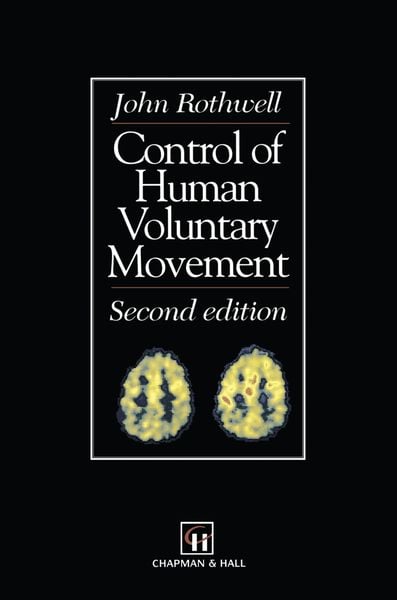
• Produktbild: Control of Human Voluntary Movement
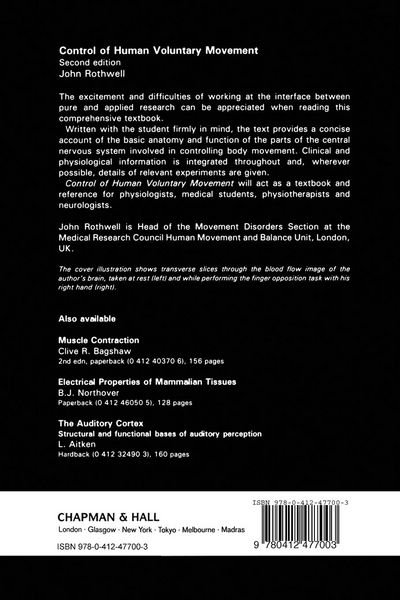
  • Produktbild: Control of Human Voluntary Movement

Control of Human Voluntary Movement

Fr. 191.00

inkl. gesetzl. MwSt., Versandkostenfrei


Beschreibung

Produktdetails

Einband

Taschenbuch

Erscheinungsdatum

31.12.1993

Verlag

Springer Netherland

Seitenzahl

520

Maße (L/B/H)

23.5/15.5/2.8 cm

Gewicht

783 g

Auflage

Second Edition 1994

Sprache

Englisch

ISBN

978-0-412-47700-3

Beschreibung

Rezension

`
Control of human voluntary movement is a difficult and even at times obscure subject ... or so I thought before I got round to reading John Rothwell's excellent pocket-sized textbook on the subject. ... The subject matter could too easily lapse into introspection, but Rothwell maintains the reader's interest by including excellent diagrams and illustrations and a fair amount of pathophysiology.
'

Nursing Times

`
The author provides a comprehensive, unbiased review of current experimental evidence and theories.
'

Physiotherapy

Produktdetails

Einband

Taschenbuch

Erscheinungsdatum

31.12.1993

Verlag

Springer Netherland

Seitenzahl

520

Maße (L/B/H)

23.5/15.5/2.8 cm

Gewicht

783 g

Auflage

Second Edition 1994

Sprache

Englisch

ISBN

978-0-412-47700-3

Herstelleradresse

Springer-Verlag GmbH
Tiergartenstr. 17
69121 Heidelberg
DE

Email: ProductSafety@springernature.com

Kundinnen und Kunden meinen

0 Bewertungen

Informationen zu Bewertungen

Zur Abgabe einer Bewertung ist eine Anmeldung im Konto notwendig. Die Authentizität der Bewertungen wird von uns nicht überprüft. Wir behalten uns vor, Bewertungstexte, die unseren Richtlinien widersprechen, entsprechend zu kürzen oder zu löschen.

Die Bewertungen sind nach Format, Anzahl Sterne und Datum sortiert.

Verfassen Sie die erste Bewertung zu diesem Artikel

Helfen Sie anderen Kund*innen durch Ihre Meinung

Kundinnen und Kunden meinen

0 Bewertungen filtern

  • Produktbild: Control of Human Voluntary Movement
  • Produktbild: Control of Human Voluntary Movement
  • 1 Introduction: Plans, strategies and actions.- 1.1 Categories of muscles.- 1.2 Problems of moving.- 1.3 A legacy.- 2 Mechanical properties of muscles.- 2.1 Review of muscle anatomy.- 2.2 Mechanical properties of muscle.- 2.3 Behaviour of isolated muscle stimulated at subtetanic rates.- 2.4 Muscle mechanics in intact humans.- 2.5 Effects of muscle properties on control of movement.- 2.6 A theory of movement control which makes use of the mechanical properties of muscle.- 3 The motor unit.- 3.1 The concept of the motor unit.- 3.2 Twitch and tonic muscle fibres.- 3.3 Physiological investigation of the motor unit.- 3.4 Histochemical and biochemical classification of muscle fibres.- 3.5 Some electrophysiological properties of motoneurones.- 3.6 Control of motor units and their recruitment order.- 3.7 The study of motor units in human physiology.- 3.8 Pathophysiology of the motor unit.- 4 Proprioceptors in muscles, joints and skin.- 4.1 Muscle receptors: I. The muscle spindle.- 4.2 Muscle receptors: II. Golgi tendon organs.- 4.3 Muscle receptors: III. Other types of ending.- 4.4 Joint receptors.- 4.5 Cutaneous mechanoreceptors.- 4.6 Recordings from human afferent nerve fibres.- 5 Reflex pathways in the spinal cord.- 5.1 Classification of nerve fibres.- 5.2 Anatomy of group I and II projections of the spinal cord.- 5.3 Reflex pathways from Ia muscle spindle afferents.- 5.4 Reflex pathways from Ib tendon organ afferents.- 5.5 Reflex pathways from group II muscle afferents and ‘flexor reflex afferents’.- 5.6 The Renshaw cell.- 5.7 Presynaptic inhibition.- 6 Investigating reflex pathways and their function.- 6.1 The tendon jerk.- 6.2 The H-reflex.- 6.3 Long latency stretch reflexes.- 6.4 Vibration reflexes.- 6.5 The servo hypothesis and ?-? coactivation.- 6.6 Investigationof activity in other reflex pathways using the H-reflex.- 6.7 Cutaneous reflexes.- 6.8 Pathophysiology of spinal reflexes.- 6.9 Movement without reflexes: deafferentation.- 7 Ascending and descending pathways of the spinal cord.- 7.1 Ascending pathways.- 7.2 Descending motor pathways.- 7.3 Summary of descending pathways.- 7.4 Investigating descending motor pathways in humans.- 8 Posture.- 8.1 The vestibular system.- 8.2 Quiet stance.- 8.3 Postural reflexes.- 8.4 Postural reflexes described in animals.- 8.5 Postural adjustments produced by voluntary movement.- 9 Cerebral cortex.- 9.1 Structure of cerebral cortex.- 9.2 Frontal motor areas of cortex.- 9.3 Electrical stimulation of the motor areas.- 9.4 Electrophysiology of the corticospinal projection.- 9.5 Sensory input to motor cortex.- 9.6 Non-primary motor areas.- 9.7 Lesions of descending pathways in humans and monkeys.- 9.8 Physiology and pathophysiology of human motor areas.- 10 The cerebellum.- 10.1 Cerebellar anatomy.- 10.2 Circuitry of the cerebellar cortex.- 10.3 Efferent pathways of the cerebellum.- 10.4 Electrophysiological studies of the cerebellum.- 10.5 Effects of cerebellar lesions.- 10.6 Adaptation and learning.- 10.7 Theories of cerebellar function.- 10.8 Studies of cerebellar dysfunction in humans.- 11 The basal ganglia.- 11.1 Anatomy.- 11.2 Electrophysiological recordings from behaving animals.- 11.3 Effects of lesions of the basal ganglia.- 11.4 Models of basal ganglia disease in humans.- 11.5 Pathophysiology of diseases of the basal ganglia in humans.