
• Produktbild: Case: Role of Central Conceptual Structures
  • Produktbild: Case: Role of Central Conceptual Structures

Case: Role of Central Conceptual Structures s Though

Fr. 83.90

inkl. gesetzl. MwSt., Versandkostenfrei


Beschreibung

Produktdetails

Einband

Taschenbuch

Erscheinungsdatum

15.04.2000

Verlag

Wiley

Seitenzahl

308

Maße (L/B/H)

22.9/15.2/1.7 cm

Gewicht

449 g

Sprache

Englisch

ISBN

978-0-631-22451-8

Beschreibung

Produktdetails

Einband

Taschenbuch

Erscheinungsdatum

15.04.2000

Verlag

Wiley

Seitenzahl

308

Maße (L/B/H)

22.9/15.2/1.7 cm

Gewicht

449 g

Sprache

Englisch

ISBN

978-0-631-22451-8

Kundinnen und Kunden meinen

0 Bewertungen

Informationen zu Bewertungen

Zur Abgabe einer Bewertung ist eine Anmeldung im Konto notwendig. Die Authentizität der Bewertungen wird von uns nicht überprüft. Wir behalten uns vor, Bewertungstexte, die unseren Richtlinien widersprechen, entsprechend zu kürzen oder zu löschen.

Die Bewertungen sind nach Format, Anzahl Sterne und Datum sortiert.

Verfassen Sie die erste Bewertung zu diesem Artikel

Helfen Sie anderen Kund*innen durch Ihre Meinung

Kundinnen und Kunden meinen

0 Bewertungen filtern

  • Produktbild: Case: Role of Central Conceptual Structures
  • Produktbild: Case: Role of Central Conceptual Structures
  • Abstract.

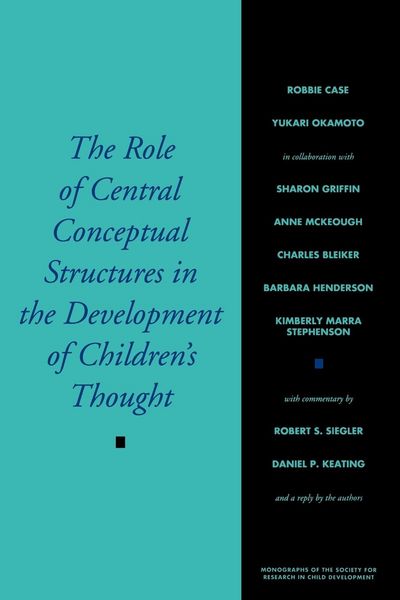
    I. Introduction: Reconceptualizing the Nature of Children's Conceptual Structures and Their Development in Middle Childhood (Robbie Case).

    II. Exploring the Microstructure of Children's Central Conceptual Structures in the Domain of Number (Yukari Okamoto and Robbie Case).

    III. Exploring the Macrostructure of Children's Central Conceptual Structures in the Domains of Number and Narrative (Robbie Case, Yukari Okamoto, Barbara Henderson, Anne McKeough, and Charles Bleiker).

    IV. Evaluating the Breadth and Depth of Training Effects when Central Conceptual Structures are Taught (Sharon Griffin and Robbie Case).

    V. Central Spatial Structures and Their Development (Robbie Case, Kimberly Marra Stephenson, Charles Bleiker, and Yukari Okamoto).

    VI. Cross-Cultural Investigations (Yukari Okamoto, Robbies Case, Charles Bleiker, and Barvara Hnderson).

    VII. Modeling the Dynamic Interplay Between General and Specific Change in Children's Conceptual Understanding (Robbie Case).

    VIII. Summary and Conclusion (Robbie Case)'.

    Appendix A. Administration and Scoring of the Numerical Tasks.

    Appendix B. Administering and Scoring of the Narrative Tests.

    Appendix C. Administration and Scoring of the Spatial Tasks.

    Appendix D. Sample Lesson from the Right start Program.

    Appendix E. Procedures and Parameters for Fitting the Growth of Working Memory with a Set of Logistic Equations.

    References.

    Acknowledgments.

    Commentary.

    A Grand theory of Development (Robert S. Siegler).

    Central Conceptual Structures: Seeking Developmental Integration (Daniel P. Keating).

    Reply.

    Modeling the Process of Conceptual Change in a Continuously Evolving Hierarchical System (Robbie Case).

    Contributors.

    Statement of Editorial Policy.