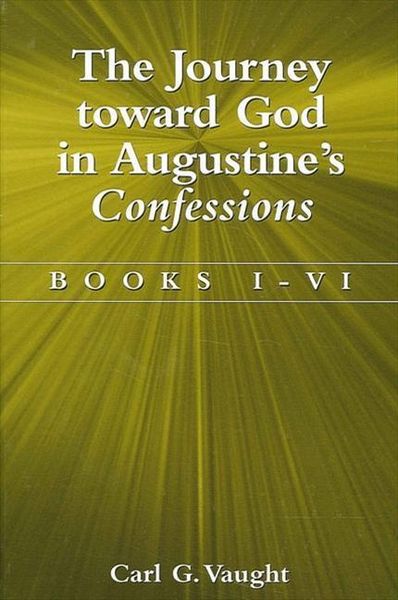
The Journey toward God in Augustine's Confessions Books I-VI
-
- Hardcover ausgewählt
- Taschenbuch
- eBook
-
Sprache:Englisch
Fr. 127.00
inkl. gesetzl. MwSt.,
Beschreibung
Produktdetails
Einband
Gebundene Ausgabe
Erscheinungsdatum
28.08.2003
Verlag
State University Of New York PressSeitenzahl
206
Maße (L/B/H)
23.3/15.4/1.1 cm
Gewicht
395 g
Sprache
Englisch
ISBN
978-0-7914-5791-7
A new interpretation of the first six books of Augustine's Confessions, emphasizing the importance of Christianity rather than Neoplatonism. This detailed discussion of Augustine's journey toward God, as it is described in the first six books of the Confessions, begins with infancy, moves through childhood and adolescence, and culminates in youthful maturity. In the first stage, Augustine deals with the problems of original innocence and sin; in the second, he addresses a pear-stealing episode that recapitulates the theft of the forbidden fruit in the Garden of Eden and confronts the problem of sexuality with which he wrestles until his conversion; and in the third, he turns toward philosophy, only to be captivated successively by dualism, skepticism, and Catholicism. Augustine's journey exhibits temporal, spatial, and eternal dimensions and combines his head and his heart in equal proportions. Vaught shows that the Confessions should be interpreted as an attempt to address the person as a whole rather than through our intellectual or volitional dimensions exclusively. The passion with which Augustine describes the end of his journey is reflected best in a sentence found in the opening chapter of the text--"You have made us for yourself, and our heart is restless until it rests in you." Interpreting this statement, Carl G. Vaught presents a more emphatically Christian Augustine than is usually found in contemporary scholarship. Refusing to view Augustine in an exclusively Neoplatonic framework, Vaught holds that Augustine baptizes Plotinus just as successfully as Aquinas baptizes Aristotle. It cannot be denied that Ancient philosophy influences Augustine decisively. Nevertheless, heholds the experiential and the theoretical dimensions of his journey toward God together as a distinctive expression of the Christian tradition.
Noch keine Bewertungen vorhanden
Verfassen Sie die erste Bewertung zu diesem Artikel
Helfen Sie anderen Kundinnen und Kunden durch Ihre Meinung.