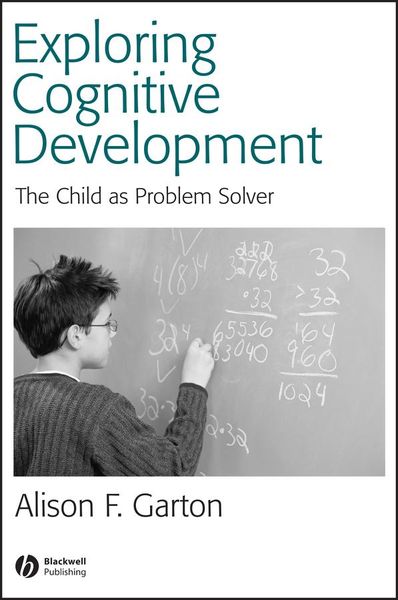
Exploring Cognitive Development The Child as Problem Solver
-
- Englisch ausgewählt
Fr. 63.90
inkl. gesetzl. MwSt.,
Beschreibung
Produktdetails
Einband
Taschenbuch
Erscheinungsdatum
23.04.2004
Verlag
WileySeitenzahl
160
Maße (L/B/H)
22.6/14.9/1.5 cm
Gewicht
245 g
Sprache
Englisch
ISBN
978-0-631-23458-6
Exploring Cognitive Development The Child as Problem Solver
'This is an exciting and provocative account of children's intellectual activities. Alison Garton makes a persuasive case that, in order to understand intellectual development, we must study the social context in which it takes place.' Professor Peter Bryant, Department of Experimental Psychology, University of Oxford
'Well grounded in the work of Piaget and Vygotsky, Alison Garton's wide-ranging account of children's problem solving encompasses the latest cognitive developmental and social cognitive theories. As well as having conceptual depth, the book is enjoyable to read.' Graeme Halford, Professor of Psychology, University of Queensland
'Alison Garton's new book is an excellent, highly readable examination of children as problem solvers...While acknowledging the influence of Piaget's and Vygotsky's theories, and highlighting some of the best research based on these theories, Garton persuades us of the importance of going beyond them. This book should find a home on the bookshelves of all who are interested in children's cognitive development.' Dr Jonathan Tudge, University of North Carolina at Greensboro
This book uses the paradigm of the child as problem solver to explore various theories of cognitive development. Focusing on collaborative tasks that are undertaken with other children or adults, the author explores a broad range of contemporary theoretical perspectives that could account for children's thinking and learning. In particular, she asks whether social interaction is the key to improvement in problem-solving skills, or whether the skills and abilities that the child brings to the task are paramount. The book draws on several studies, including the author's own research into dyadic problem solving.
Kundinnen und Kunden meinen
Verfassen Sie die erste Bewertung zu diesem Artikel
Helfen Sie anderen Kund*innen durch Ihre Meinung